A single-story stucco house with a tile roof seen beneath large overhanging oak branches, with a lawn and blurred agave and grasses in the foreground.

Heat Pump Repair in Davis, CA

Tell us about the job

Takes about a minute. No obligation.

RepairHeat PumpYolo County, CA
Step 1 of 2

What ZIP code is the job in?

Dry air is gentler on the system

Summer air here holds less moisture than in most of the country, with a dew point averaging 48°F through June, July and August. A heat pump's coil does less work pulling moisture out of dry air, so it isn't straining the way one would in a humid climate.


A breakdown is more likely wear than damage

Yolo County has seen damaging wind 46 times between 2015 and 2024, which is low enough that storm damage is rarely the reason a heat pump here is failing. Most problems in this area trace back to a part reaching the end of its life or a system that missed maintenance, not an outside event, and that kind of problem is usually fixable.

6 months
November through April, your system heats
5 months
May through September, it cools
39°F
the average winter night it heats against
93°F
the average summer afternoon it cools against
Isometric grayscale illustration of a cutaway house showing interior rooms, ducted air handler and duct runs, connected by pipes to an outdoor condenser unit beside the building.
Your system heats November through April and cools May through September.

NOAA nClimDiv, 1991–2020 normals

Half the homes in Yolo County were built in 1983 or later.

A heat pump that came with a newer house still has years of working life in it, which is a good reason to repair it instead of replacing it.

Every kilowatt it wastes here costs more than it would almost anywhere else

Power here costs 32.97 cents per kilowatt-hour
46 damaging wind events from 2015 to 2024
Climate zone 3B

October is worth paying attention to. Heat here switches on in November and runs through April, six months in all, and the first cold stretch is when a weak part finally gets tested. A capacitor or a contactor that limped through the mild months can fail the moment the system has to hold a house at temperature on a 39 degree night. If your heat pump struggled last winter, that same part is still in there. Getting it looked at before November means finding that out on your schedule, not on the coldest night of the month.

Fix it. The house is probably still young enough to make that the right choice.

If your heat pump came with the house and the house is newer, repair is the call. Have it looked at and keep it running.

Find a contractor
A man in a dark cap, gray long-sleeved shirt and brown work pants, carrying a canvas tool bag with pens and tools in its pockets, steps up onto a porch toward an orange-red paneled front door, with gray horizontal siding and a potted shrub in a terracotta planter to the right.
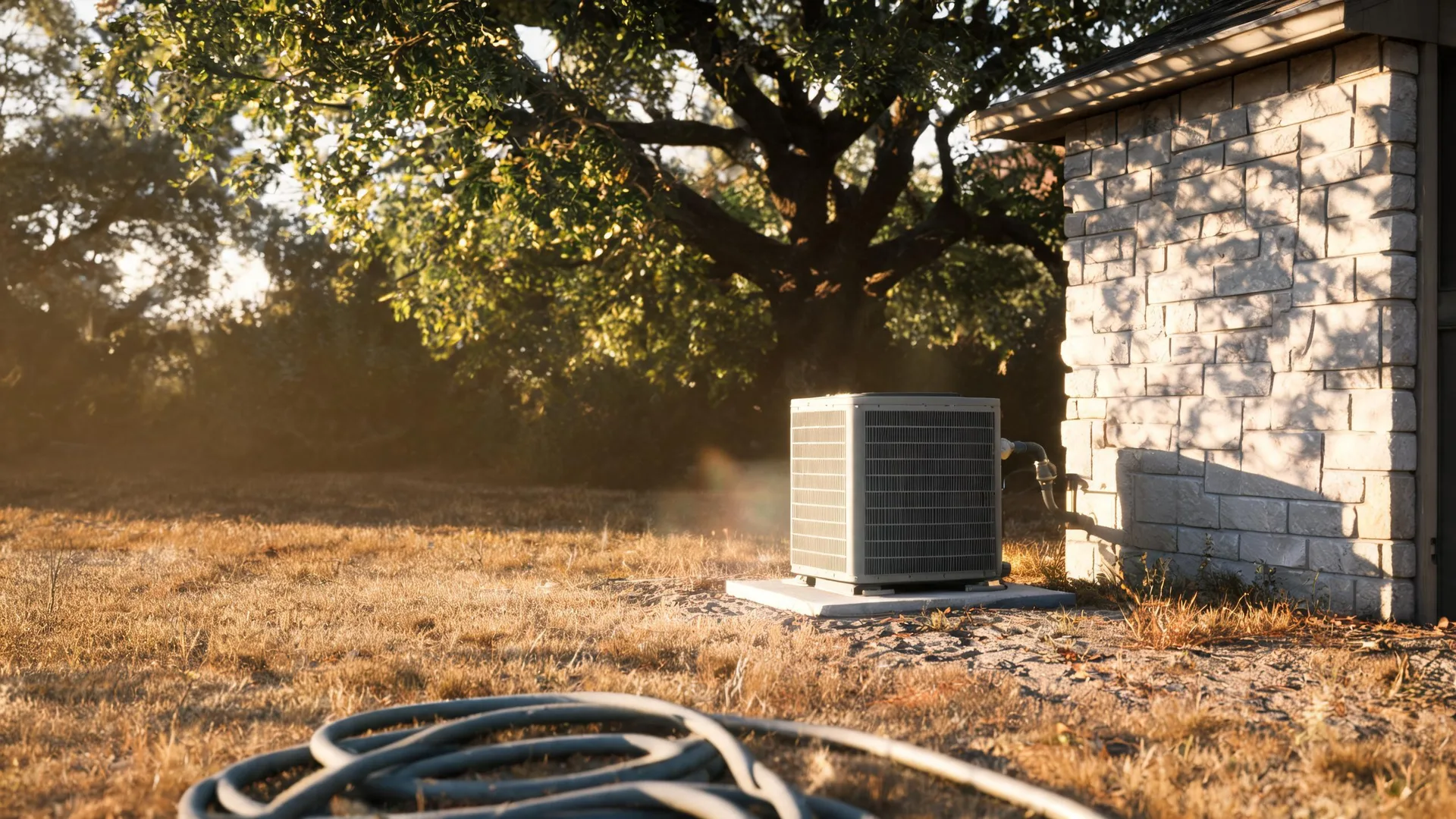
A gray heat pump condenser unit mounted on a concrete pad against the gray lap-siding exterior wall of a house.

Low strain over the years adds up to a system worth keeping

A machine that works this easy still runs for years, and a day-to-night clip of it cycling on and off doesn't show much strain either way. The time that adds up on this system is mostly idle time. Summers are dry and winters are mild here, so it isn't grinding through long stretches at full output the way one would in a harsher climate. When something does go wrong, get it looked at. A part that's reached the end of its life can usually be replaced on its own without touching the rest of the system.

Check the thermostat first

Make sure it's set to heat, not cool, and that the set temperature is actually above room temperature. Check the batteries if it has a screen that looks dim or blank. If it's a smart thermostat, check that it didn't lose its schedule or get switched to a hold setting by accident.

Look at the outdoor unit and the air filter

Walk outside and see if the outdoor unit is blocked by leaves, a cover, or anything stacked against it. Ice or frost covering the coil heavily, rather than a thin layer, is worth noting for the contractor. Inside, pull the air filter and hold it up to light. If you can't see light through it, swap it or clean it before anyone comes out, since a clogged filter can mimic a bigger problem.

A heat pump usually tells you something is wrong before it quits outright. The air coming from the vents turns lukewarm instead of warm, or it runs for long stretches without ever quite reaching the set temperature. Ice builds up on the outdoor unit and does not clear during the defrost cycle, so you see frost sitting on the coil hours after it should have melted off. It might start cycling on and off more than it used to, never settling into a steady run. A hissing or bubbling sound near the lines can mean refrigerant is escaping, and a hard clunk or grinding noise when it starts usually points to the compressor or a fan motor. If the outdoor unit is blowing air but the house stays cold, or if one room runs warm while another stays cold no matter how you set the thermostat, that is worth a call rather than a wait.

A heat pump that's running but not keeping up still runs up the meter while it does it. Power here costs more than almost anywhere else, so a bad capacitor or a low refrigerant charge is worse on this bill than it would be most places. It won't fix itself, and it won't get cheaper to ignore. If yours is cycling oddly or blowing lukewarm air, that's the part to have looked at. Getting it sorted now is simpler than waiting for it to go out on a cold night.