View from under a wood-beamed patio roof across a gravel yard toward a stucco house wall and a concrete block boundary wall, with a large gnarled tree beyond.

Heat Pump Repair in El Centro, CA

Tell us about the job

Takes about a minute. No obligation.

RepairHeat PumpImperial County, CA
Step 1 of 2

What ZIP code is the job in?

Check the thermostat and the breaker first

Make sure the thermostat is set to the mode you want and the temperature is past the point where the system should kick on. Then check the breaker panel for the heat pump and the air handler. A tripped breaker or a thermostat set wrong gets mistaken for a broken system more often than people expect.


Look at the outdoor unit and the filter

Walk outside and see if the outdoor unit is running, iced over, or blocked by leaves or debris. Inside, pull the filter and hold it up to light. If you can't see through it, airflow is choked and the system is working harder than it needs to just to move air through the house.

3 months
December through February, your system heats
8 months
March through October, it cools
45°F
the average winter night it heats against
106°F
the average summer afternoon it cools against
Isometric cutaway illustration of a single-story house showing interior rooms, attic ductwork and an air handler, with an outdoor condenser unit connected by lines along the exterior wall.
Your system heats December through February and cools March through October.

NOAA nClimDiv, 1991–2020 normals

Half the houses in Imperial County were built in 1988 or later.

A heat pump installed with a newer home usually still has years left in it, so a repair call makes more sense than a replacement call.

November is when El Centro heat pumps get caught off guard

Cooling runs March through October
Heat runs December through February
Power costs 31.97 cents a kWh statewide
A system that still has years leftHalf the homes in Imperial County were built in 1988 or later, and so was what's heating and cooling them.

Electricity here ran 31.97 cents per kilowatthour in 2024, among the highest rates in the country. A heat pump that's low on refrigerant or straining through a dirty coil doesn't just cool or heat worse, it pulls more power to do less. That difference shows up on next month's bill whether you call someone or not. A system running wrong in El Centro costs more to ignore than it does almost anywhere else.

Repair it

If your system came with a newer house, it likely has plenty of life left. Repair is usually the right call.

Find a contractor
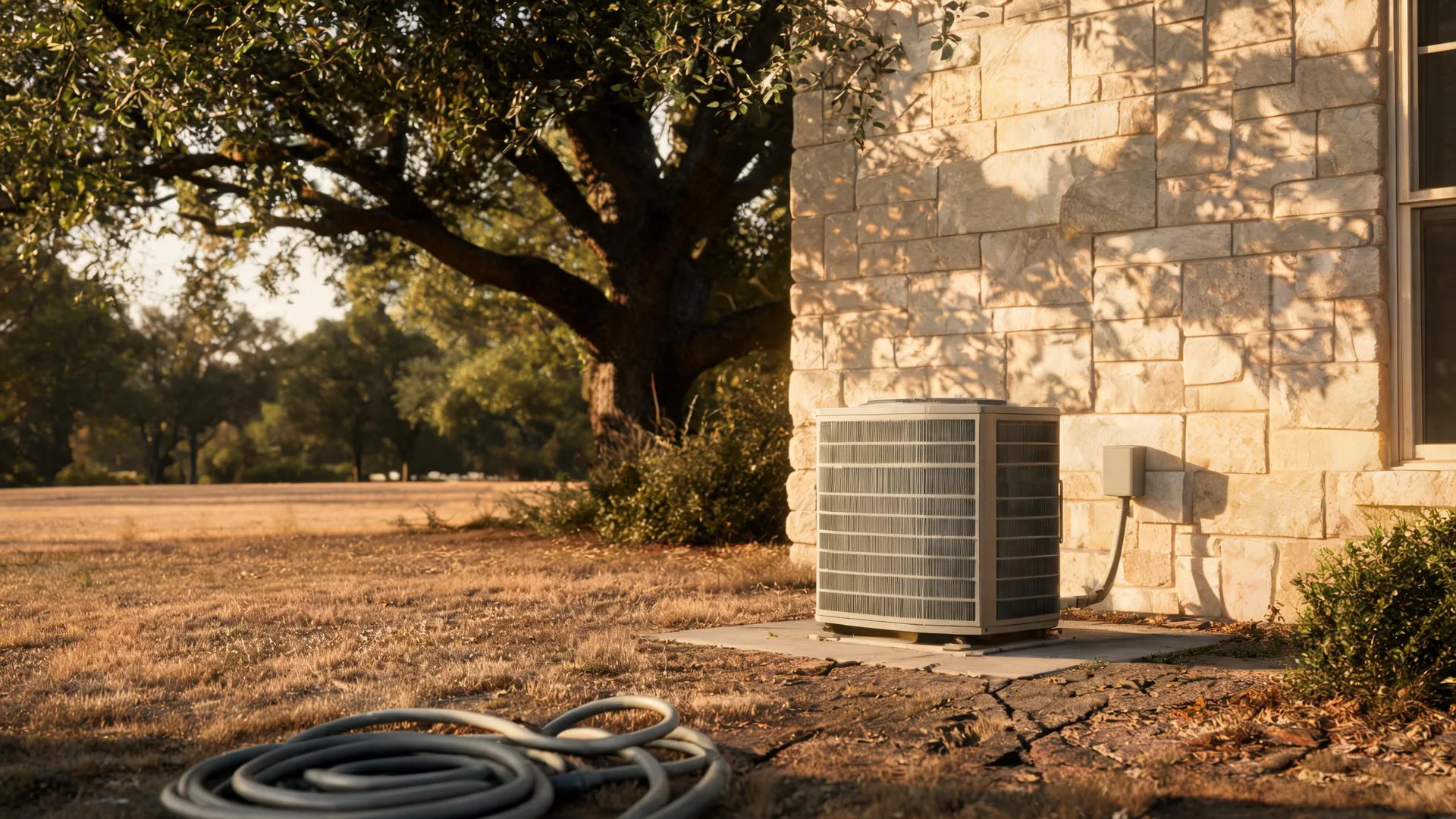
A gray heat pump outdoor unit mounted on a concrete pad next to a residential house with lap siding and stone accents.

What a heat pump tells you before it quits

A heat pump works in both directions all year, so it wears in places a straight air conditioner never does. Watch it in heat mode. It should frost lightly sometimes and shed that frost on its own, a few minutes where it hisses or runs louder as it reverses to defrost. If it stays caked in ice, or you see ice when the weather's mild, the reversing valve or the defrost control is a likely suspect. Short-cycling is another tell, the system kicking on and off every few minutes instead of running a full cycle. That strains the compressor, and the compressor is the part you least want to replace on its own. A hard clunk when the system switches between heating and cooling often points to the reversing valve too, and it's worth a call before it sticks in one position. If the air at the vents feels only a little off from room temperature instead of properly warm or cool, the system is running but not doing its job. None of this means the unit is done. It means something specific is wrong, and most of what's wrong is a part, not the whole system.

A weak compressor only gets weaker

A compressor that's starting to fail still runs, just poorly, pulling current it can't fully turn into heating or cooling. Every cycle it completes under that strain adds wear a healthy compressor wouldn't see. Left alone, a problem that started as reduced output can end as a compressor that won't start at all.

A refrigerant leak doesn't hold steady

A system low on refrigerant keeps running because the thermostat keeps asking for it to run. But low charge means the compressor works harder to move less heat, and it can run hot enough to damage itself over time. What started as a slow leak and a minor repair can turn into a compressor replacement if the system keeps cycling on it.

Most heat pump failures start small and get bigger because the system keeps running anyway. A capacitor that's losing its charge still starts the compressor, just with a harder kick each time, until one day it doesn't. A contactor with pitted points still closes the circuit, until the pitting gets bad enough that it doesn't close reliably, and the outdoor unit hums without starting. Dirty coils make the whole system work harder to move the same amount of heat, and that extra strain lands on the compressor, the one part nobody wants to replace. A failing run capacitor, a sticking contactor, and a coil caked with dust aren't dramatic on their own. They're the usual reasons a heat pump that worked fine last season doesn't start, doesn't hold its charge, or trips its breaker now.

A diagnostic visit starts before anyone touches the unit. A tech asks what the system is doing, when it started, and what mode it was in, because a problem that only shows up in heat mode points somewhere different than one that shows up in both. Then come the gauges, checking refrigerant pressure against what the system is supposed to run at, and a set of electrical tests on the capacitor and contactor to see if they're holding the values they should. The outdoor unit gets opened up so the coil and the reversing valve can actually be seen, not just guessed at. Most of this takes longer than fixing the problem once it's found. The diagnosis is the part that tells the tech which single part is failing, so the repair only touches what actually needs it.