A row of stucco houses with red clay tile roofs seen behind a tall stucco wall and trimmed hedges, framed by overhanging tree branches.

Heat Pump Repair in Marysville, CA

Tell us about the job

Takes about a minute. No obligation.

RepairHeat PumpYuba County, CA
Step 1 of 2

What ZIP code is the job in?

Weather here takes a toll on outdoor units

Yuba County logged 295 severe weather events between 2015 and 2024, including 239 winter storms and 54 damaging wind events. An outdoor heat pump unit sits outside through all of it, exposed to wind-driven debris and whatever a winter storm brings through.


A unit that still runs may have taken a hit

Wind and storm debris can hit the outdoor unit without stopping it cold. If your heat pump has been through a bad storm, it's worth having someone look at the coil and fan even if the system seems to be working.

6 months
November through April, your system heats
5 months
May through September, it cools
38°F
the average winter night it heats against
91°F
the average summer afternoon it cools against
Isometric line illustration of a cutaway house showing interior rooms with furniture, ceiling ductwork under a dark shingled roof, and an outdoor condenser unit connected by lines on the right.
Your system heats November through April and cools May through September.

NOAA nClimDiv, 1991–2020 normals

Electricity here runs 38.55 cents a kilowatt-hour, among the highest rates in the country.

A heat pump that's struggling pulls more power to do the same job, and that shows up fast at this rate.

Half the homes here were built in 1986 or later, so the system inside is probably not the original

Half the homes here were built by 1986
54 damaging wind events from 2015 to 2024
239 winter storms from 2015 to 2024
The first cold snap in November finds the weak spotHeat runs November through April here, and October is the month to catch a problem before it does.

If your heat pump came with the house, parts are probably still available for it and a repair is worth doing. A system installed within the last couple of decades is also more likely to still be under some portion of its original warranty, so it's worth checking before paying out of pocket. Pull whatever paperwork came with the house, or look for a model and serial number plate on the unit itself, and have whoever comes out check the install date against it. That one number tells you more about whether to repair or replace than how the system sounds or how old the house feels.

Get it checked now, before the next storm finds the damage the last one left

A heat pump that's been through a storm can still run while something inside it is already damaged. If yours took wind or debris and hasn't been checked since, that's worth doing before the next one hits.

Find a contractor
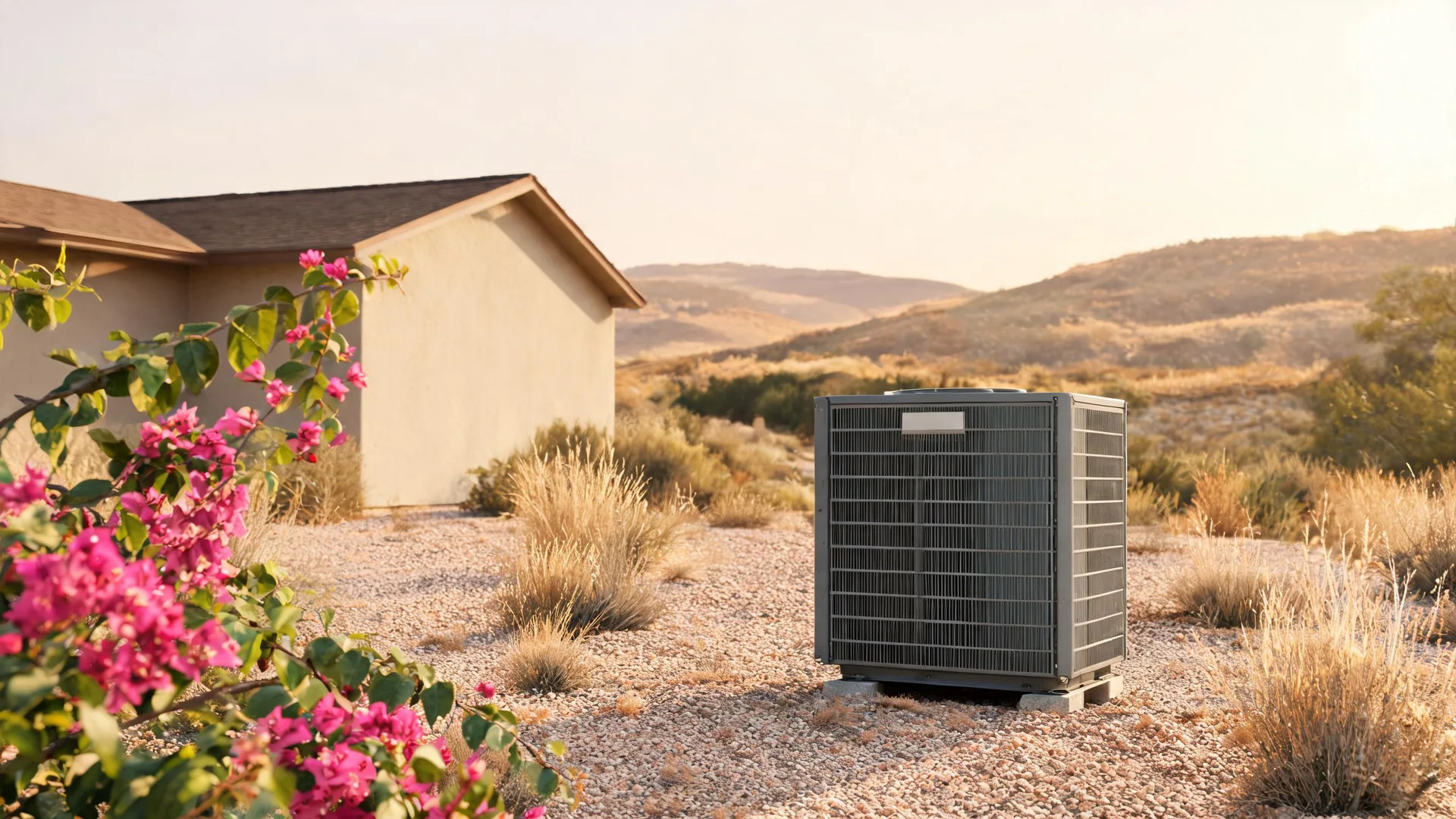
A gray heat pump outdoor unit mounted on a concrete pad next to the stone-accented exterior wall of a house.

What to check yourself before the call

Before anyone comes out, there are a few things worth checking yourself. Go outside and look at the unit. If there's debris caught in the coil, leaves, grass clippings, anything blocking the fins, clear it away by hand. Don't use a hose on it unless you know the power is off at the breaker. Check that nothing is stacked against the sides or sitting on top, since the unit needs open air on all sides to move heat. Look at the fan on top and see if it spins freely or looks bent or off center. Inside the house, check your thermostat has power and is set to call for heat or cool, not sitting in some off or idle mode. Check your breaker panel for a tripped breaker on the heat pump's circuit, and reset it once if it's tripped, but don't keep resetting it if it trips again. Pull the air filter and hold it up to a light. If you can't see light through it, swap it or clean it, because a blocked filter starves the system of airflow and can freeze the coil or shut the whole thing down. If the outdoor unit is coated in ice or frost and won't defrost on its own after a while, that's worth noting for whoever comes out. None of this fixes a failed compressor or a refrigerant leak, but it rules out the simple stuff first.

Most failures start with the outdoor coil or the fan motor

The outdoor unit does the harder job. Its coil has to give up heat or pull it in no matter what the air outside is doing, and the fan that pushes air across it runs constantly. Dirt and bent fins choke airflow across the coil until the system can't move enough heat either direction. Fan motors wear out from running hours, and a motor that's starting to fail usually makes noise or spins slower before it quits outright.

A refrigerant leak shows up as reduced heat, not no heat

Heat pumps run on a sealed refrigerant charge, and that charge doesn't get used up. If a system is low, refrigerant is leaking out somewhere, usually at a fitting or a coil that's corroded through. A low charge makes the system run longer to reach the same temperature and can ice up the outdoor coil. It won't always stop the unit cold, which is why a system that's losing refrigerant can keep limping along for a while before anyone notices.

A heat pump that's running rough doesn't stop costing you just because it still runs. A failing fan motor or a low refrigerant charge both make the system work longer to reach the same temperature, and at the rate power costs here, that extra runtime shows up on the bill fast. Waiting to see if it gets better usually just means paying for the same repair later, after more months of running inefficiently. Get it looked at now rather than putting it off.

A diagnostic visit starts outside at the unit itself. The tech checks refrigerant pressure at the service ports, since that number tells them right away if the charge is low and where to start looking. They'll pull the fan and check the motor for play in the bearing, listen to how it sounds under power, and check the capacitor that gets it started. Inside, they check the air handler or furnace coil, the blower wheel, and the electrical connections at the board, since a loose wire or a corroded contact causes the same symptoms as a bad part. They'll run the system in both heat and cool if the weather allows it, because a problem that only shows up in one mode can hide during a visit that only checks the other. The goal is to find the actual failed part before anything gets replaced, not to swap parts and see what helps.