







A row of cream stucco houses with red tile roofs behind trimmed hedges and shrubs, framed by a stucco wall in the foreground and overhanging tree branches above.

Heat Pump Repair in Merced, CA

Tell us about the job

Takes about a minute. No obligation.

RepairHeat PumpMerced County, CA
Step 1 of 2

What ZIP code is the job in?

Half the homes in Merced County were built in 1986 or later. That matters when a heat pump starts acting up, because it points to a system that hasn't been running for decades. A newer house usually means newer ductwork and electrical work to match, which gives a repair a better chance of actually solving the problem instead of just buying time. None of that guarantees your unit is young, since equipment gets swapped out and homes get older, but if your heat pump came with the house, there's a decent chance it still has years left in it. That's worth knowing before anyone talks about replacing it instead of fixing it.

6 months
November through April, your system heats
5 months
May through September, it cools
40°F
the average winter night it heats against
92°F
the average summer afternoon it cools against
Isometric illustration of a cutaway house showing interior rooms, ceiling ductwork and an air handler, connected by lines to an outdoor condenser unit on a pad beside the building.
Your system heats November through April and cools May through September.

NOAA nClimDiv, 1991–2020 normals

Merced air stays dry all summer, with the dew point around 44 degrees, lower than most of the country.

A heat pump working dry air doesn't fight the strain a humid climate puts on it, so there's often less wear behind the breakdown you're dealing with.

Power here costs more, so a struggling heat pump costs more too

Power here costs 33.97 cents per kilowatt-hour
Climate zone 3B
Cooling runs May through September
Timing Tells You SomethingHeat here runs November through April. A heat pump that struggles in the first cold snap of November was already weak going in.

A heat pump that's short cycling or running constantly doesn't give you a break on the power bill while you wait and decide. With rates here among the highest in the country, a stuck contactor or a low charge keeps costing you for every day it's not looked at. This isn't the kind of problem that gets cheaper if you leave it. Getting a tech out soon, before the compressor has to strain through another hot stretch, is what keeps the bill from climbing any higher than it already has.

A Newer System Is Usually Worth Fixing

If your heat pump came with the house, it's probably not old enough to write off. Get it looked at and repaired before guessing it's time to replace.

Find a contractor
A man in a dark long-sleeve shirt and tan work pants walks up concrete steps toward an orange front door, carrying a waxed canvas tool bag in his right hand, with a potted shrub beside the gray-sided house.
A gray heat pump outdoor unit mounted on a concrete pad next to the stone-accented exterior wall of a house.

What's Aging This Unit Isn't Hours Run

Wind is the bigger risk to this machine than the air it breathes. Merced County saw damaging wind 64 times between 2015 and 2024, and an outdoor unit takes that straight on, out in the open, all year. Debris against the coil or a cabinet knocked out of square is a different problem than wear from heavy use, and it's usually a simpler one to fix. Worth having a tech check the cabinet and the fan for that kind of damage before assuming the compressor itself is what's struggling.

The Reversing Valve Is Usually the First Thing to Go

The reversing valve is what lets a heat pump switch between heating and cooling, and it fails more than almost any other part on the machine. A stuck valve can leave the system blowing cold air when it should be heating, or stuck in one mode no matter what the thermostat asks for. It's a mechanical part that moves every time the system changes modes, so it wears in a way parts that just turn on and off don't.
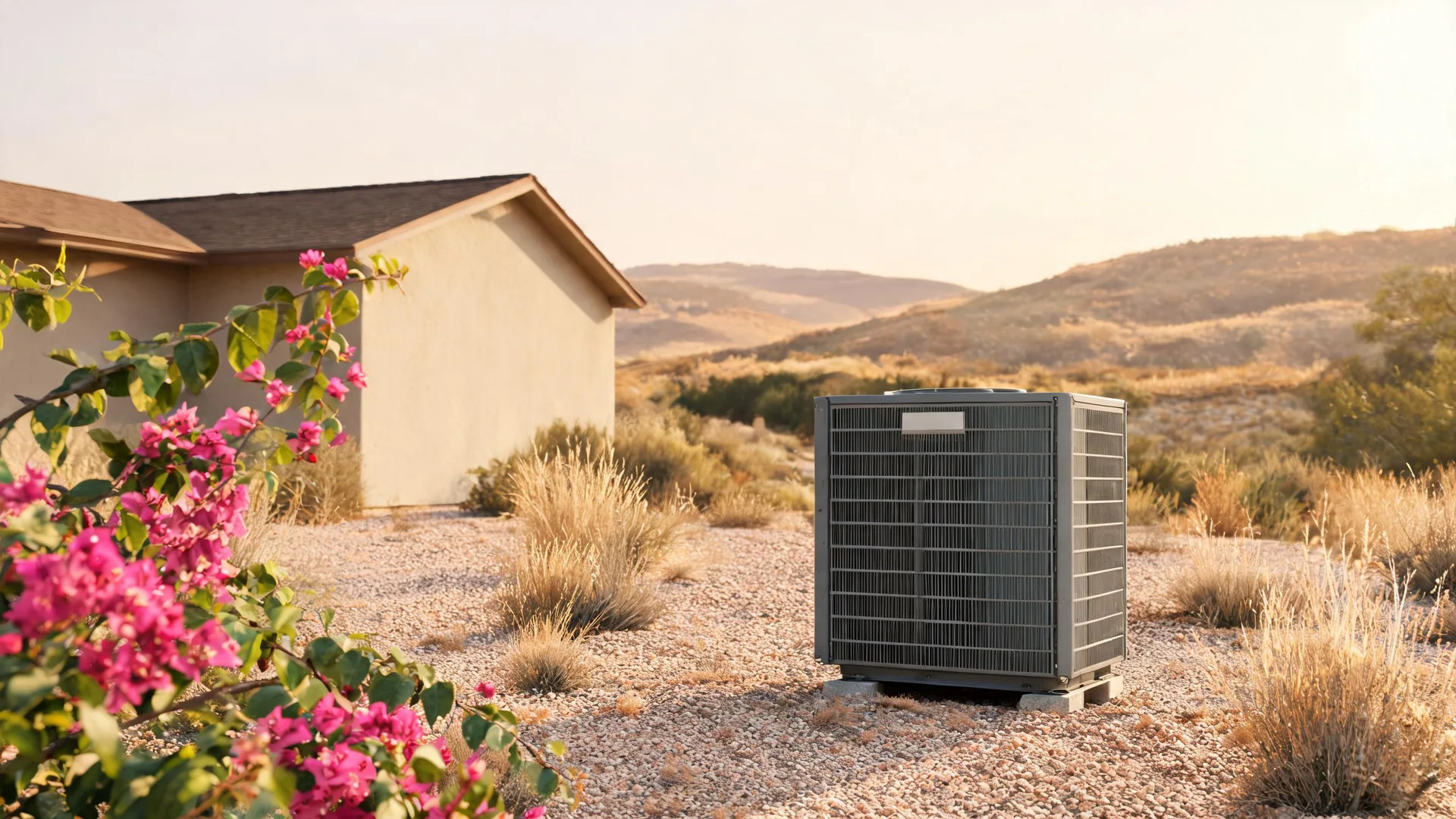
The Outdoor Coil Takes the Punishment

The outdoor coil sits exposed year round, and anything that coats it, bent fins, dirt, a layer of grime, makes the whole system work harder to move heat in or out. A heat pump leans on that coil in both seasons, not just one, so a dirty or damaged coil shows up as weak heating and weak cooling both. Catching it early is usually a cleaning or a straightening job. Left alone, the compressor behind it is what ends up straining to make up the difference.

Before anyone comes out, a few things are worth checking yourself. Look at the outdoor unit and clear away any leaves, grass clippings or debris sitting against the coil or blocking the fan. Check that the air filter inside isn't clogged, since a dirty filter starves the whole system and can show up as weak heating or weak cooling at the vents. Check the thermostat is set to the right mode and the batteries aren't dying, because a thermostat stuck on the wrong setting looks exactly like a broken reversing valve. Walk around and listen for ice building up on the outdoor coil, especially in cold weather, since some frost is normal but a heavy coating usually means the defrost cycle isn't working. If the breaker has tripped, you can reset it once, but if it trips again, leave it off and call someone rather than resetting it over and over.

Age is the first thing worth weighing, but it's not the only one. A heat pump that's been repaired piecemeal over the years, a new capacitor here, a new fan motor there, is a different case than one hitting its first real failure. If the compressor itself is the problem, that's usually the point where repair stops making sense, since it's the most expensive part in the system and the labor to replace it isn't cheap either. A refrigerant leak is worth asking about too: a slow leak patched once can show up again somewhere else in the line, while a one time puncture from debris is usually the end of it. None of this is about how long the unit has run so much as what's actually failed and whether that part tends to fail alone or take others with it. A tech who's opened the cabinet and seen what's actually wrong can tell you which kind of problem you've got.