White stucco houses with terracotta roofs are built into a tree-covered hillside at dusk, with a dry golden hill rising behind them.

Heat Pump Repair in San Luis Obispo, CA

Tell us about the job

Takes about a minute. No obligation.

RepairHeat PumpSan Luis Obispo County, CA
Step 1 of 2

What ZIP code is the job in?

Air that doesn't feel warm enough

A heat pump in heating mode puts out air that feels cooler than a furnace would, so that alone isn't a problem. What matters is whether it keeps up. If the house never quite reaches the set temperature, if the system runs constantly without satisfying the thermostat, or if you notice the outdoor unit caked in frost that doesn't clear during its defrost cycle, something is off with the refrigerant charge, the reversing valve, or the defrost control.


Why it's worth a call sooner, not later

A heat pump that's struggling often keeps running anyway, just less efficiently, which hides the problem until the compressor takes the strain. Short-cycling, a reversing valve that won't switch between heating and cooling, or an outdoor coil that stays frozen all point to a system working harder than it should. Catching these early usually means a simpler repair than waiting until the compressor itself fails.

6 months
November through April, your system heats
4 months
June through September, it cools
38°F
the average winter night it heats against
87°F
the average summer afternoon it cools against
Isometric line illustration of a cutaway house showing interior rooms, an air handler with ductwork in the attic space, and an outdoor condenser unit beside the exterior wall.
Your system heats November through April and cools June through September.

NOAA nClimDiv, 1991–2020 normals

Winters here stay mild, with overnight lows averaging 38°F through December, January and February.

A heat pump that isn't fighting hard cold all winter usually has less wear on the compressor, which is why a repair is often the right call.

November is when a weak heat pump gets found out

Cooling runs June through September
Heat runs November through April
Climate zone 3C
A county of young systemsHalf the homes in San Luis Obispo County were built in 1983 or later, which is why repair is usually where to start.

Get a technician out to confirm what's actually wrong before you write off the unit. A compressor that hasn't spent years fighting hard freezes is more likely to still have life in it, so a strange noise or a weak heat output is often a stuck reversing valve, a low charge, or a failing defrost control rather than something terminal. Those are parts, not the whole system. Wind is the bigger risk to equipment in this county, not cold, so if the outdoor unit took a hit in a storm, say so when you call and have them check the coil and fan for bent fins or debris alongside whatever else is going on.

Half the homes here were built in 1983 or later

Half the homes in San Luis Obispo County were built in 1983 or later. If yours is one of them, the heat pump likely hasn't been running long enough to wear out on its own. That's a reason to get it looked at, not replaced.

Find a contractor
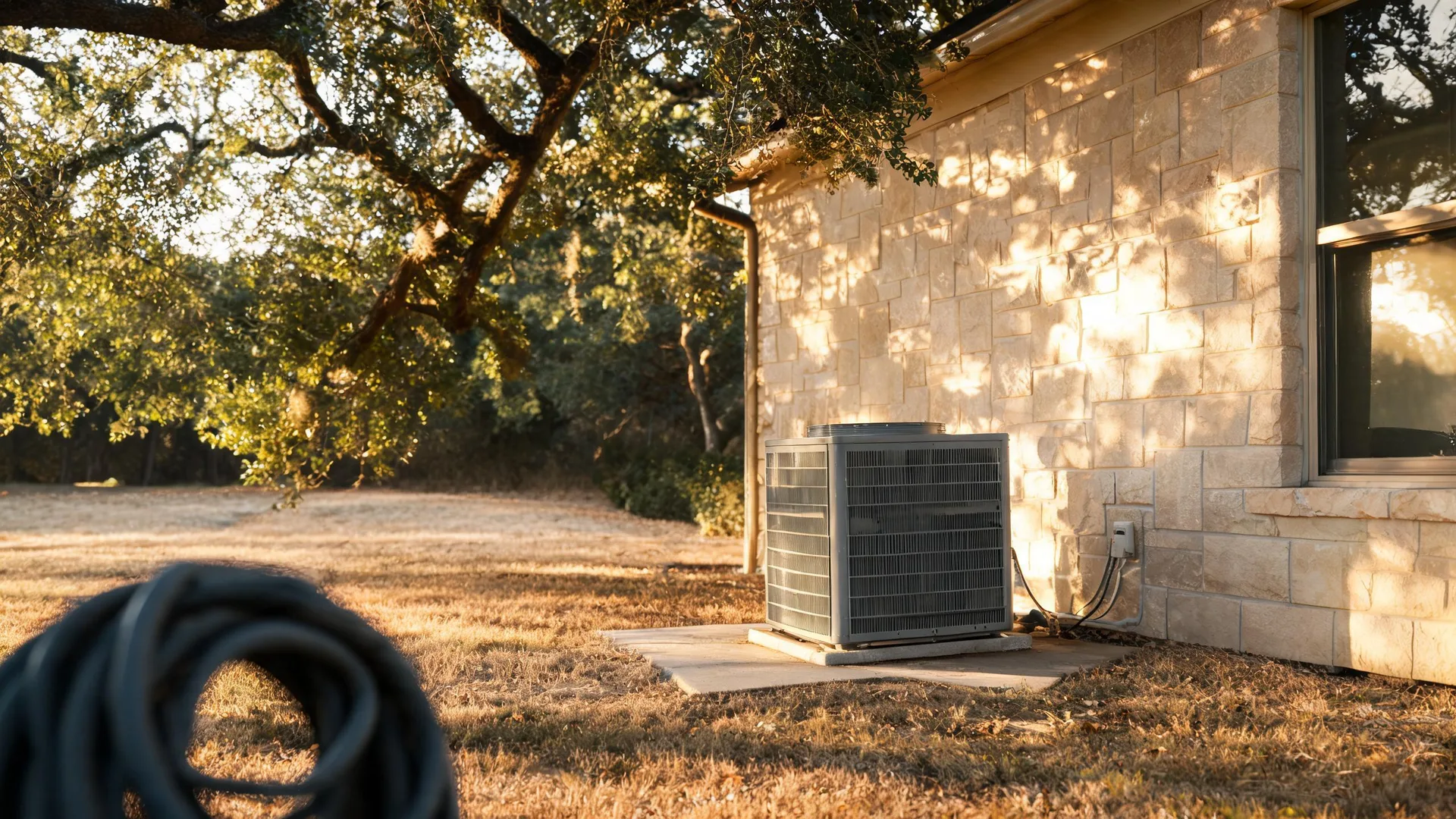
A residential heat pump outdoor unit mounted on a concrete pad next to a house with gray vinyl siding.

Letting it run doesn't buy you time, it spends the compressor's

A heat pump that's struggling still tries to satisfy the thermostat, so it keeps calling for more runtime instead of shutting off. That extra runtime is what turns a small problem into a bigger one. A reversing valve that's starting to stick gets worked harder every time it's asked to switch, until it stops switching at all. A low refrigerant charge means the compressor is pumping less refrigerant than it was built to handle, and running it that way for weeks wears on the compressor itself, not just the part that's actually low. Frost that isn't clearing on the outdoor coil blocks airflow, so the system pulls harder to move the same amount of heat, and that strain lands on the compressor too. None of these fix themselves by running longer. The machine doesn't rest and recover between cycles, it just keeps drawing on a part that's already failing. The earlier it gets looked at, the more likely the repair is the valve, the charge, or the control board, and not the compressor.

What you can check at the thermostat

Set it to heat and raise the temperature a few degrees above the room. Air should start moving within a minute or so, and it should feel warm against your hand even if it's not hot like furnace air. If the system clicks on but no air moves at all, or the air stays cold the whole time, that's worth noting before the technician arrives. Also check the batteries if it's a battery-powered thermostat, since a dying thermostat can look like a dead heat pump.

What you can check outside

Walk out to the outdoor unit and look at the coil, the fins around the sides. Frost or ice is normal in small amounts during a defrost cycle, but a coil that's solid white or caked in ice means it isn't clearing like it should. Also look for anything blocking airflow around the unit, leaves, branches, a fence panel too close to the sides. Clear what you safely can, but don't chip at ice or force the fan blades. If the outdoor fan isn't spinning at all while the system is calling for heat, that's useful to mention on the phone.

Most heat pump failures trace back to a handful of parts that do the hardest work. The reversing valve switches the system between heating and cooling by redirecting refrigerant flow, and that back-and-forth is what eventually wears it out, usually starting as a valve that hesitates before it fully switches. The defrost control senses when the outdoor coil needs to clear and tells the system to run a defrost cycle. When that sensor or board fails, frost builds up unchecked and blocks airflow across the coil. Refrigerant charge drops slowly through small leaks at fittings or coil joints, and a system low on charge makes the compressor work harder to move heat, which shortens its life. Capacitors that start the compressor and fan motors weaken with age and eventually stop delivering the jolt those motors need to start. None of these fail all at once. They show up first as weak heat, a longer runtime, or a coil that stays frosted, long before the compressor itself gives out.

The compressor is the part that decides most of these calls. Almost everything else on a heat pump, the reversing valve, the capacitors, the defrost control, gets replaced on its own without touching the compressor, and the system runs like new once that one part is fixed. Repair stays the sensible choice as long as the compressor itself is still sound. It tips toward replacement when the compressor is the thing that's failed, since that's the part the rest of the system is built around. It also tips that way when the unit has needed repair after repair, each one buying a little more time before the next part gives out. A system that's only now showing its first real problem is in a different spot than one that's been patched together for years, and a technician who's traced the actual cause can tell you honestly which one you're looking at.