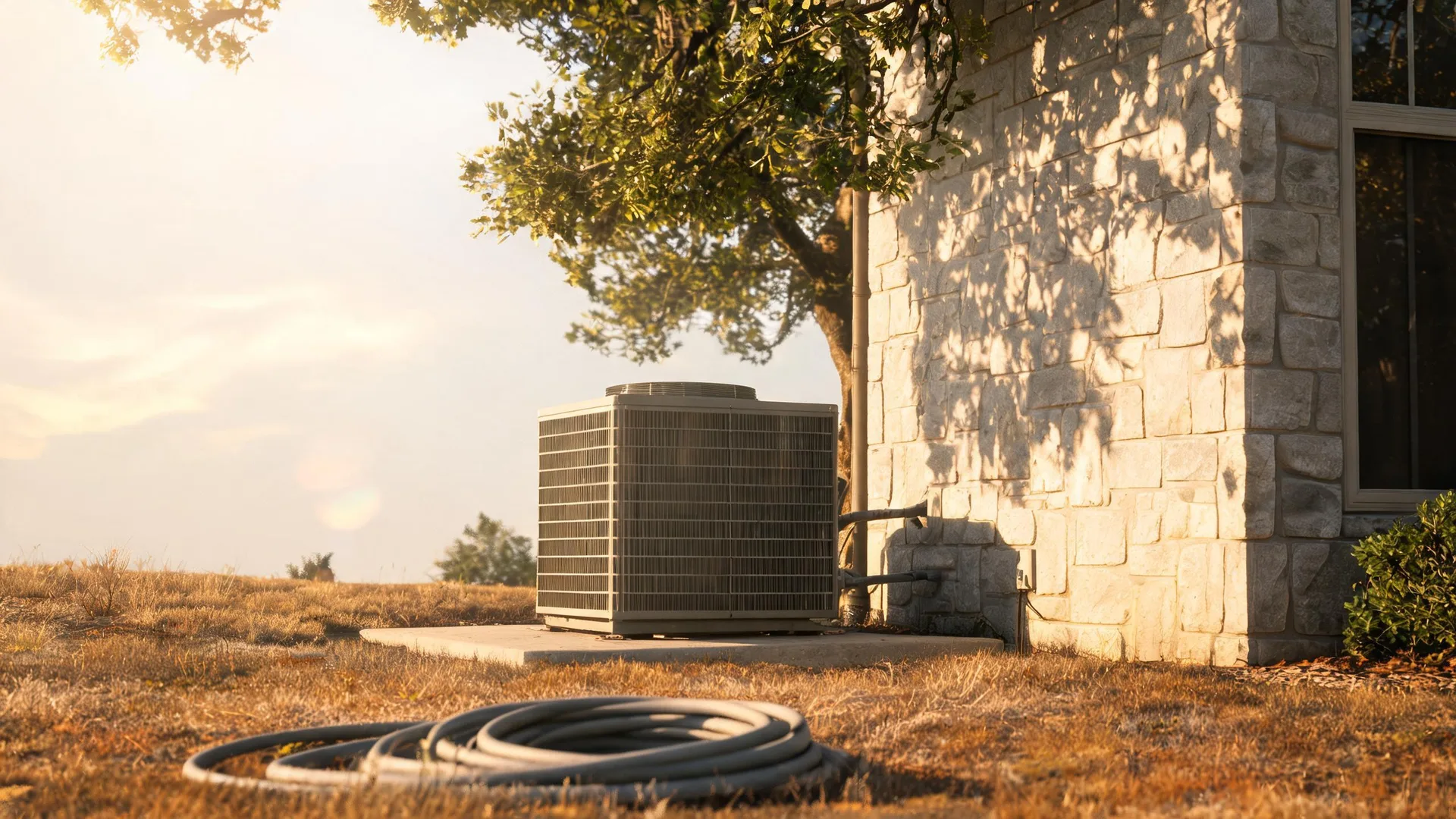
Winters here stay mild
Overnight lows in Santa Barbara County average 40°F through December, January and February. A heat pump here isn't fighting the deep cold that wears down compressors and coils elsewhere.
Takes about a minute. No obligation.
Overnight lows in Santa Barbara County average 40°F through December, January and February. A heat pump here isn't fighting the deep cold that wears down compressors and coils elsewhere.
A heat pump that's acting up here probably isn't broken from strain. More often it's a part that's worn out or something that's been overlooked. That's usually worth fixing rather than replacing.

NOAA nClimDiv, 1991–2020 normals
Heat here starts in November, with October the month to get a heat pump looked at.
A heat pump that limped through last season tends to show it the first cold morning it has to work hard again.




A heat pump fails in a handful of predictable ways, and most trace back to parts that wear with use rather than weather. The reversing valve is a common one. It's what switches the system between heating and cooling, and after years of switching back and forth it can stick or leak, leaving the system stuck in one mode or blowing air that's not the temperature you set. Refrigerant leaks show up too, usually at a fitting or coil, and a system low on refrigerant will run long and still underheat. Capacitors wear out from simple age, and when one goes the outdoor unit can hum without starting or the fan can spin slow. The defrost board and its sensor fail sometimes as well, and when they do the outdoor coil can ice over and stay iced instead of clearing itself the way it's supposed to. None of these are about the system working too hard. They're about parts that reach the end of their life whether the season was mild or not.
It has an easier job here than in most places, so your heat pump is often in decent shape. Repair is usually worth it.
Find a contractorA heat pump that's struggling doesn't fix itself by staying on. If ice is building on the outdoor coil, letting it keep running just packs more frost on before the next defrost cycle has a chance to clear it. If the refrigerant charge is low, the compressor keeps trying to move a full load of heat with too little refrigerant to do it, and that's what shortens its life, not the running time alone. A reversing valve that's starting to stick gets worse with every cycle it's forced through. Even a weak capacitor, left alone, leads to a compressor pulling hard on every start until that wears out too. The longer a worn part keeps working under load, the more it drags down the part next to it.
A heat pump in trouble rarely shuts off outright. It runs longer than it used to and still doesn't get the house to temperature. The air coming out of the vents feels lukewarm instead of warm. Outside, the unit may cycle on and off more than it should, or run nonstop without ever catching up. Each of these is the system telling you a part isn't doing its job anymore, even though the system itself is still turning over.
A hissing or bubbling sound near the outdoor unit points to a refrigerant leak. Ice that builds up on the outdoor coil and doesn't clear on its own points to the defrost board or its sensor. A humming outdoor unit with a fan that won't spin, or spins slow, points to a failing capacitor. Air blowing the wrong temperature for the mode you set points to the reversing valve. Knowing which sign you're seeing tells the contractor where to look first instead of starting from scratch.
Before anyone comes out, there are a few things worth checking yourself. Look at the air filter first. A filter clogged with dust chokes airflow across the indoor coil, and that alone can make a heat pump run long and still fall short of the set temperature. Check the thermostat batteries and the mode setting, since a thermostat stuck in the wrong mode looks exactly like a failing reversing valve from the vents. Walk outside and look at the unit itself. Leaves, mulch or a cover pressed against the cabinet block airflow across the coil the same way a dirty filter does indoors. If the outdoor coil is caked in ice, don't chip at it or run a hose on it. Switch the system off and let it thaw on its own, then call if the ice comes back. None of this fixes a bad capacitor or a stuck valve, but it rules out the simple stuff before anyone opens the cabinet.
A repair decision usually comes down to what's actually failed and whether the rest of the system is sound around it. A reversing valve, a capacitor, a defrost sensor, these are single parts, and replacing one doesn't put stress on anything else in the system. The compressor is a different question. It's the most expensive part to replace and often the reason a contractor starts talking about a new system instead of fixing the old one. If the compressor itself is failing, that's usually where repair stops making sense, because everything else in the system was built to work with it. Age matters less than what's actually broken. A heat pump with one failed part and a sound compressor is almost always worth fixing. One where the compressor is going is a different conversation entirely.