






A row of single-story stucco houses with red clay tile roofs recedes behind a tall stucco wall, with large oak trees overhead and shrubs along the sidewalk.

Heat Pump Repair in Concord, CA

Tell us about the job

Takes about a minute. No obligation.

RepairHeat PumpContra Costa County, CA
Step 1 of 2

What ZIP code is the job in?

November is when heat pumps here switch over to heating mode after months of running cooling, and that switch is when a weak part finally gives out. A contactor or capacitor that was limping along all summer can fail the moment the system has to reverse and push warm air instead. Concord runs heat from November through April, so October is worth a check before the load picks up. If your heat pump is already struggling to keep rooms warm, or it's running constantly without catching up, that usually points to something specific rather than normal wear. A technician can tell you whether it's the reversing valve, a refrigerant issue, or something electrical, and whether it makes sense to repair it now.

6 months
November through April, your system heats
4 months
June through September, it cools
41°F
the average winter night it heats against
85°F
the average summer afternoon it cools against
Isometric cutaway illustration of a small house showing interior rooms with furniture, an indoor air handler with flexible ducting, and refrigerant lines running to an outdoor condenser unit beside the building.
Your system heats November through April and cools June through September.

NOAA nClimDiv, 1991–2020 normals

Winter lows here average 41°F, not the teens or single digits some places get.

A heat pump in Concord isn't fighting extreme cold, so a repair usually brings it back to normal rather than patching over a system that was already overmatched.

Concord doesn't stress a heat pump. When one breaks, something actually failed.

Half the homes here were built by 1978
166 damaging wind events from 2015 to 2024
12 hail events from 2015 to 2024
A heat pump that's struggling shows up on the bill before it shows up as a breakdownCalifornia homes paid 31.97 cents per kilowatt-hour for electricity in 2024, so a heat pump that's running inefficiently costs more here than it would elsewhere.

A heat pump that keeps running while something's wrong usually makes the problem worse, not better. Take a refrigerant leak. Run the system low on charge and the compressor has to work harder to move heat at all, and that extra strain is what burns a compressor out. A failing contactor works the same way. It can still close the circuit most of the time, but each cycle that struggles pits the contacts a little more, until one day it doesn't close at all. A system icing over because of a stuck reversing valve will keep building ice as long as it keeps running, and that ice can damage the coil fins underneath it. None of these get better by waiting. They get harder to bring back.

A mild winter means your heat pump is worth repairing

Get it looked at. A heat pump that's spent its life in Concord's mild winters doesn't wear out from the cold, so when something's off, it's almost always one part that failed rather than a system worn down from fighting the weather. That's a straightforward fix.

Find a contractor
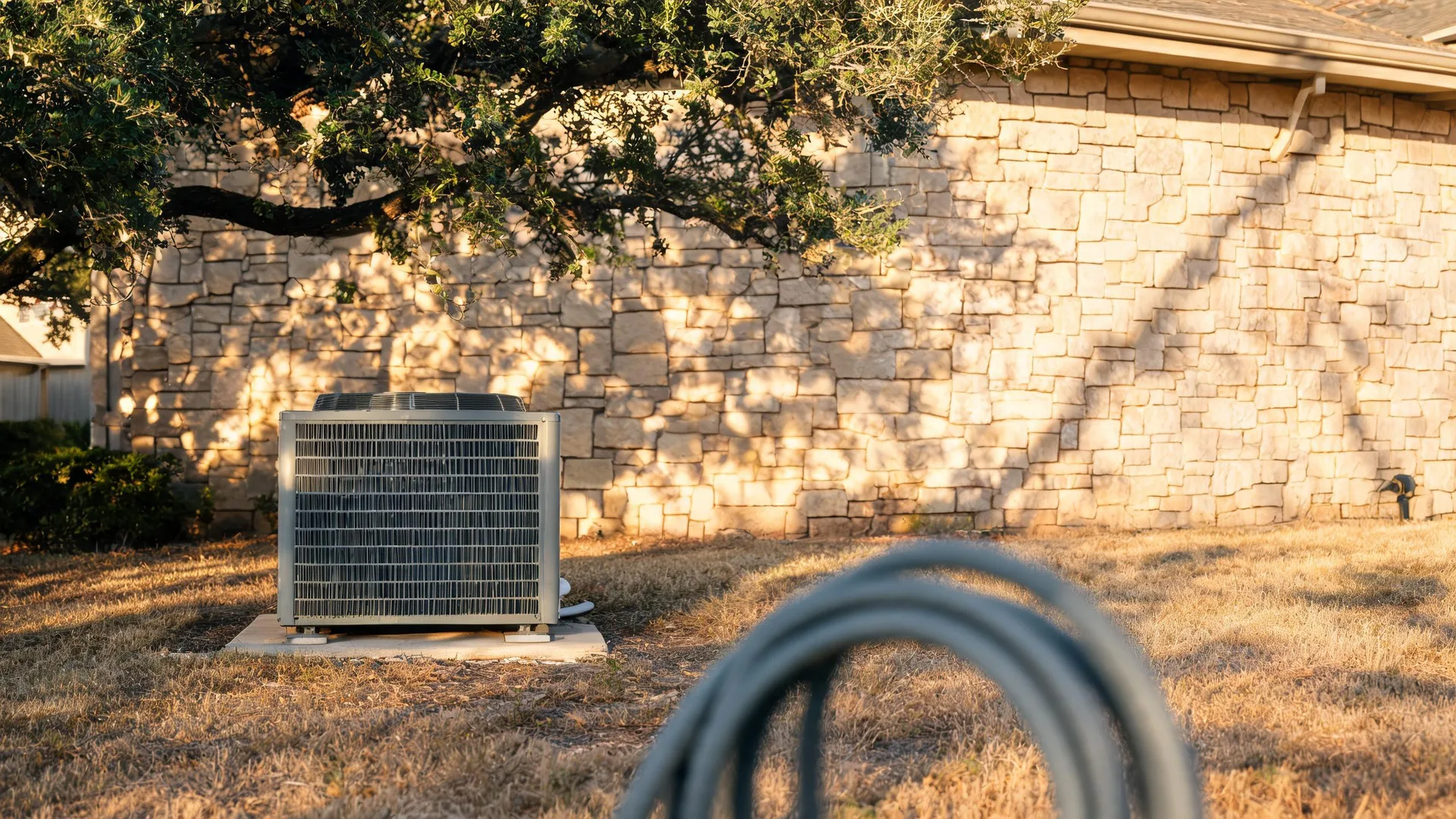
A gray heat pump outdoor unit mounted on a concrete pad next to the stone-accented exterior wall of a house.

What actually wears out, and why

A heat pump runs the same compressor and the same reversing valve on every cycle, so parts wear from hours of use, not from how cold or hot it gets outside. The contactor is usually first to go. It opens and closes every time the system cycles on and off, and over enough cycles the contact points pit and burn until they stop making a clean connection. A capacitor is next. It holds the charge that gets the compressor and fan motors started, and it weakens slowly, so the system still runs but starts harder each time until one day it doesn't start at all. The reversing valve is the part unique to a heat pump, and it can stick from a failed solenoid or from debris that keeps it from seating fully, which leaves the system blowing the wrong temperature air or stuck in one mode. Refrigerant doesn't get used up on its own, so a system that's low has a leak somewhere, usually at a fitting or a coil, and running it low strains the compressor every hour it keeps going. None of these failures come from one bad stretch of weather. They come from a part reaching the end of what it had.

What you'll actually notice first

The system runs but the air coming out isn't warm, or it's warm and then it suddenly isn't. Rooms that used to heat evenly now have cold spots. The thermostat says it's satisfied while the house tells you otherwise. Sometimes it's a smell, a burning or electrical smell when the system kicks on. Sometimes it's a sound that wasn't there before, a clicking that doesn't lead to startup, a buzz from the outdoor unit, a hard clunk when it switches modes. Any of these means a part is already failing, not about to.
How soon it's worth calling someone

A heat pump that won't start, or that trips its breaker when you reset it, needs a technician before you try running it again. One that's running but not keeping up can wait a little while. Ice building on the outdoor unit or water pooling where it shouldn't are both signs of a problem that gets worse the longer the system keeps cycling.

Before calling anyone, a few things are worth checking. Start at the thermostat. Make sure it's set to heat, not sitting in auto where it might be reading the room wrong. Go outside and look at the unit itself. Ice on the coil or leaves and debris packed around it will choke airflow, and that alone can stop it from heating right. Check the breaker panel. A tripped breaker can be reset once, but if it trips again, stop and leave it for a technician to sort out. Last, walk around and feel for air at the vents. No airflow at all is a different problem than air that's simply not warm, and knowing which one you have before the technician arrives means they can get to the real issue faster.

A diagnostic visit starts with the complaint, not the unit. A technician asks what the system is doing, when it started, and whether anything changed right before it did. Then they check the thermostat call, confirm the system is actually being told to heat, and watch how it responds. Outside, they'll check the reversing valve's position against what the thermostat is asking for, since a stuck valve shows up as the system doing the opposite of what it's supposed to. They'll check refrigerant pressures, because low charge points straight to a leak that needs finding, not just topping off. Electrical parts get tested under load, since a contactor or capacitor can look fine sitting still and still be the part that's failing. The goal is to find the one thing that's actually wrong, not to start swapping parts and see what helps.