Aerial view of a gray central air conditioning condenser unit on a concrete pad next to a house with vinyl siding.

AC Installation in San Mateo, CA

Tell us about the job

Takes about a minute. No obligation.

New system or replacementCentral ACSan Mateo County, CA
Step 1 of 2

What ZIP code is the job in?

Weather here is rougher than it feels

San Mateo County recorded 282 severe weather events between 2015 and 2024, and damaging wind caused most of them, 266 times in that same stretch. Hail hit 9 times. None of that matches the mild, easy reputation this county has day to day.

The outdoor unit sits outside through all of it

A new condenser gets placed somewhere on the property and stays there through every wind event and hailstorm that comes. Power cuts matter too. Close to 17 percent of California households lost power for a day or more in 2024, and a cut that long affects both the AC and the water heater.

73°F
the average summer afternoon it cools against
9 hail events
in ten years, and hail bends the fins on outdoor coils
13.4 SEER2
the federal minimum any new unit must meet
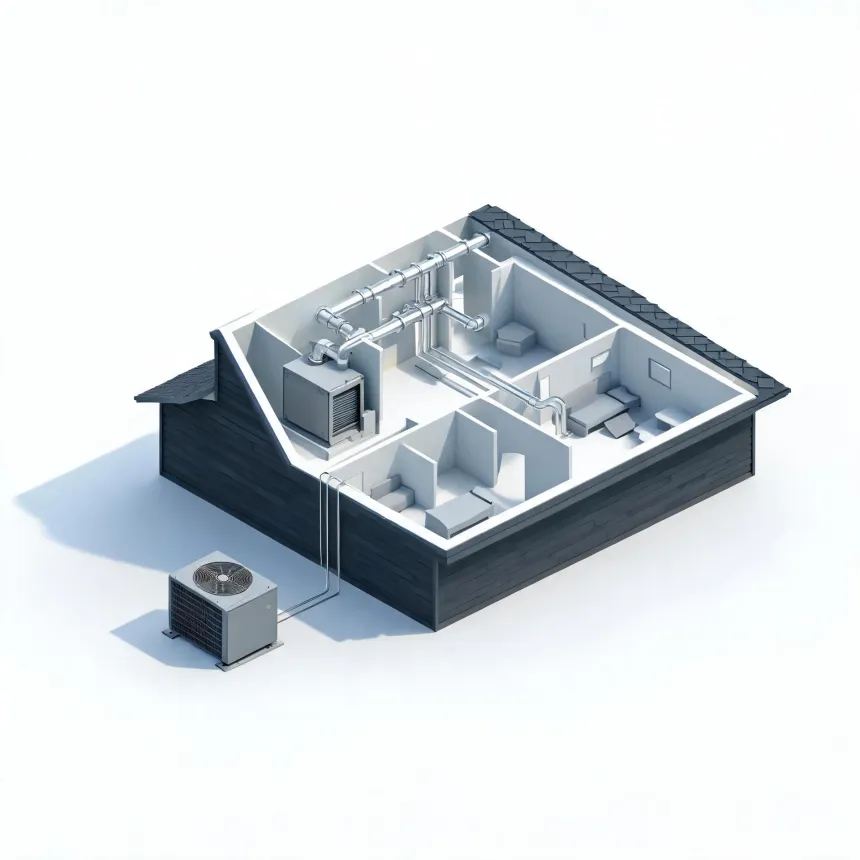
Isometric 3D cutaway render of a house with dark siding showing interior rooms, ductwork and an air handler, connected by lines to an outdoor condenser unit on a white background.
Your air conditioner works hardest from July through September.

NOAA nClimDiv, 1991–2020 normals

Electricity here runs 38.23 cents per kilowatt-hour, well above most of the country.

An inefficient system burns through that rate every time it cycles on.

Half these houses were built before central air was standard

Half the homes here were built by 1966
Climate zone 3C
Power here costs 38.23 cents per kilowatt-hour

Gas heats 62.8 percent of homes in San Mateo County, more than anything else. If your house already has a gas furnace, the AC side of a new system is the coil and the outdoor condenser, wired to work with the furnace you have rather than replacing how the house heats. That keeps the installation simpler and keeps parts on hand that match what's already common here. A house on electric heat is a different job, since the air handler itself has to do more of the work. Either way, what matters is matching the new equipment to what's already running in your house, not swapping in whatever is cheapest that day.

Plan the install around the weather, not just the heat

A condenser install is a good time to decide where the unit sits and what's around it. A spot away from fence lines and open to wind still needs a pad that won't shift, and a technician can walk the property with you to pick it. Worth asking about surge protection for the system too, since the grid here isn't the most reliable. If the furnace is gas, it keeps working in an outage regardless of what the AC side does, which is one less thing to plan around.

Find a contractor
A man in a cap, gray long-sleeve shirt and brown pants carries a worn canvas tote bag up porch steps toward an orange front door beside a potted olive tree.
A gray residential air conditioning condenser unit mounted on a concrete pad outdoors, surrounded by green grass under a partly cloudy blue sky.

It won't work hard, so build for reliability instead

Afternoon highs average 73°F across June, July and August. That is not weather that pushes a system hard. An AC here spends most of its life barely working, cycling on for a mild afternoon rather than fighting day after day of real heat. Low strain means a unit that develops a problem is usually worth fixing rather than replacing, since it was never worn down the way one in a hotter county would be. When something does go wrong here, age and upkeep are the more likely cause, not the workload.

Size is what makes or breaks the job

A condenser and coil have to match the house they're cooling, not just the box they came in. Too big and the system short cycles, cooling the air fast but never running long enough to pull moisture out. Too small and it runs constantly without catching up. Getting this right takes a load calculation, checking the square footage, the windows, the insulation, the duct layout. That work shapes the whole job more than any single part on the truck.

The ducts already in the house decide a lot

If the ductwork is sound, sized right, and sealed, a new system ties into it and the job stays straightforward. If the ducts are old, leaky, or were sized for a smaller unit, they need work before the new equipment can perform the way it's rated to. A condenser can be installed perfectly and still deliver weak airflow if the ducts feeding it are the weak point. That inspection has to happen before anyone commits to a price.

An overhead view of a residential air conditioning condenser unit mounted on a concrete pad next to a house with vinyl siding.

Going above the federal minimum saves little here, about $0 a year.

  • A new unit at the federal minimum, 14.3 SEER2$50 a year
  • A higher-efficiency unit$50 a year

Estimates for a typical San Mateo County home, from EIA household energy data, California fuel prices and NOAA climate normals. Your home will differ.

A technician starts by shutting down and disconnecting the old equipment if one is coming out, then sets the new condenser on its pad and runs the line set to the indoor coil. The refrigerant lines get connected, pressure tested, and checked for leaks before anything is charged. Once the system holds pressure, the lines are evacuated to pull out moisture and air, since either one left behind will damage the compressor over time. Electrical work comes next: a dedicated circuit, a disconnect box within sight of the unit, and the control wiring run back to the thermostat. After that the system gets charged with refrigerant to the amount the manufacturer specifies for that line length, not just filled until it seems full. Before anyone leaves, airflow gets checked at the vents and the system runs through a full cycle to confirm it cools and shuts off the way it should.