A warmly lit Craftsman-style house on a wet residential street at night, surrounded by tall evergreen trees under a dark overcast sky.

AC Repair in Eureka, CA

Tell us about the job

Takes about a minute. No obligation.

RepairCentral ACHumboldt County, CA
Step 1 of 2

What ZIP code is the job in?

Storms come through often here

Humboldt County logged 282 severe weather events between 2015 and 2024, including 145 cases of damaging wind and 21 hail events. An outdoor AC unit sits outside through all of it, exposed to whatever blows through or falls on it.

Running doesn't mean undamaged

A unit that took wind-blown debris or hail can keep running for a while with a bent fin, a cracked line or a dented cabinet. Those problems tend to get worse, not better, so a unit that's been through a storm is worth having looked at even if it still cools the house.

79°F
the average summer afternoon it cools against
21 hail events
in ten years, and hail bends the fins on outdoor coils
145 wind events
in ten years, and wind drives debris into outdoor units
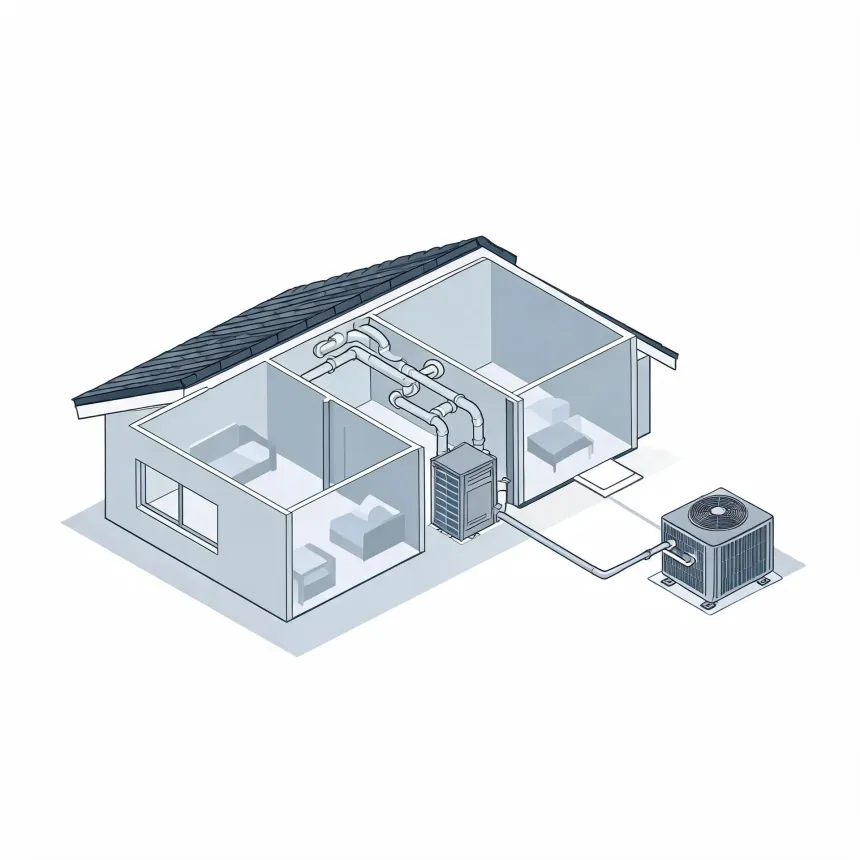
Isometric line illustration of a cutaway single-story house showing interior rooms, ductwork, an indoor air handler or furnace, and a refrigerant line running to an outdoor condenser unit on a pad.
Your air conditioner works hardest from July through September.

NOAA nClimDiv, 1991–2020 normals

Electricity in Humboldt County runs 38.43 cents per kilowatt-hour, among the highest rates in the country.

A unit that's running rough burns that rate every hour it limps along, not just over a season.

Half the homes here were built before your AC unit was

Half the homes here were built by 1973
Climate zone 4C
Power here costs 38.43 cents per kilowatt-hour

If your AC unit came with a house built in 1973 or earlier, ask the contractor straight out how much life is left in it before you pay for a major repair. A compressor that's near the end can take a new part and still fail again within a year or two, and at that point the repair bill just adds to what you'll spend on a replacement anyway. An older unit can also mean a wait on parts, which is worth knowing before you commit to the work, not after. It costs nothing to ask the question first.

Had a storm come through? Get the unit checked now

If a storm has come through recently, get the outdoor unit looked at before the next one hits, even if it's still cooling the house fine. A bent fin or a cracked line doesn't fix itself.

Find a contractor
An outdoor air conditioning condenser unit mounted on a concrete pad surrounded by gravel, photographed against a partly cloudy blue sky.

What the unit is telling you before it quits

An air conditioner doesn't fail the same way twice. The first sign is usually a change in sound: a hum before the compressor kicks on, a rattle that wasn't there last year, a click that repeats instead of starting the unit. Airflow is the other tell. A vent that used to push cold air hard and now just moves air around points to a failing blower motor or a coil caked with dirt. Short cycling, where the unit shuts off soon after it starts, strains the compressor every time it happens and usually gets worse until something breaks for good. Water pooling near the indoor unit means a clogged condensate line, and left alone it can damage the floor or the unit itself. None of these fix themselves with time off. A unit left to run rough keeps running rough, and the parts around the failing one start absorbing the extra strain.

Most failures start with the capacitor or the fan motor

The capacitor gives the compressor and fan motor the jolt they need to start. It weakens with age and heat, and once it's too far gone the unit either hums without starting or shuts off soon after it does. The fan motor fails on its own too, usually after the bearings wear out, and a motor that's seized or straining puts heat back on the compressor every time it tries to run.

The compressor is the expensive way this ends

Most of what goes wrong on an AC is a part feeding into the compressor rather than the compressor itself: low refrigerant from a slow leak, a dirty coil making it work harder, electrical strain from a dying capacitor. Catching those early is what keeps the compressor out of it. Once the compressor itself fails, the fix usually costs enough that a straight replacement starts to make more sense than a repair.

Overhead view of a gray outdoor AC condenser unit on a concrete pad beside a mulched garden bed and a house with vinyl siding.

A new air conditioner would save little on running costs in Humboldt County, so the repair decision comes down to the unit's condition.

  • A new one at the federal minimum, 14.3 SEER2$90 a year
  • An older air conditioner$100 a year

Estimates for a typical Humboldt County home, compared with an older unit built to the previous federal minimum, from EIA household energy data, California fuel prices and NOAA climate normals. Your home will differ.

Repair makes sense when a part like a capacitor or contactor has failed.

Replacement makes sense when the compressor has failed or the system uses R-22 refrigerant, which is no longer made.

A unit that's cycling on and off, or running without ever getting the house cold, is drawing power the whole time it does that. Power here already costs more than most places pay, so that draw shows up on the bill before the unit ever fully quits. Waiting doesn't pause the cost. A weak capacitor or a dirty coil keeps pulling current at that rate while it drags the rest of the system down with it. Getting the unit looked at now stops that, whether the fix turns out small or it turns into a bigger conversation about the compressor.