






Overhead view of an outdoor AC condenser unit on a concrete pad next to a house with a dark shingle roof.

AC Repair in Santa Cruz, CA

Tell us about the job

Takes about a minute. No obligation.

RepairCentral ACSanta Cruz County, CA
Step 1 of 2

What ZIP code is the job in?

Santa Cruz County saw 228 severe weather events between 2015 and 2024. Most of that was damaging wind, 207 events in the same stretch. Wind throws branches and debris into an outdoor unit, and the coil fins bend easily when something hits them. The county has also had 15 hail events, which dents the cabinet and the fins both. A unit can take a hit like that and keep running, sound fine, cool the house, and still be worse off than it was before. If your outdoor unit sat through a windstorm or a hail event, it's worth having someone look at the coil and the fan blade before the next heat wave asks more of it.

76°F
the average summer afternoon it cools against
15 hail events
in ten years, and hail bends the fins on outdoor coils
207 wind events
in ten years, and wind drives debris into outdoor units
Isometric cutaway illustration of a house showing attic ductwork, an indoor air handler, and an outdoor condenser unit connected by lines.
Your air conditioner works hardest from July through September.

NOAA nClimDiv, 1991–2020 normals

Warm air still coming out of the vents means the system isn't just underperforming, it's failing somewhere.

Find the cause now and it's a repair. Wait, and the compressor can go next.

Electricity here runs 38.48 cents a kilowatt-hour, so a struggling AC burns money every hour it's on

Power here costs 38.48 cents per kilowatt-hour
Summer afternoons average 76°F
207 damaging wind events from 2015 to 2024

A system that's short cycling, low on charge, or fighting a weak capacitor pulls hard every time it kicks on, and at this rate the difference shows up fast. You don't have to guess what's wrong to know it's worth stopping. A repair now costs less than another month of a unit working harder than it should to do the same job. Put off the call and you're paying twice, once for the power and again when the part that's struggling finally gives out.

Had a storm come through? Get the unit checked before you need it.

If your outdoor unit sat through this year's wind or hail, get the coil and fan blade checked now, before the next heat wave puts load back on it.

Find a contractor
A man in a dark shirt and tan work pants, seen from behind, carries a canvas tool bag up concrete steps toward an orange front door flanked by gray siding and a potted shrub.
A gray cylindrical air conditioning condenser unit mounted on a concrete pad next to a light-colored vinyl-sided house exterior.

Left alone, a small problem feeds on the running

A failing part rarely stays contained to itself. A capacitor that's weakening still gets the compressor and fan motor started, just with a harder kick each time, and that extra strain on the motor windings is what turns a cheap part into an expensive one. Low refrigerant works the same way. The compressor keeps trying to move a full load of refrigerant that isn't there, running hotter than it should, and heat is what kills a compressor. A dirty coil makes the whole system work against itself, so it runs longer to do the same job and every part in that run time wears faster than it would otherwise. None of this shows up as the system shutting off. It shows up as the system doing its job badly while something inside it gets closer to the point where it won't start at all. Shutting it down when something's off doesn't fix the part, but it stops the damage from compounding until someone can get to it.

Check the filter first

A clogged filter starves the system of airflow, and a lot of what looks like a failing AC is really just that. Pull it out and hold it up to a light. If you can't see through it, replace it. This takes a few minutes and rules out the most common cause before anyone gets a service call.

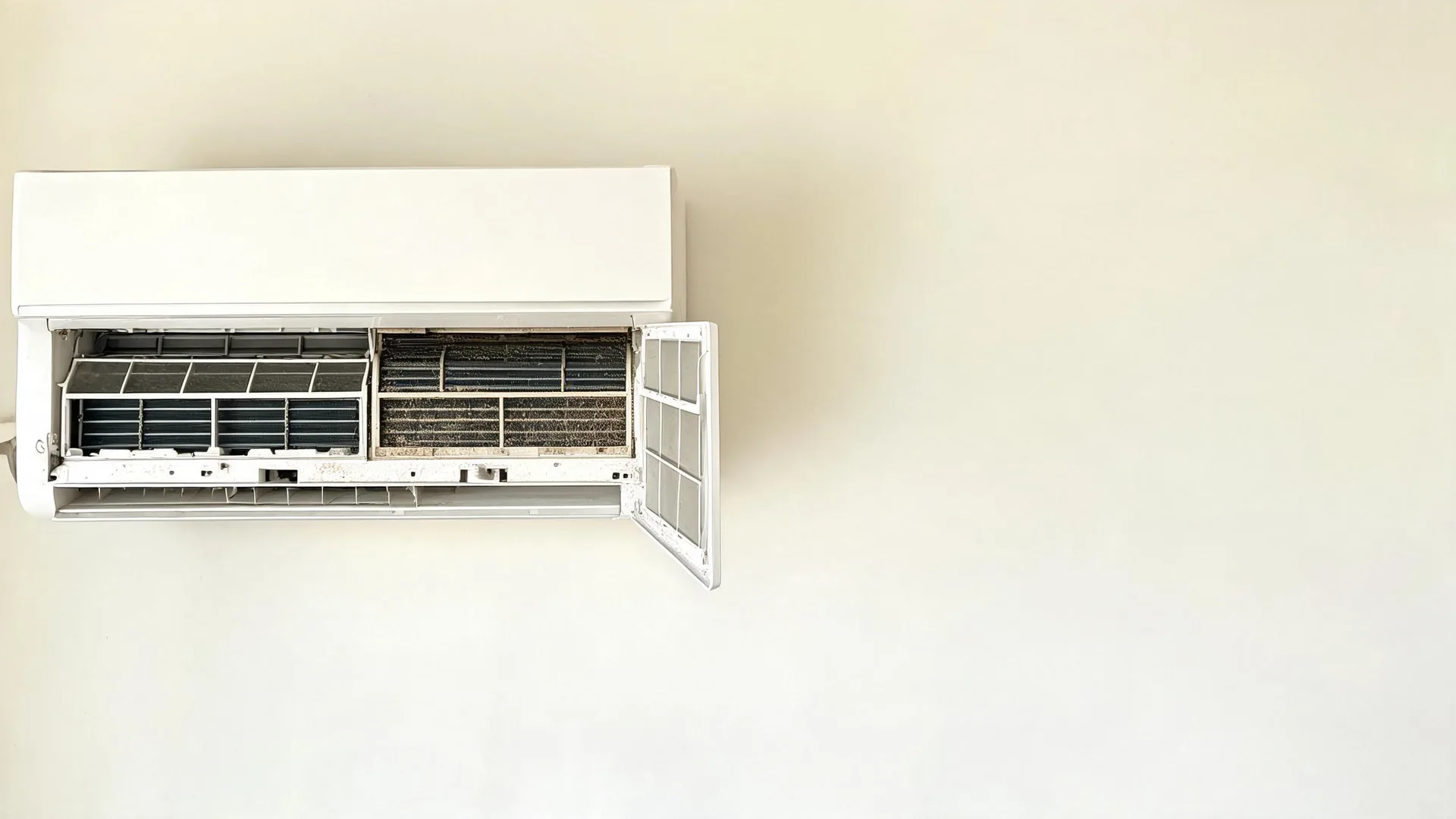
Look at the outdoor unit

Walk outside and check that nothing is pressed up against the condenser. Leaves, a fallen branch, or anything blocking the fins stops the unit from shedding heat, and it will run poorly until that airflow is clear. Also check that the breaker for the outdoor unit hasn't tripped. These are the only two things worth touching outside. Bent fins, a seized fan motor, or anything involving refrigerant is not a homeowner job, and opening the cabinet further than this risks a shock or a burn.

Overhead view of an air conditioning condenser unit on a concrete pad next to a house with asphalt shingle roofing and vinyl siding.

A new air conditioner would save little on running costs in Santa Cruz County, so the repair decision comes down to the unit's condition.

  • A new one at the federal minimum, 14.3 SEER2$80 a year
  • An older air conditioner$90 a year

Estimates for a typical Santa Cruz County home, compared with an older unit built to the previous federal minimum, from EIA household energy data, California fuel prices and NOAA climate normals. Your home will differ.

Repair makes sense when a part like a capacitor or contactor has failed.

Replacement makes sense when the compressor has failed or the system uses R-22 refrigerant, which is no longer made.

A diagnostic starts with gauges, not guesses. The tech connects them to the service ports and checks refrigerant pressure on both the high and low side, because that number alone points toward a handful of specific problems. They'll check the temperature of the air coming off the coil against the air going into it, which tells them whether the system is actually moving heat the way it should. The capacitor gets tested under load, not just looked at, since a capacitor can look fine and still be too weak to start the compressor cleanly. They'll check amp draw on the compressor and fan motor too, because a motor pulling more current than it's rated for is a motor on its way out even if it's still running today. Electrical connections get checked for corrosion and heat damage, since a loose connection can mimic a failing part. By the end, the tech isn't guessing what's wrong. They know which part is failing and why, and that's what gets written up before any repair starts.