






Illuminated white stucco houses with terracotta roofs clustered on a dry hillside at dusk.

AC Repair in Stockton, CA

Tell us about the job

Takes about a minute. No obligation.

RepairCentral ACSan Joaquin County, CA
Step 1 of 2

What ZIP code is the job in?

Stockton runs its air conditioning about five months straight, May through September, and June through August the afternoon high averages 91°F. That is the stretch where a system either holds up or doesn't. A compressor or capacitor working at 91 degrees day after day wears faster than the same part in a milder county, and it doesn't always fail all at once. Weak cooling, short cycling, a unit that runs longer than it used to, these often trace back to that long stretch of heat rather than one bad part. Getting the actual cause diagnosed matters more here than in places where the system gets a break most of the year.

5 months
May through September, your air conditioner is on duty
91°F
the average summer afternoon it cools against
2 hail events
in ten years, and hail bends the fins on outdoor coils
21 wind events
in ten years, and wind drives debris into outdoor units
Isometric line illustration of a cutaway house showing interior rooms with ductwork, an air handler and furnace, connected by lines to an outdoor condenser unit on the ground outside.
Your air conditioner works hardest from June through September.

NOAA nClimDiv, 1991–2020 normals

Electricity in California ran 31.97 cents per kilowatthour in 2024, among the highest rates in the country.

A Stockton AC that's losing efficiency burns through that expensive power every time it runs, so a repair put off is a cost that keeps adding up.

Half the houses in San Joaquin County date to 1984 or later

Half the homes here were built by 1984
Cooling runs May through September
Summer afternoons average 91°F
Stockton AC RepairCooling starts in May. Problems show up early, when the heat finds the weak part first.

A system that's struggling in July won't always show it with a dead compressor. Sometimes it's a capacitor that's weakened enough to make the compressor labor but not enough to shut it down yet. Sometimes it's a thermostat sensor reading wrong after months of heat on the siding around it. A tech who checks the actual part instead of guessing can tell you if what's failing now is close to taking something bigger with it. That's worth knowing before the next heat wave, not after it.

A newer system is usually worth repairing

If your house dates to 1984 or later, the AC likely isn't old enough to be the problem on its own. A repair now gets the actual part fixed instead of replacing a system that still has years in it.

Find a contractor
A gray metal air conditioning condenser unit mounted on a concrete pad in a flat grassy field under a partly cloudy sky.

What to check yourself first

Before anyone comes out, check the filter. A clogged filter starves the system of airflow and the coil behind it can ice over, and an iced coil will blow warm air no matter what else is right with the unit. Next, look at the outdoor unit itself. If the fan isn't spinning, or if it's covered in leaves, grass clippings or a layer of dirt, that alone can push the compressor harder than it should work. Check the thermostat batteries and make sure it's set to cool, not just on. Walk the vents inside and confirm they're open and not blocked by furniture or rugs. If the system is running but the air coming out isn't cold, or if it cycles on and off in short bursts, don't take the cover off the outdoor unit or touch anything electrical. That points to a refrigerant or electrical problem, and that's where a homeowner's checklist ends and a tech's starts.

Warm air from a running system

If the blower is moving air but the air isn't cold, the problem usually isn't the fan. It points to the refrigerant charge or the compressor itself, since those are what actually pull heat out of the air. This is different from no airflow at all, and it changes what a tech checks first.

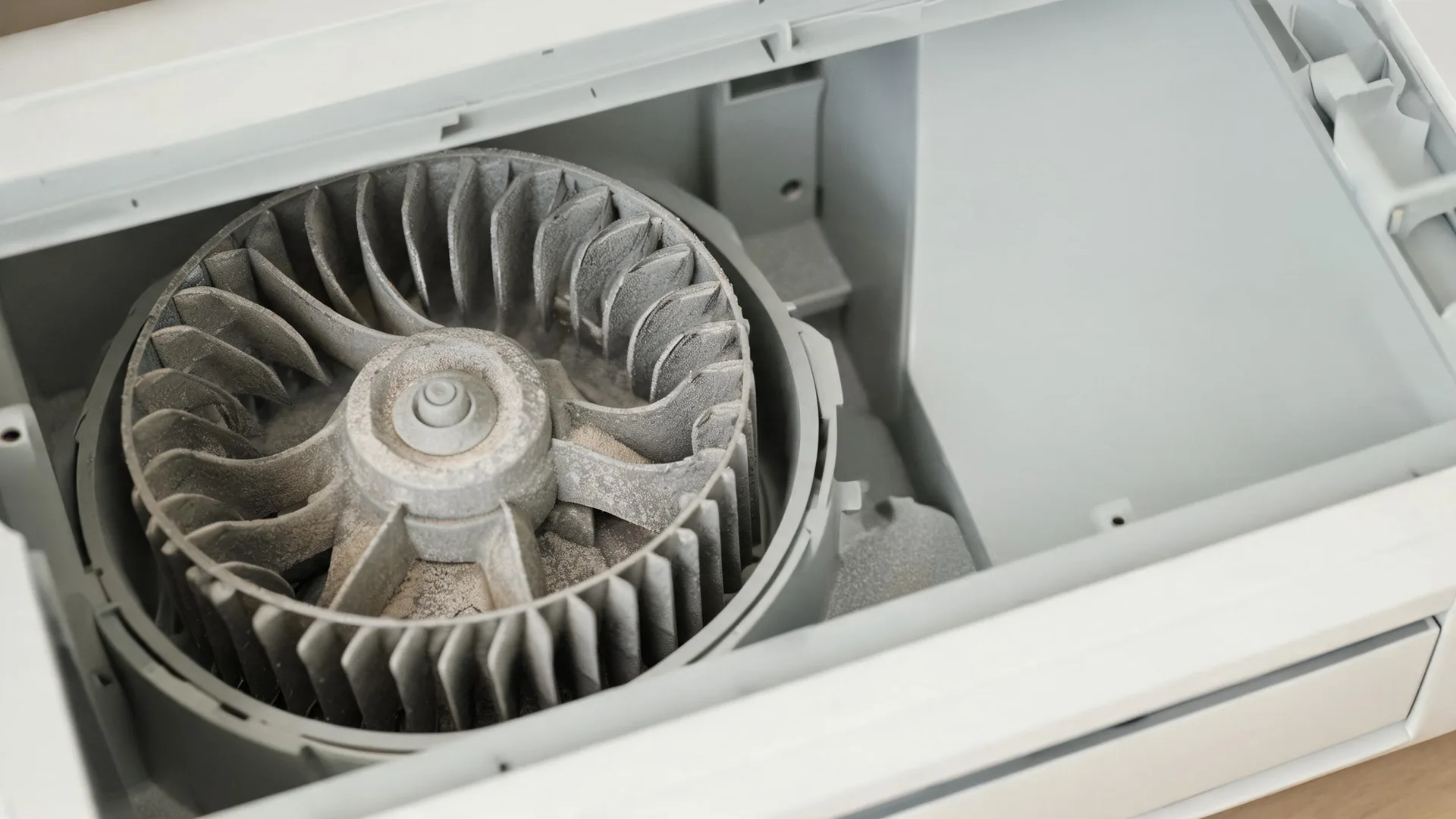
A sound that wasn't there before

A grinding, screeching or clicking that repeats every cycle is usually a motor bearing or a relay wearing out, not dirt or debris. Unlike a noise that happens once and stops, a repeating sound means a part is failing on a schedule, and it's worth having someone listen to it before it quits mid-cycle.

An outdoor air conditioning condenser unit positioned beside a blue-sided house at sunset.

A new air conditioner would cut about $80 a year off cooling for a typical San Joaquin County home.

  • A new one at the federal minimum, 14.3 SEER2$500 a year
  • An older air conditioner$580 a year

Estimates for a typical San Joaquin County home, compared with an older unit built to the previous federal minimum, from EIA household energy data, California fuel prices and NOAA climate normals. Your home will differ.

Repair makes sense when a part like a capacitor or contactor has failed.

Replacement makes sense when the compressor has failed or the system uses R-22 refrigerant, which is no longer made.

Repair makes sense when one part failed and the rest of the system is sound. A capacitor, a contactor, a fan motor, these can be replaced on their own without touching anything else, and the compressor they support goes back to running the way it should. Replacement starts to make more sense when the compressor itself is the problem. It's the most expensive part in the system and the hardest to justify replacing on its own, especially in an older unit where other parts are closing in on the end of their life too. Age matters alongside the symptom. The same failure in a system a few years in and one well past its expected life point in different directions, even though the broken part looks identical under the cover. A tech who's opened the unit up can tell you which situation you're actually in.