AC smells like burning in San Bernardino, CA

Let a pro reach out

A burning smell from your AC in San Bernardino heat is not something to wait out. Summers here run long and hot, and a system that smells like something is burning usually means it is working hard with a problem already inside it. You do not need to figure out whether it is a wiring issue, a motor strain, or dust burning off a part. That is not a guess you should have to make standing in front of the unit. What you need is someone licensed who can look at it and tell you straight. Send the form and you are done hunting. No scrolling through reviews, no calling three companies and repeating the same description of the smell three times, no sitting with quotes trying to compare apples to oranges. A contractor who works on San Bernardino County homes gets your information and takes it from there. The finding part, the part that eats your afternoon, is off your plate the moment you hit send.

Why does my AC smell like something is burning?

A burning smell from your AC is unsettling, especially in a San Bernardino summer when the system runs most of the day. You want to know whether this is something minor or a sign the unit is about to fail, and whether it is safe to keep it running while you figure out what to do next.

It usually means an electrical part is overheating, not the air itself burning

A burning smell almost always points to something electrical rather than the air coming through your vents. A motor bearing, a frayed wire, or a blower running against resistance it was not built for can all heat up enough to give off that smell. With San Bernardino summers pushing a system to run for hours at a stretch, these parts get more wear than they would in a mild climate, and a weak point shows up faster. If the smell is sharp and sudden, shut the system off at the thermostat or breaker rather than waiting to see if it passes. Running it longer can turn a part that needs replacing into one that takes the whole system down with it.

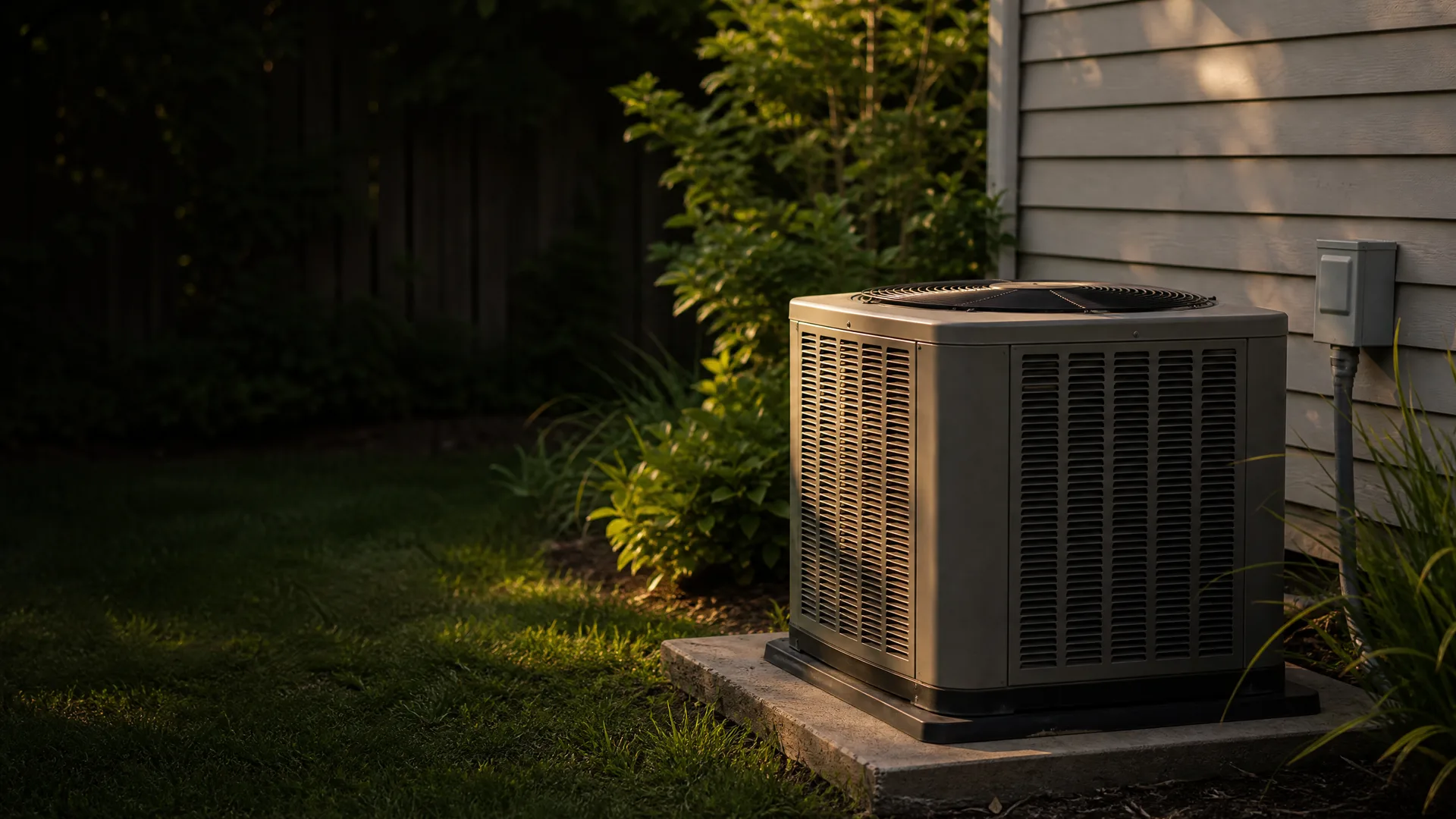
A gray outdoor air conditioning condenser unit on a concrete pad beside a house with horizontal lap siding, with a conduit and electrical disconnect box on the wall and a green shrub in mulch to the right.

Running clean

This is what a condenser should look like through a San Bernardino summer. The grille is clear, the fins are open, and nothing is piled against the base. Air moves through it the way it was built to, so the system isn't working any harder than it has to just to push heat out of the house.

A weathered outdoor air conditioner condenser unit on a concrete pad beside a house with horizontal vinyl siding, with a conduit and disconnect box on the wall to the right.

Choked and neglected

Dirt packed into the grille and leaves built up around the base block the airflow this unit needs to release heat. A condenser running like this works harder for the same cooling, and that extra strain is one of the ways a burning smell starts. Left alone through another summer, it gets worse, not better.

Burning Smell: Safe to Run or Shut Off

Safe to run for now

  • The smell is faint, shows up only at startup, and clears within a minute or two once the system is moving air.
  • You can see dust on the vent covers or notice it was stirred up after the system sat off for a while.
  • No breaker has tripped and the outdoor unit sounds the way it always has, with no grinding or rattling.
  • There's no haze or visible smoke anywhere near the indoor unit or the vents.
  • The smell doesn't get stronger the longer the system runs through a hot San Bernardino afternoon.

Shut it off now

  • The smell is sharp, like burning plastic or hot metal, rather than a dusty or musty odor.
  • You see any smoke, even a thin wisp, coming from a vent or the outdoor unit.
  • The breaker for the AC has tripped, or the system shuts itself off partway through a cycle.
  • The smell gets stronger the longer the system runs instead of fading.
  • You hear a new grinding, buzzing, or clicking sound along with the odor.
  • The smell is strongest right at the outdoor unit or right at the indoor air handler, not spread evenly through the house.
An outdoor air conditioner condenser unit sits on a concrete pad beside a house with horizontal lap siding, surrounded by grass and shrubs in low evening light.

You're out back around seven, watering the pots along the fence before it gets fully dark. The condenser sits against the house where it always has, and tonight it's quiet in a way that catches you. The fan isn't turning. The air coming off the unit carries that burning smell again, sharper out here than it was inside the kitchen an hour ago. The light's gone that low gold color San Bernardino gets in August, and the heat hasn't let up with the sun. You crouch down and look at the grille, like that's going to tell you something. It doesn't. You already know you won't be the one opening this thing up, and you won't spend tomorrow calling around to find out who will.


One request and it's handed off

A burning smell doesn't go away on its own, and running the system again to see if it happens twice just gives whatever's wrong another chance to get worse. Finding someone for this on your own means pulling up reviews you can't verify, calling a few numbers, explaining the smell and when it happens to each one, then waiting to see who actually quotes you a price and who just never calls back. In San Bernardino in July or August, that's time with no AC while you sort through it. Send the request here and that part is done. One contractor who works on these systems gets your information and reaches out, so you're not managing a list of callbacks or repeating yourself to a third stranger on the phone. What's left is the actual repair, not the search for who might do it.

What that smell is usually from

A burning smell from a condenser is often the motor windings or a run capacitor working past what they're rated for. San Bernardino summers push a condenser to run for hours without a break, and a motor that's already weak gets hotter each cycle until the insulation on the windings starts to smell. Indoors, the same smell can come from the blower motor bearings or from dust burning off a hot resistance heater strip some systems use for a boost. None of these fix themselves by running less. The smell is the system telling you a part is already past where it should be, not a sign it's about to be past it.

Why waiting costs more here

Power in San Bernardino County is among the most expensive in the country, and a motor or capacitor working overheated pulls more current to do the same job. That shows up on the bill before it shows up as a breaker trip. A capacitor that's failing can take a compressor down with it, and a compressor is the most expensive part in the unit to replace. Catching this at the smell stage, before a trip or a seized motor, is usually the difference between swapping one part and replacing the outdoor unit entirely.

An outdoor air conditioner condenser unit on a concrete pad beside a house with horizontal lap siding, with a conduit running to a gray electrical disconnect box on the wall.
Before you get your air conditioner repair
A gray outdoor air conditioner condenser unit on a concrete pad beside a house with horizontal lap siding, with a wall-mounted disconnect box and conduit at left and a green shrub and mulch bed at right.
After you get your air conditioner repair
  1. Power cuts off, or you shut it off at the breaker.

  2. A contractor pulls the panel and checks the capacitor first.

  3. A meter tests the motor windings for a short.

  4. Burnt wiring or a failed part gets replaced.

Cooling runs May through October

May through October, your air conditioner is the thing standing between you and a San Bernardino summer, running most of the day on the hottest ones. A burning smell on day one of that stretch is a problem for the next six months, not just today.

NOAA nClimDiv 1991-2020

A burning smell from your AC means something inside it is already overheating, whether that's a motor, a capacitor, or wiring, and it won't fix itself by running less or running more. In San Bernardino heat, a condenser that's already stressed doesn't get a break to recover on its own. The smell is the warning, not the damage itself, which is why it matters to have it checked before the part it's coming from fails outright. A contractor can trace it to its source, replace what's burnt or worn, and confirm the system runs clean afterward. That's the whole question answered: don't wait, don't guess, get it looked at. Where you stand right now is simple. The smell told you something. What it is exactly takes someone with a meter and a panel open to say for sure. Until then, the safest move is the system off and a call made, not a system run again to see what happens.

A smiling man in a green long-sleeve shirt stands at a dark kitchen counter with a ceramic mug, with wood cabinets, white tile backsplash, and a window and dining table behind him.
A smiling man with wavy dark hair and a beard, wearing a navy sweater, sits at a kitchen counter with a gray mug, with a dining table, potted plant and windows behind him.
A bearded man in a dark green sweater smiles and looks to his right while seated at a white kitchen counter with a gray mug, with windows and greenery behind him.
A smiling man in a dark navy sweater stands in a home interior beside a counter with a white mug, with a kitchen, hallway and potted plant in the background.

Air Conditioner Repair

Done looking for an air conditioner pro

Skip calling shops to ask who repairs air conditioners in San Bernardino County.

A black smartphone standing upright on a plain white background, its screen filled with solid green.
RepairCentral ACSan Bernardino County, CA
Step 1 of 2

What ZIP code is the job in?