An outdoor heat pump unit mounted on a concrete pad beside a house with beige siding and a landscaped garden bed.

Heat Pump Repair in Oakland, CA

Tell us about the job

Takes about a minute. No obligation.

RepairHeat PumpAlameda County, CA
Step 1 of 2

What ZIP code is the job in?

October is when weak parts show up

Heat here switches on in November, so October is when a heat pump that has been idle on cooling gets asked to run heat again. A capacitor or a charge that was borderline all summer often fails on that first call for heat.

Waiting means losing heat in a cold house

A heat pump with a real problem does not get better on its own once the weather turns. A repair made in October happens while the house does not need the heat yet. The same repair in November happens while the house does.

6 months
November through April, your system heats
3 months
July through September, it cools
41°F
the average winter night it heats against
82°F
the average summer afternoon it cools against
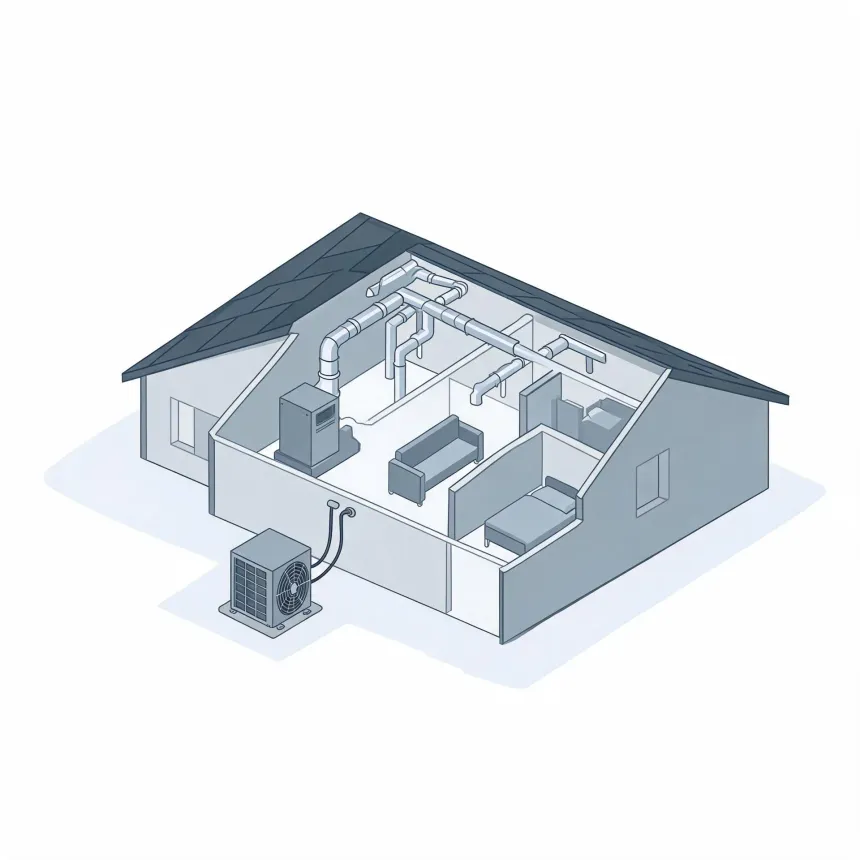
Isometric cutaway illustration of a single-story house showing interior rooms with furniture, an attic duct network connected to a furnace or air handler, and an outdoor condenser unit linked by lines outside the wall.
Your system heats November through April and cools July through September.

NOAA nClimDiv, 1991–2020 normals

Oakland winters stay mild, with overnight lows averaging 41°F even in January.

A heat pump here isn't fighting single-digit nights, so a unit acting up is more likely a worn part than a system worked past its limits.

Half the homes in Oakland are older, and older means the heat pump may be too

Half the homes here were built by 1969
166 damaging wind events from 2015 to 2024
19 hail events from 2015 to 2024

Half the homes in Alameda County went up in 1969 or earlier, and a heat pump doesn't last as long as the house around it. If yours came with the place and nobody's swapped it since, ask the contractor straight out how many years it has left before you commit to the repair. A cracked heat exchanger or a compressor on its way out is worth knowing about before parts get ordered. If it's a newer unit someone added later, none of this applies, and the repair is probably just a repair.

This is most likely a straightforward repair

Nothing about Oakland works a heat pump harder than anywhere else. Mild winters mean the system isn't straining against the cold, so a unit acting up is probably a worn part, not a machine pushed past what it can do. Electricity here runs 31.97 cents per kilowatt-hour, which is reason enough to get a broken unit fixed instead of running on backup longer than it has to.

Find a contractor
A man in a cap, dark long-sleeved shirt and tan work pants climbs wooden porch steps toward an orange front door, carrying a canvas tool bag with tools in it, beside a potted shrub in a terracotta planter.
A dark gray heat pump unit mounted on a concrete pad next to a house with gray siding and a stone veneer wall.

Keep running it and the one bad part takes others with it

A part that's failing but still running doesn't hold steady. A capacitor losing its charge makes the compressor or fan motor strain to start, and that strain is what finishes it off. A refrigerant leak gets worse while the system keeps pulling from a charge that's already low, and a compressor run on a low charge long enough can wear itself out from the inside. Ice on the outdoor coil blocks airflow more each time the unit runs without defrosting properly, and the system compensates by running longer, which puts more hours on whatever else is already weak. A reversing valve stuck halfway can let refrigerant flow where it shouldn't, and a compressor built to push gas one way doesn't do well being asked to do both. None of this fixes itself by waiting. The part that's worn stays worn, and everything downstream of it keeps paying for it.

What a failing heat pump sounds like

A heat pump that used to run quiet and now clicks, buzzes or grinds when it starts is telling you something inside has worn down, often the contactor or the fan motor bearing. Short cycling, where the system shuts off a few minutes after starting, usually points to a sensor reading wrong or a refrigerant charge that has dropped. Ice building up on the outdoor coil when the unit is in heating mode means the defrost cycle isn't working the way it should.

What it means for comfort inside

Air coming out of the vents that feels cool instead of warm often means the reversing valve is stuck, not that the whole system has failed. A heat pump that runs constantly without the house reaching the temperature on the thermostat is losing the fight somewhere, whether that's a failing compressor or a coil too dirty to transfer heat. Rooms that used to feel even and now run cold in some spots point to airflow trouble rather than the compressor itself.

Most heat pump failures trace back to a handful of parts, and they fail for ordinary reasons. The contactor wears from simply opening and closing every time the system cycles, until the contacts pit and stop making good contact. A capacitor loses its charge-holding ability over years of heat and vibration, and when it goes, the compressor or fan motor struggles to start. Refrigerant doesn't get used up, so a low charge almost always means a leak somewhere in the lines or coil, not normal consumption. The reversing valve, which is what lets the same system heat and cool, can stick in one position after enough cycles, leaving the house with only one or the other. Outdoor coils collect dirt and debris over time, and once they're coated enough, the system has to work harder to move heat across them. None of this means the whole unit is failing. Most of the time it's one part that wore out on its own schedule, and the rest of the system is fine once that part is replaced.

A diagnostic call starts with the complaint, whatever made the reader notice something was wrong. The tech runs the system in whatever mode it's failing in rather than trust a description of what it did yesterday. Electrical readings come next. Voltage at the contactor, the capacitor's actual capacitance against what's stamped on it, amp draw on the compressor and fan motor. If the complaint points to weak heat, the tech checks refrigerant pressures and the line temperatures, since those numbers say more about a leak or a bad charge than looking at the coil ever could. A stuck reversing valve shows up here too, because the pressures won't match what the thermostat thinks the system is doing. Airflow gets checked separately from all of this, since a dirty filter or a blocked return can mimic a failing part and send someone chasing the wrong fix. By the end the tech can usually point to the one part that actually failed, rather than guessing from the symptom alone.