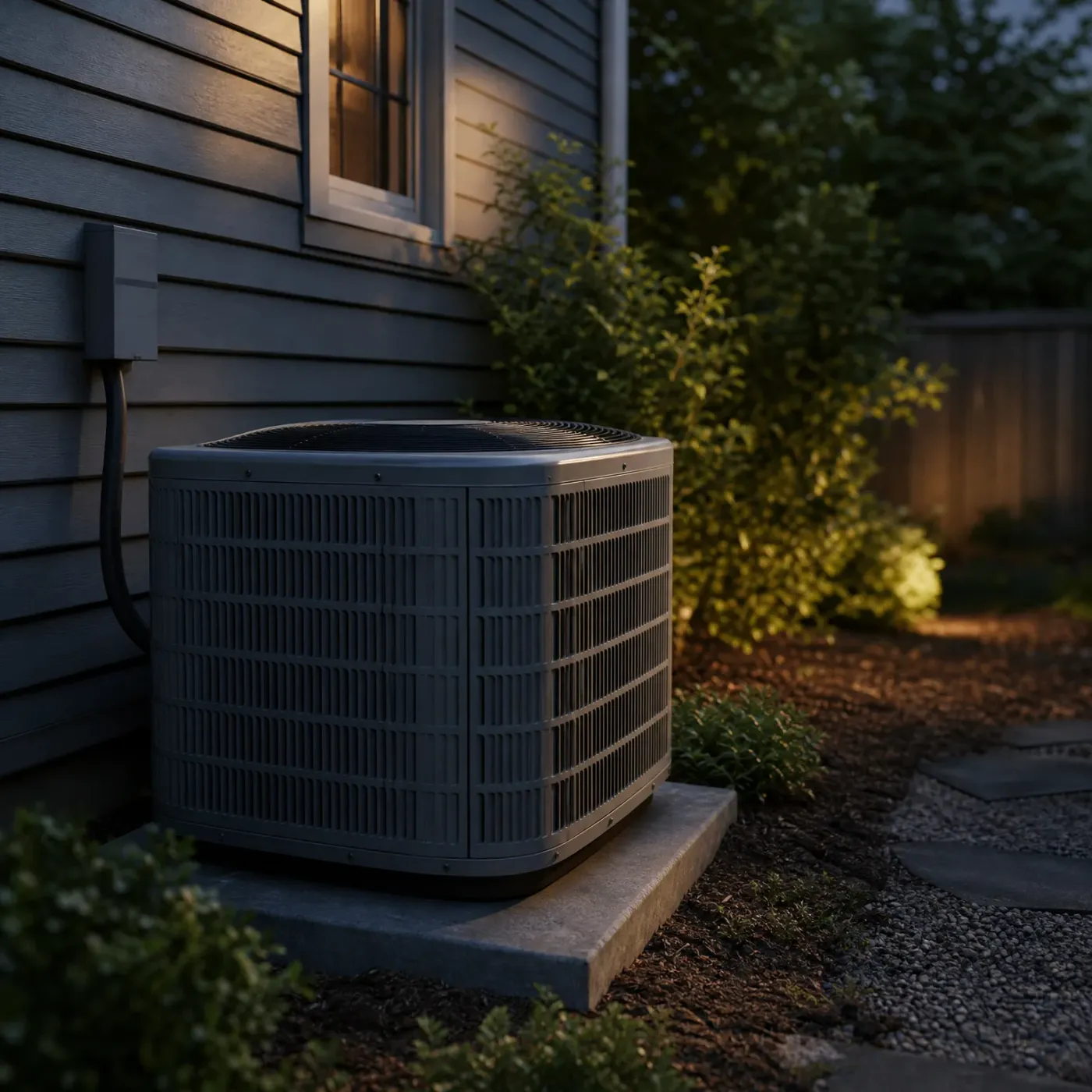


An outdoor air conditioner condenser unit on a concrete pad beside a gray horizontal-siding house at dusk, with a wall-mounted disconnect box, shrubs, and a gravel path with stepping stones nearby.

No phone calls to make

How to keep your AC running in a California heat wave

When the heat spikes, you want your AC keeping up, not struggling. Power rates here make a system running poorly expensive fast, and gas heat means your AC does all the cooling work alone. This page covers what keeps a California AC running through a heat wave, and what maintenance catches before the hot stretch finds it.

Fill out one form

When the temperature climbs past what your AC sees most of the year, it runs longer, more often, and under more strain, and that's when a weak part that was getting by finally fails. A system that already struggles to keep up on a normal day doesn't have anything in reserve for a 105 degree afternoon. It runs closer to its limit for hours at a stretch, so a dirty coil, a low charge, or a capacitor on its way out shows up as the house never quite reaching the temperature on the thermostat. Since gas heats most homes here, the AC is the only thing cooling the house, with nothing to share the load if it falls behind. Regular maintenance catches the weak part before the heat wave finds it. A system that's been serviced runs the way it's supposed to when it matters most, instead of losing ground hour after hour while the house gets warmer and the unit works harder for less.

A smiling bearded man in a dark crewneck sweater sits at a dinner table with a lit candle, glasses of wine and water, and plates of food in the foreground, with a lamp, framed art and a potted plant behind him.
A woman with dark hair in a bun reclines on a gray sofa with her eyes closed and a slight smile, wrapped in a cream knit sweater and blanket, with an open book resting in the foreground and a lit lamp in the dim room behind.

Why the strain shows up late

A capacitor or contactor that's wearing out can still start the compressor on an 80 degree day without any sign of trouble. Push the same system to run for hours straight against 105 or 110, and that same part has to work harder with less room for error. That's why a heat wave is when a marginal part finally gives out, even though it was failing long before the heat arrived. Maintenance catches a weak part while it's still working, not after it's picked the worst week of the year to quit.


What a tune-up actually checks

A seasonal check on a California AC means testing the refrigerant charge, checking the capacitor's output against its rating, cleaning the condenser coil outside, and confirming the system is pulling the airflow it needs across the evaporator coil. Dirt on that outdoor coil makes the whole system work harder to shed heat, which matters more when it's 108 outside than when it's 80. None of this is guesswork. Each of these has a measurable reading, and a reading that's drifted off spec is the part most likely to fail once the heat really pushes the system.

A smiling woman with dark shoulder-length hair in a cream V-neck sweater sits at a marble counter with a glass of red wine, with a kitchen and softly lit living room behind her.
A woman in a dark green sweater laughs while seated at a marble kitchen island with a glass of red wine, with open shelving, cabinets and a living room visible behind her.
A woman with long dark hair in a cream knit sweater laughs while looking off to the side, seated at a counter with a glass of red wine, in a dimly lit living room with a sofa, lamp, framed pictures and houseplant behind her.
A smiling woman with long dark hair in a beige sweater sits at a marble kitchen counter with a glass of red wine, with a dimly lit living room behind her.
A gray outdoor air conditioning condenser unit on a concrete pad beside a house with horizontal lap siding, with a wall-mounted disconnect box and conduit, and shrubs to the left.

Clean and clear

The pad is clean and the unit sits in the open, nothing crowding the sides. Air moves through the coil the way it's supposed to, so the system sheds heat and shuts off when it's satisfied. On a 110 degree day this is the system that keeps up.

An outdoor air conditioning condenser unit on a concrete pad beside a house with horizontal siding and a concrete foundation, with dry brown leaves on the ground to either side.

Dirty and boxed in

Leaves pile against the cabinet and the coil underneath is caked with a season of dust. The unit has to run longer to move the same heat out, and on a 110 degree day that's the difference between keeping up and running nonstop without catching up.

An outdoor air conditioning condenser unit on a concrete pad beside a house with light vinyl siding, an electrical disconnect box and conduit on the wall, bare shrubs and mulch to the right, and a concrete walkway in the foreground.
Before you get your air conditioner maintenance
An outdoor air conditioner condenser unit on a concrete pad beside a house with beige horizontal siding and a stone-veneer base, with refrigerant lines running to a gray wall-mounted electrical box, surrounded by dark mulch, a flowering shrub and an evergreen on the left.
After you get your air conditioner maintenance
Single-story gray horizontal-siding house with multiple front gables, a white front door, white-trimmed windows, and a mown lawn under a clear blue sky.

A summer dew point averaging 50°F across California means the air your AC pulls in is dry. That matters because a dry-air system spends most of its effort moving heat, not wringing moisture out of the air, so the strain a heat wave puts on it is almost entirely about temperature. When a part is already worn, that's where it gives out first, not from humidity load. If your AC does need a look before the next heat spike, you're matched with one local contractor, someone who works on California systems all summer and knows which parts give out first in a dry heat wave, instead of a list of companies to call and compare yourself.

NASA POWER T2MDEW county cells weighted by homes

One form, no calling around

Finding out which part is worn enough to fail during a heat wave takes someone who already knows your system, not someone meeting it for the first time when it's 110 outside. A local contractor who services AC units all season in California has likely seen your model's capacitor or contactor wear out before and knows what to check first. Without that, you're calling around, explaining the same symptoms to three or four companies, and sorting through quotes while your house gets hotter. Handing off the request once means you skip that, and the person who shows up already has a sense of what tends to go first on a system like yours. That matters more here than almost anywhere, since a system that's struggling on a mild day has nothing left when the heat spikes and your power bill is already climbing. Getting it looked at before the next heat wave, rather than during one, is what keeps your AC the one that shuts off satisfied instead of the one that just keeps running.

Where your AC stands now

  • A heat wave finds the weak part your AC was already hiding, not a new problem it creates.
  • Maintenance checks the capacitor, contactor, and coil before a 110 degree day forces the issue.
  • A system that's been serviced keeps running when the temperature climbs; one that hasn't is the one that quits.
  • Finding a contractor, explaining the problem, and comparing quotes is work you can skip with one match.
  • A local contractor who works on California AC units all summer has likely already seen your model fail this way.
  • One contractor means one call, not a string of follow-ups from companies competing for the job.

The question was never whether your AC can handle a normal day. It's whether it can handle the day the temperature hits 110 and stays there. A capacitor, a contactor, a dirty coil, any of these can carry a system through a mild afternoon and still fail the moment a heat wave asks for hours of steady running. Maintenance catches that part before the heat wave does, while it's still a five minute check instead of a dead AC and a house that won't cool down.

Getting there usually means calling around, explaining the same problem to three or four companies, and sorting through quotes that are hard to compare because nobody looked at the same thing. That work goes away with one match to a contractor licensed to work in California. It's one contractor, not five companies racing to call you back first. And it's someone local, who's spent the summer in and out of attics and side yards working on these same systems, who has likely already seen your exact model fail this exact way when the heat pushes past what it sees most of the year. That's not a stranger learning your AC for the first time at 110 degrees. That's someone who already knows where to look.

Your AC either gets checked before the heat wave or it gets tested by it. One of those you control.

A shingled two-story house with lit windows and stone accents at dusk, with a stone paver walkway and landscape lighting leading past ornamental grasses toward a calm bay under an orange and blue sky.

Air Conditioner Maintenance

Skip the search

Tune-up, service, or cleaningCentral ACCalifornia
Step 1 of 2

What ZIP code is the job in?

  • A dimly lit living room corner with a beige upholstered sofa holding a dark green cushion and a chunky knit throw, beside a wooden sideboard with a lit ceramic table lamp, a small potted plant, and a wooden bowl, with a framed artwork on the wall and a mug on a book in the foreground.
    • A local pro who services air conditioners gets in touch about the tune-up.
    • Say what's going on with your air conditioner, and a pro who works on them reaches out.
  • A round wooden coffee table holding a round stone vase of green foliage, a lit candle in a glass container, and a small dark bowl, with a beige sofa, cushions and knit throw behind and a window at left.
    • Send the form, and lining up the air conditioner tune-up stops being yours to chase.
    • Send the request and finding a pro stops being your problem.
  • Sunlit living room with a wooden coffee table holding a ceramic vase of leafy branches and a carved wooden tray with two stacked books, in front of a beige sofa with tan and green cushions and a potted plant near a window.
    • Fill out one form instead of calling around for an air conditioner tune-up.
    • Describe your air conditioner job once, to one pro.
  • Interior corner with a lit ceramic table lamp and wooden bowl on a wood sideboard, a framed picture and branch-filled vase behind, a knit throw over an upholstered chair, and a lit candle in a glass holder, stoneware mug and round planter of green foliage on a wooden table in the foreground.
    • Your request goes to one pro, not a list of companies.
    • The pro who reaches out is licensed in California.