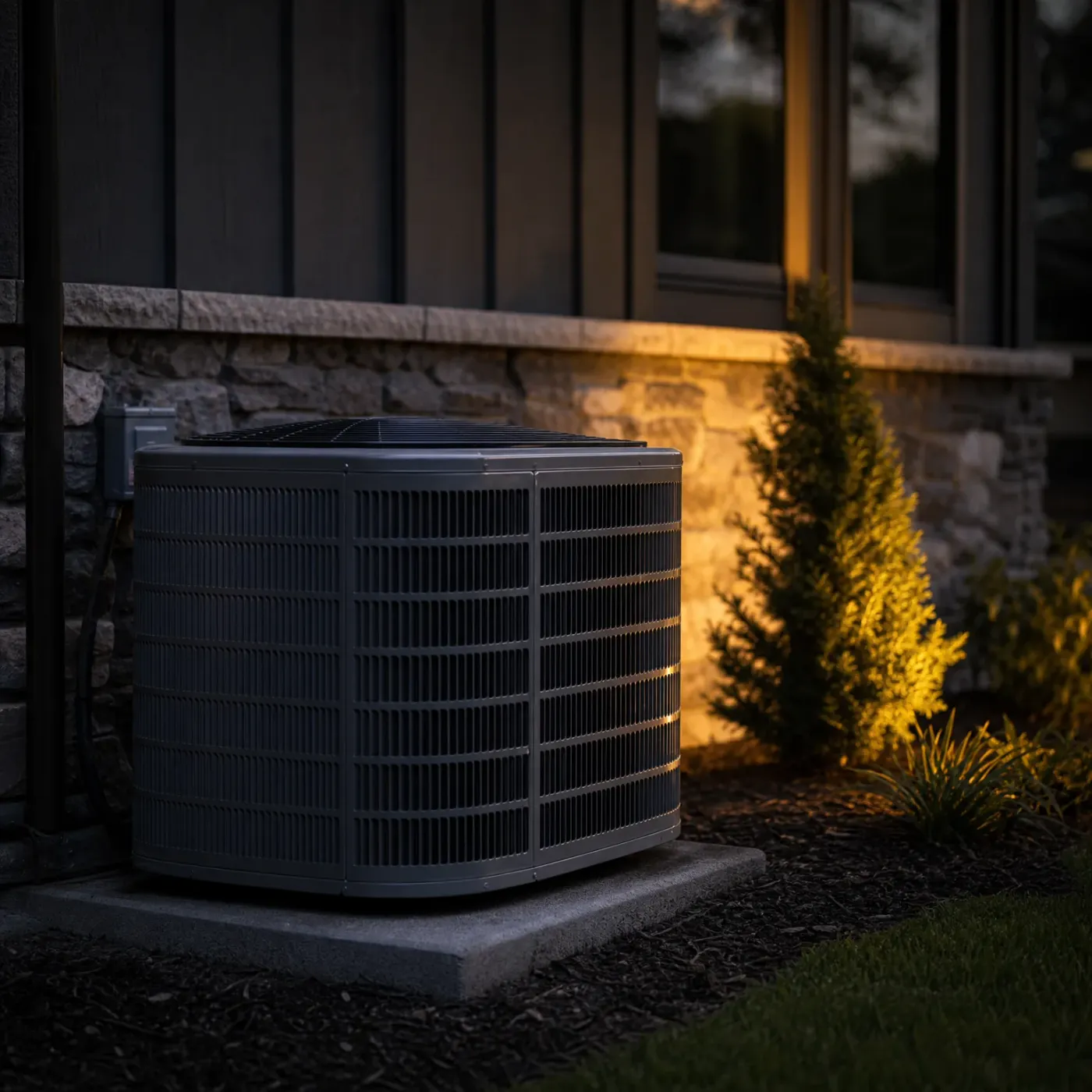


An outdoor air conditioning condenser unit on a concrete pad beside a house with stone veneer and vertical board siding, with a small shrub and mulch bed lit by a ground light at dusk.

Let someone else find the pro

What an AC tune-up covers before a California summer

A tune-up before summer checks the things that make an AC quit on a hot day: refrigerant charge, the condenser coil, the electrical connections, airflow through the system. This page covers what a technician actually looks at and why it matters before the heat sets in. Skip the search for who's any good and who answers the phone. Send the form and that part is done.

Let a pro reach out

A tune-up before summer means a technician checks your AC while it's easy to fix something, instead of after it quits in July. Warm weather here starts early and holds on, so the system runs for months without a break, and anything weak in it shows up as a breakdown on the first real hot stretch. Dust on the condenser coil, a refrigerant charge that's a little low, a connection that's loosened over the year, low airflow from a dirty filter or blocked return: none of these stop your AC right away, but each one makes it work harder and raises what you pay to run it. Caught now, they're small adjustments. Left alone, they turn into the compressor failing or the system freezing up mid-summer, right when you need it most and when getting someone out to fix it takes longer. The tune-up is what catches the small problem before it becomes the expensive one.

A man in a blue T-shirt sits on a light gray sofa, laughing while looking at an open laptop in the foreground, with a framed picture, lamp and potted plant behind him.
A bearded man in a blue and brown plaid flannel shirt stands indoors looking out a window at snow-covered trees, with a ceramic mug on the windowsill.

What a dirty coil costs you

A condenser coil caked with dust and leaves cannot shed heat the way it should. The compressor runs longer to reach the same temperature, and power here already costs more than almost anywhere else in the country. A technician cleans the coil as part of a tune-up, which is also when they will catch the buildup before it forces the system to work past what it was built for. A clean coil is one of the few things you can actually see improve a cooling bill.


Why the charge gets checked

An air conditioner loses a little refrigerant over time through fittings and connections, even with no leak to point to. Low charge makes the compressor work harder for less cold air, and left alone it shortens the life of the compressor itself. Checking the charge and the pressures takes a gauge and a few minutes, and it is part of what gets looked at during a tune-up. It is also one of the few problems that gives no obvious sign until the system is already struggling in the heat.

A smiling man in a navy long-sleeve shirt sits at a wooden table in a kitchen and dining area, with a ceramic mug, a potted plant, and a sliding glass door behind him.
A smiling bearded man in a green henley shirt stands at a kitchen island with a gray mug, looking off to the side, with a dining area and shelves blurred behind him.
A smiling bearded man in a navy sweater sits at a white kitchen island with a ceramic mug, with open shelves, potted plants and a range hood behind him.
A smiling man in a dark olive long-sleeve shirt sits in a kitchen beside a counter with a dark mug, with a dining table, sideboard and hallway visible in the blurred background.

Skip it and hope for the best

Most AC systems in California run for years without a tune-up and never leave anyone stuck in a hot house. If the system is young and nothing about it worries you, that gap of a year or two probably costs nothing. But a weak run capacitor or a coil that's lost half its airflow won't announce itself. It just makes the compressor work harder every time the system cycles, on your dime, until the day it doesn't start at all, usually on the one afternoon you needed it most. Skipping the check is a bet, and most of the time it pays off quietly.

Have it looked at now

A technician checking the system before summer finds the same things that cause a no-cool call in July, while there's still time to fix them without the heat working against you. If the capacitor is weak or the charge is low, it gets handled on a mild day instead of a 95 degree one, and you're not the one who had to figure out which of the dozen HVAC companies in your area to call, explain the problem to, and wait on. That part is done once the form goes in. The system still runs the same hours this summer either way. What changes is whether it's running right.

An outdoor air conditioner condenser unit sits on a concrete pad beside a stucco wall, with refrigerant lines and conduit running to the wall and a shrub to the left.
Before you get your air conditioner maintenance
A gray outdoor air conditioner condenser unit on a concrete pad beside a house with dark horizontal siding and a stone base, surrounded by gravel, with a flowering shrub at left and a concrete walkway in front.
After you get your air conditioner maintenance

One afternoon over 100 degrees

That's often when a weak part finally gives out. If your AC quits then, you're the one calling around for someone who can still fit you in.

Answer a few questions

One form, sent once

You describe the problem a single time. A contractor takes it from there, and you're done hunting for who's available.

Answer a few questions

What does a technician actually check during an AC tune-up?

You want to know if a tune-up is just a quick filter swap or something more thorough. Before you pay for a service call, it helps to know what's actually being done to the system sitting outside your house, not just a vague promise that it will "run better" this summer.

A tune-up goes through the system part by part, not a once-over

A technician checks the refrigerant charge against what the system calls for, since too little or too much makes the compressor work harder. The condenser coil gets cleaned if it's caked with dust, because a dirty coil can't shed heat well. Electrical connections get tightened, since a loose one can burn out a part mid-summer. The capacitor and contactor get tested, as these wear out from the heat they sit in. Airflow gets checked at the return and the supply side, and the thermostat gets confirmed to be reading and signaling correctly. Each of these can fail quietly for months before you notice the house isn't cooling the way it used to.

A two-story cream-colored house with horizontal siding and a gray hipped roof, flanked by large green trees and shrubs, with a concrete walkway crossing a lawn to a wet street in the foreground.

California air doesn't feel heavy the way it does in the South, and that's not just a feeling. Averaged across June, July and August, the dew point here sits around 50°F, according to NOAA climate data, which is dry by national standards. That's good news for you, but it doesn't mean your AC is coasting. Dry air cools faster, so a system in good shape can satisfy the thermostat quickly and shut off. One that's low on refrigerant or dragging on a dirty coil has to run longer to get there anyway, and that extra runtime is what shows up on the power bill. The dry air hides a weak system instead of making it obvious.

NASA POWER T2MDEW county cells weighted by homes

Done looking for an air conditioner pro

Skip calling around to set up an air conditioner tune-up.

There's no charge for the request.

A gray outdoor air conditioner condenser unit on a concrete pad beside a house with horizontal lap siding, with a wall-mounted disconnect box and conduit, mulch bed, shrub, and lawn nearby.

Running fine

This is what a healthy system looks like sitting on the pad. Refrigerant lines run clean up the wall, the coil is clear, and the unit cycles on and off without strain. Left alone, it can run like this for a long stretch if nothing inside it has started to wear.

An outdoor air conditioner condenser unit sits on a gray pad beside a light vinyl-sided wall, on a concrete slab next to a gravel bed.

About to fail

Nothing here looks different from the outside. The trouble is in a weak capacitor, a low charge, or a connection working itself loose, none of it visible from the yard. It still runs, until the afternoon it doesn't, usually on the hottest day of the month.

Why is your AC struggling on hot afternoons?

You notice it first in the late afternoon, when the house won't quite cool down even though the unit is running. Maybe it cycles on and off more than it used to, or the air coming out of the vents feels less cold than it should. Outside, the condenser might be humming louder, or running longer stretches before it shuts off. None of this means the system is finished. It usually means something inside it, a dirty coil, a weak connection, a refrigerant charge that's drifted low, is making it work harder than it needs to. Left alone through a full California summer, that strain is what turns a small, cheap fix into a dead compressor on the one day you need the system most.

  1. Technician checks refrigerant pressure against the system's rated charge

  2. Condenser coil gets washed clean of dust and leaves

  3. Electrical connections and capacitor get tested under load

  4. Blower and ductwork get checked for full airflow

Power costs 31.35 cents per kilowatt-hour statewide

At 31.35 cents per kilowatt-hour, every hour your compressor runs longer than it needs to shows up on the bill. A weak capacitor or a dirty coil makes the system work harder to cool the same house, and here that extra strain costs more than it would almost anywhere else.

EIA-861 2025 statewide residential average

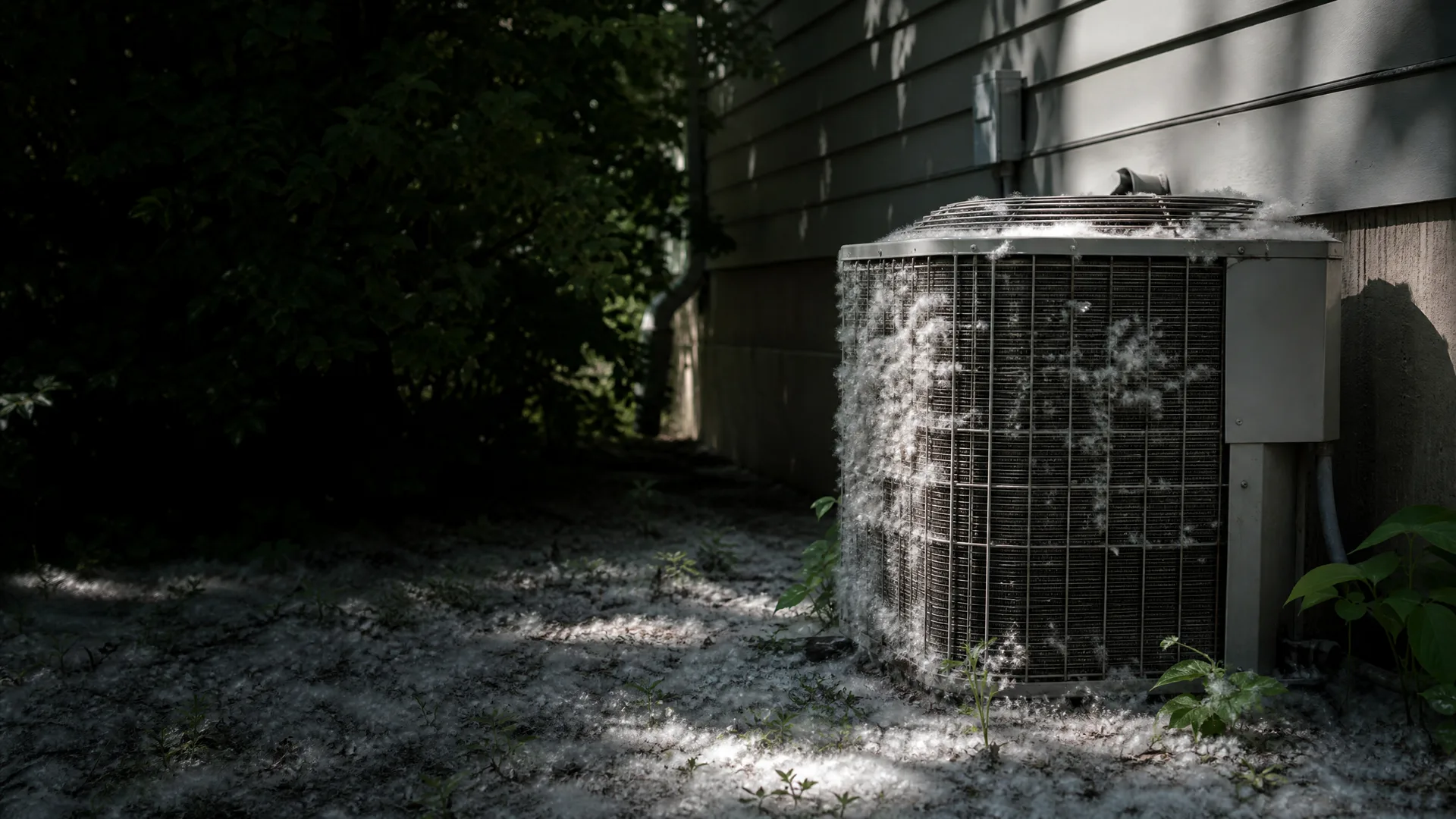
An outdoor air conditioner condenser unit beside a house with horizontal siding, its coil covered in white cottonwood fluff that also blankets the ground around it.

You're out pulling weeds along the side yard in late May when you notice it, the low hum from the condenser sounds a little strained. You walk over and see why. The fins are packed with white fluff, drifted off the cottonwood tree next door, thick enough that you can't see the metal underneath in places. It's been building up for weeks without you looking closely. You run a finger across it and the fluff comes away in a damp clump. Behind it the coil feels warm to the touch even though the unit just kicked off. You make a note to call someone before the first real hot stretch hits.

A closed silver laptop and a glazed ceramic mug on a wooden table, with a blurred kitchen counter, potted plant, cutting board and window in the background.

A tune-up is a short list, checked before summer makes it matter

A technician checks the charge, washes the coil, tests the electrical parts under load, and confirms air is moving the way it should. None of that is complicated. All of it is easier to fix in May than in August, when the same weak part has already failed and the house is sitting at 85 degrees.

You could spend the next week finding someone to do it: searching, calling a few numbers, explaining what the unit sounds like each time, waiting on quotes that come back on different days. Or you send one form and let a contractor take it from there. The system on your pad either gets checked now or gets tested by the first real heat wave. One of those you control.

Interior corner of a dining room with a round wooden table, a ceramic vase holding olive branches, a dark spindle-back chair near a curtained window, and a sideboard with a lamp against beige walls.
At dusk, a dark board-and-batten house with a standing-seam metal roof and lit entry walkway of stone pavers, with two large outdoor heat pump units on a stone-walled pad at right and trees and hills in the background.

Air Conditioner Maintenance

It's off your list after this

Tune-up, service, or cleaningCentral ACCalifornia
Step 1 of 2

What ZIP code is the job in?

  • A ceramic vase holding leafy green branches and a shallow wooden bowl sit on a wooden window ledge beside a sunlit window, with a cream upholstered chair and knit throw in the foreground.
    • A local pro who services air conditioners gets in touch about the tune-up.
    • Describe your air conditioner job, and a local pro who handles it gets in touch.
  • Sunlit living room corner with a beige upholstered sofa, a round wooden side table holding a ceramic vase of olive branches, linen curtains at a window, a floor vent in the baseboard, and a woven jute rug on hardwood flooring.
    • Once you send the form, finding a pro is off your list.
    • After you send the request, you're done searching.
  • A wooden side table with a single drawer holds a shallow carved wood bowl and a white ceramic vase of green eucalyptus stems, beside a window and an upholstered chair draped with a cream knit throw.
    • One form replaces the calls you'd make to find an air conditioner pro.
    • Answer a few questions instead of calling shop after shop.
  • Corner of a house with horizontal siding, a white-framed window and stone veneer base, beside a covered entry with wooden steps, a potted plant, mulched beds of green shrubs and a flagstone path.
    • A licensed local pro takes the request for your air conditioner tune-up.
    • The pro who reaches out is licensed in California.