Power here runs 37.93 cents a kilowatt-hour
That is higher than what most counties in the country pay. A mini-split draws electricity every time it runs, so that rate applies to every hour it's on.

Takes about a minute. No obligation.
That is higher than what most counties in the country pay. A mini-split draws electricity every time it runs, so that rate applies to every hour it's on.
With power priced like this, the difference between a unit that runs efficiently and one that doesn't shows up on the bill every month. The install is a chance to get that part right.
NOAA nClimDiv, 1991–2020 normals
Every mini-split carries two efficiency numbers, one for cooling and one for heating, and a low price on the unit doesn't mean both are good.
Ask for both numbers on anything you're comparing, not just the one printed biggest on the brochure.




Butte County falls under climate zone 3B, and any split system heat pump installed here, ductless included, has to hit federal minimums: at least 14.3 Btu of cooling for every watt-hour it draws, and at least 7.5 Btu of heat for every watt-hour in winter. That's not a target, it's the floor. A unit that doesn't clear it can't legally go in. This narrows what a contractor can offer you, and it's worth knowing going in so a quote that sounds good doesn't turn out to be a unit that barely qualifies. Ask where the system you're considering lands above that floor, not just whether it clears it.
Power here costs more than in most places, and that cost shows up every hour the system runs. The fix is picking the right one before it's installed, not after. Get quotes that show both efficiency numbers and where this unit lands above the minimum, not just the price for the box.
Find a contractorA mini-split that's too big for the space it's cooling or heating still costs more to run than one that's sized right. It cools the room fast, shuts off, and starts again a few minutes later, and every one of those restarts draws a jolt of power the unit wouldn't need if it just ran steady. It also never gets long enough to pull moisture out of the air, so the room feels clammy even at the temperature you set. Too small, and it runs flat out and still can't keep up on the hottest or coldest days, which wears on the compressor. Getting the size right isn't a guess. A contractor measures the room or the whole house: the square footage, how many windows and which way they face, how much insulation is in the walls and attic, how many people use the space. That math has a name, a Manual J load calculation, and it's what tells the installer which size unit actually matches the space instead of just picking the one that seems about right.
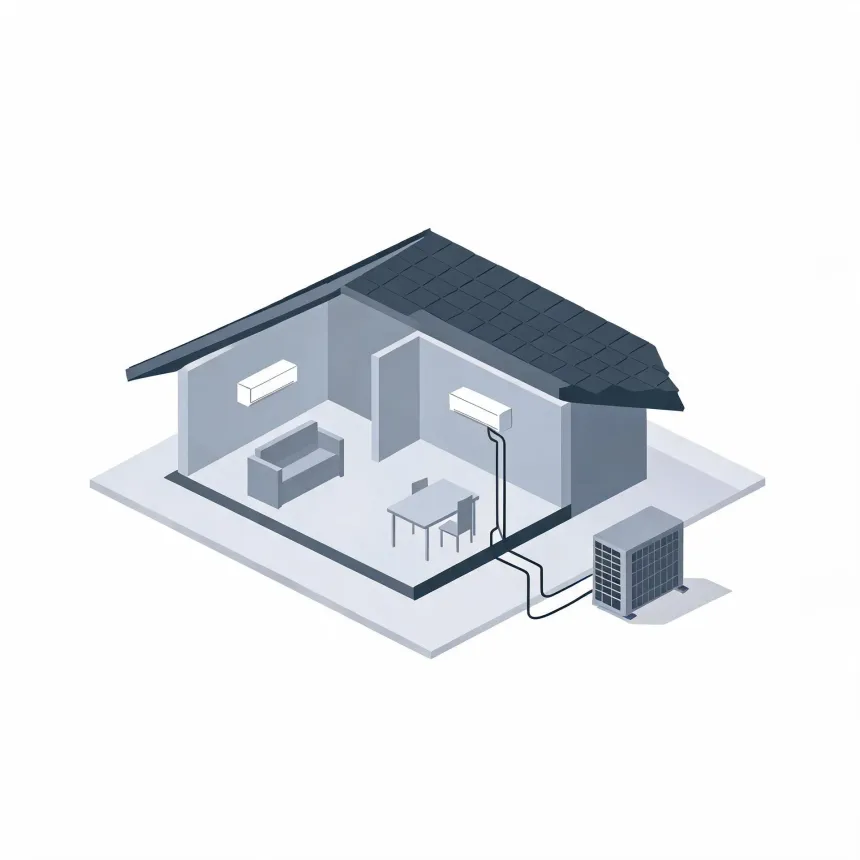
A mini-split moves heat through a line set connecting the indoor head to the outdoor condenser, and that line set has to be the length and diameter the manufacturer specs for that unit. Too long a run, or too many bends, and the refrigerant charge that was right at the factory is no longer right once it's installed. The charge then has to be weighed in or adjusted on site, not just hooked up and switched on. A system charged wrong runs harder to do the same job, and that shows up for as long as the unit is in the wall.
An indoor head needs clear air in front of it and space around it to pull air in and push it back out. Mounted too close to a ceiling corner, blocked by furniture, or facing straight into a wall, it has to work harder to move the same air through the room. The outdoor unit needs the same consideration: airflow across the condenser coil, clearance from fences or shrubs, and a spot that doesn't trap hot exhaust air back into its own intake. None of that shows up on a spec sheet. It comes down to where the installer decides to put each half of the system.
The efficiency number on the label is a ratio, not a guarantee. It tells you how much heat the unit moves for the power it draws under test conditions, same as a mileage sticker on a car. Run the unit outside those conditions and the real number shifts, sometimes a lot. A unit caked with dust on the coil, low on refrigerant charge, or starved for airflow will draw the same power and move less heat, no matter what the label says. That number also only holds if the installer sizes and sets up the system to match it. A mini-split that's oversized for the room or charged wrong never runs the way its rating promises, even brand new. The label tells you what the equipment is capable of. Whether it actually runs that way comes down to the install and what happens to it afterward.
An install day has an order to it, and skipping steps is how a system ends up running worse than its rating. The line set gets cut and run first, then the lines get purged with nitrogen and pressure tested before anything is charged. That pressure test matters because a joint that leaks slowly can pass a quick glance and still bleed refrigerant for months. Once the lines hold pressure, the system gets pulled into a vacuum to clear out moisture and air, since either one left behind turns into acid or ice inside the lines over time. Only after that does the refrigerant go in, weighed to the amount that line length calls for. The last part is airflow, checking that the indoor head throws air where the room needs it and the outdoor unit has room to breathe. Each step depends on the one before it holding up.