





A lit craftsman-style house at night on a wet residential street lined with evergreen trees.

Mini Split Installation in Eureka, CA

Tell us about the job

Takes about a minute. No obligation.

New system or replacementMini-splitHumboldt County, CA
Step 1 of 2

What ZIP code is the job in?

Humboldt County saw 282 severe weather events between 2015 and 2024. Most of that was wind and winter storms, 145 damaging wind events and 115 winter storms, with 21 hail events and one tornado mixed in. An outdoor condenser sits outside through all of it, taking wind-blown debris and hail. Statewide, 17% of households went at least a day without power in 2024. A mini-split with a heat pump keeps you warm or cool only as long as the power stays on, same as any gas furnace blower or electric water heater.

8 months
October through May, your system heats
37°F
the average winter night it heats against
79°F
the average summer afternoon it cools against
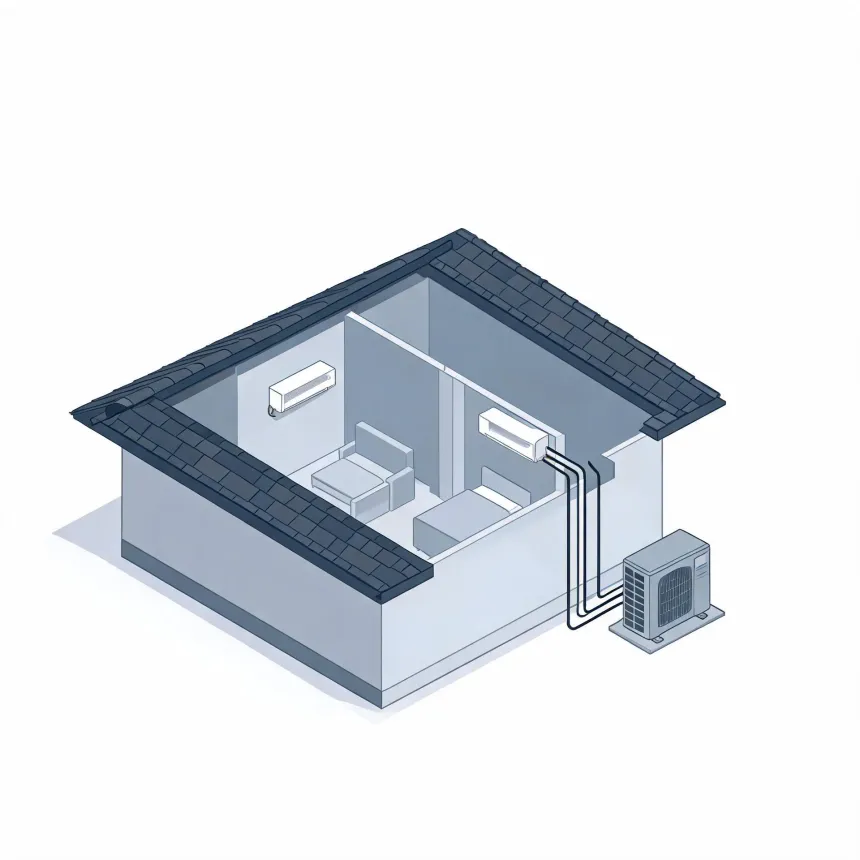
Isometric illustration of a cutaway house with tiled roof showing two wall-mounted indoor mini-split units connected by line sets to an outdoor condenser beside the building.

Gas heats 55.5 percent of homes in Humboldt County.

A mini-split works alongside that furnace instead of replacing it, so the house still has heat when the power is out.

Every kilowatt-hour here costs more, so a unit running wrong wastes more

Power here costs 38.43 cents per kilowatt-hour
Climate zone 4C
Summer afternoons average 79°F
An Older House Needs a Unit That Fits ItHalf the homes in Humboldt County were built in 1973 or earlier.

Humboldt County falls under zone 4C in the 2021 energy code, a marine climate that asks real work of both heating and cooling. That sets a floor on what a contractor can install. Any mini-split manufactured from January 2023 onward has to clear federal minimums as a split-system heat pump: at least 14.3 Btu of cooling for every watt-hour it draws over the summer, and at least 7.5 Btu of heat for every watt-hour over the winter. Ductless systems get no separate category or lower bar. A unit that meets those numbers may also qualify for the federal tax credit available on qualifying heat pumps.

Plan the install around the outages, not just the weather

Get the outdoor unit placed where debris and wind have less of a shot at it, and ask about surge protection before the install, not after a storm takes something out. If you're adding a mini-split alongside the furnace, you've already got a backup for heat. Worth asking what keeps the mini-split itself running, or usable, when the power drops.

Find a contractor
A man seen from behind in a dark jacket, tan work pants and boots climbs wooden porch steps toward an orange front door, carrying a waxed canvas tool bag, with a potted shrub beside the entry.
A white outdoor air conditioner condenser unit mounted on metal wall brackets against gray horizontal siding, with a blue sky and white clouds behind it.

Sized for the house you have, not the one on paper

That house, if it's on the older half, means a contractor doing this install has to size the unit around what the house already is, not the other way around. A heat loss and heat gain calculation for the rooms you're conditioning tells a contractor what the house needs. Square footage alone doesn't. Where the line set can run and where the outdoor unit can sit both depend on a layout that was already built before this equipment existed. Get the sizing wrong and the unit either short cycles or runs constantly, and either way it's fighting the house instead of working with it.

The Line Set Run Sets Real Limits

The outdoor condenser connects to each indoor head through a refrigerant line set, and that run has a maximum length and a maximum number of turns before the system starts losing capacity. A contractor has to find a path between where the condenser can sit and where each head goes, through walls or along an exterior, and that path decides how much labor the job takes. A short straight run costs less to install than one that has to snake around a roofline or climb multiple floors.
One Head Costs Less Than Four

A single-zone system has one indoor head tied to one outdoor unit, and that's the simplest version of this job. Multi-zone systems split one outdoor condenser across several indoor heads, each one controlling its own room, and each added head means another line set run, another mounting location, and another spot where the installer has to get the refrigerant charge right. More zones means more precision at every joint, not just more equipment.

The old system doesn't have to come out before the new one goes in, and in a lot of installs it doesn't come out at all. A mini-split can run alongside an existing furnace, each one covering what it's better at. If a system is being fully replaced, though, a few things need doing right. Refrigerant has to be recovered from the old lines, not vented, and that's true whether it's a window unit, a central system, or another mini-split coming out. Old line sets usually aren't reused. They've been sized and routed for different equipment, and the flare fittings and insulation degrade over years of expansion and contraction, so a new run gets pulled rather than tied into what's already there. If the old system used ductwork and the new one won't, those ducts don't need to come out, but they do need to be sealed off so conditioned air isn't leaking into a space nobody's using anymore.

A mini-split with a high efficiency rating draws less power to move the same amount of heat or cool air, and on a bill where every kilowatt-hour already costs more, that difference shows up every month, not just once. The federal minimums set a floor, but installers carry models that clear it by a good margin, and that's worth asking about before you settle on equipment. Ask what SEER2 and HSPF2 numbers a contractor is quoting you, not just the tonnage. A unit sized right for the rooms it's conditioning also runs more efficiently than one that's oversized or undersized, since either mistake means it's cycling on and off or running flat out to keep up. Getting the sizing and the equipment right at install is the one chance to control what this system costs to run for as long as you own it.