Electricity here runs 31.97 cents a kilowatt-hour
California power costs more than it does in most states. A mini split that draws less power to do the same heating or cooling shows that difference on every bill, month after month.
Takes about a minute. No obligation.
California power costs more than it does in most states. A mini split that draws less power to do the same heating or cooling shows that difference on every bill, month after month.
With power priced this high, the gap between a mid-efficiency mini split and a high-efficiency one matters more in Modesto than it would somewhere with cheaper electricity. Compare the ratings before deciding on a system.
NOAA nClimDiv, 1991–2020 normals
Utility gas heats 66.1% of homes in Stanislaus County.
A mini split here usually goes in alongside that furnace, or in a room the ducts never reached.




Taking out the old system depends on what it is. A window unit or a through-wall sleeve comes out in an afternoon, patched over and done. A full split system, with an outdoor condenser and an indoor air handler, takes more care. The old refrigerant has to be recovered, not vented, since the line set and coil are under pressure and the refrigerant inside is regulated. Once that's done, the condenser, the indoor coil and any old line set get disconnected and hauled off. If the new mini split is replacing a window unit, there's no ductwork to deal with. If it's replacing a central system, the old ducts may stay in place for other rooms or get capped off where they're no longer needed. Either way, the old equipment doesn't need to run again once it's out, so there's no reason to keep it around.
Get the rating right before the system goes in, since that's the number you're stuck with on every bill after. Ask the contractor to show you the efficiency rating side by side with what it costs installed, not just the install price alone.
Find a contractorFive months of cooling, afternoons near 91, every year this system runs. That kind of load points straight at sizing. A mini split too big for the room cycles on and off instead of holding steady, and one too small just runs flat out the whole afternoon without catching up. Ask the contractor for a load calculation on the room, not a guess based on square footage. Ask what the compressor is rated to handle at that outdoor temperature, since that's the number it has to meet here, not in a milder place.
A load calculation looks at the room itself. Window area, wall area, what's on the other side of each wall, the ceiling height. Square footage alone leaves too much out. A room with a west-facing window and a room the same size with no window don't carry the same load, and sizing off floor space treats them as if they do.
With a furnace, oversizing is forgiving in a way it isn't here. A mini split that's too big for the room satisfies the thermostat fast, shuts off, then kicks back on a few minutes later. That cycling wears on the compressor more than running steady does, and the room swings between cool and warm instead of holding one temperature.
The equipment is only part of what sets the price. Where the indoor and outdoor units sit matters just as much. Run a line set across a wall, around a corner, up through an attic, and the labor climbs with every extra foot of refrigerant line and wire. A straight shot between indoor and outdoor units costs less than a run that has to snake through finished walls or a tight crawlspace. The electrical side counts too. A mini split needs a dedicated circuit, and if the panel has no room left or sits far from where the unit goes, that work adds to the job before the system itself is even mounted. Multi-zone systems, where one outdoor unit feeds several indoor heads, cost more than a single zone, since each head needs its own line set and its own mount. None of this shows up until someone actually walks the space and figures out where the lines have to go.
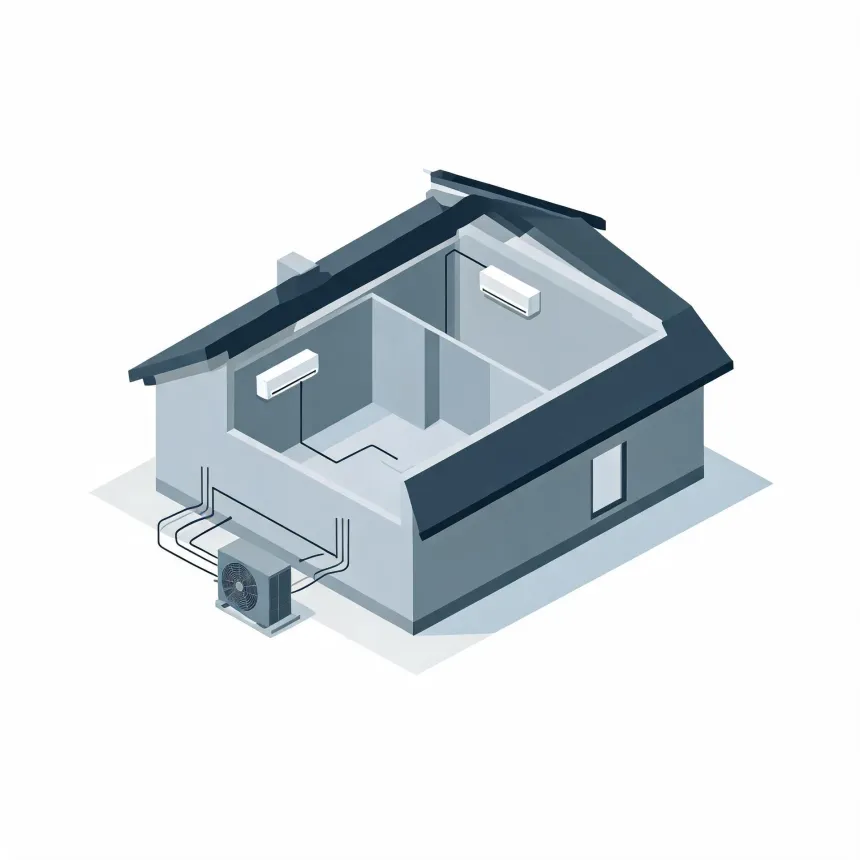
Installation day starts outside, with the outdoor unit set on a pad or bracket somewhere level and clear of anything that blocks airflow. Indoors, the mounting plate goes up first, and the installer runs a small hole through the wall for the line set, the refrigerant lines, drain line and electrical wiring bundled together. That line set connects the indoor head to the outdoor unit, gets charged with refrigerant, then pressure tested before anything is powered on. A vacuum pump pulls moisture and air out of the lines, since any left behind turns to acid or ice once the system runs. Once that holds, the electrical connections get made, the system gets powered up, and the installer checks airflow at the head and proper temperature split between the air going in and the air coming out. Nothing gets left for later. By the time the crew packs up, the system should already be holding whatever temperature it's set to.