Electricity here runs 38.55 cents a kilowatt-hour
That is higher than what most counties in the country pay. A mini-split that cycles on and off the way it should will cost less to run than one left to struggle through a setting it can't quite hold.
Takes about a minute. No obligation.
That is higher than what most counties in the country pay. A mini-split that cycles on and off the way it should will cost less to run than one left to struggle through a setting it can't quite hold.
Salinas doesn't ask a mini-split to run as many hours as homes in muggier places do. But each one of those hours is billed at a higher rate, so an undersized or poorly matched unit shows up fast on what you pay.
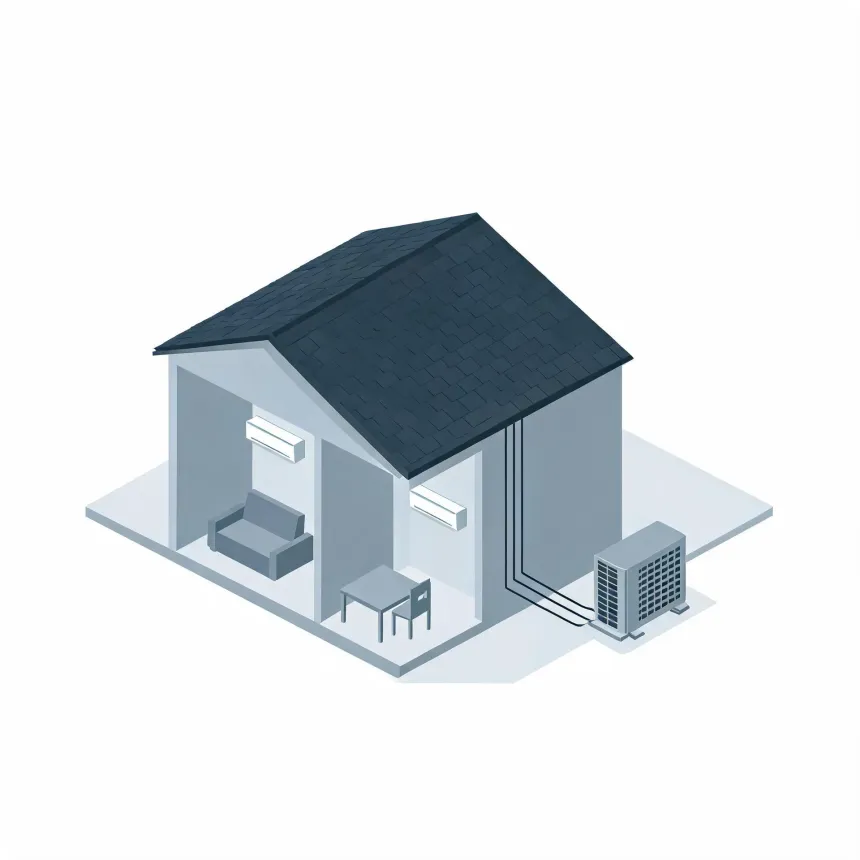
NOAA nClimDiv, 1991–2020 normals
Cooling in Salinas starts in July.
Get the mini-split installed by June and it's running on day one of the heat, not somewhere in the middle of it.



Monterey County falls in climate zone 3C, the mild marine band under the 2021 energy code. Any mini-split put in here has to meet the federal minimum for a split-system heat pump: at least 14.3 Btu of cooling for every watt-hour it draws over the summer, and at least 7.5 Btu of heat for every watt-hour over the winter. That floor applies to the unit whether it's ductless or not. It sets what can legally go on the wall, not what's worth buying. Given what power costs here, a unit that only clears the minimum will cost more to run than one built to beat it.
A mini-split only pays you back on power this expensive if it's matched to the room and installed the way the manufacturer specs it. That part is worth getting right before anything goes on the wall.
Find a contractor
Whatever is heating or cooling those rooms now doesn't just disappear once the mini-split goes in. If it's a window unit, it comes out of the window. If it's an old wall furnace or electric baseboard serving that space, a licensed contractor can disconnect and remove it, cap the gas line or make the wiring safe. None of that gets left half done, because an abandoned gas line or a live wire behind a wall is not something to leave for later. A mini-split can also just add capacity to a room that had nothing dedicated to it before, in which case there's nothing to remove at all. Either way, the old equipment's condition doesn't affect whether the new one gets sized and installed correctly. That's decided by the room, not by what used to heat it.
The indoor head connects to the outdoor unit through a refrigerant line set, and that run has to be sized and charged for its actual length. A longer run between a wall mount and where the condenser sits means more refrigerant, a bigger line set diameter past a certain distance, and more labor to insulate and secure it along the way. Where the outdoor unit can go, and how far it is from the room being served, moves the cost before anything else does.
A mini-split needs a dedicated circuit back to the panel, not a shared outlet. If the panel has room and the run to it is short, that's a straightforward add. If the panel is full or sits on the far side of the house, the installer is pulling new wire a longer distance or dealing with a subpanel first. None of this shows up until someone opens the panel, which is why two homes with the same unit on the wall can take very different amounts of work to wire.
Comparing two mini-splits on the number painted across the box tells you almost nothing. Ask what the rated output is at the coldest and hottest temperatures the unit will actually see, not just at the mild test point manufacturers use for the headline rating. Some units hold most of their capacity as it gets colder outside. Others fall off hard right when the demand is highest, and still run, just at a fraction of the output you're paying for. Ask how the system modulates, whether the compressor actually ramps down for a mild afternoon or just cycles fully on and off like a window unit. Ask what sound rating applies to the indoor head at its lowest fan speed, since that's the speed it runs most of the time. And ask what the warranty covers if the compressor or the board fails, and whether it requires the installer who put it in to be the one who services it later.
Installation day starts outside, not in. The contractor picks a spot for the outdoor unit with clearance on all sides so it can pull air through the coil and push it back out again. Inside, the wall mount goes up high, on a stud or a bracket solid enough to hold it, away from direct sun on the thermostat sensor and clear of anything that would block the airflow across the room. A hole gets drilled through the wall for the line set, the refrigerant lines, the electrical wiring and the condensate drain, all bundled together and run from the indoor head to the outside unit. The lines get connected, then the system gets evacuated with a vacuum pump to pull out air and moisture before any refrigerant is released into them. Skip that step and moisture left in the lines turns to acid over time and eats at the compressor from the inside. Once the vacuum holds, the installer checks the charge against what the line length calls for, tests the system on both heat and cool, and confirms the condensate drains the way it should instead of backing up into the wall.