A row of stucco houses with red clay tile roofs seen from behind a tall beige stucco wall, framed by overhanging oak branches and shrubs in the foreground.

Mini Split Installation in San Jose, CA

Tell us about the job

Takes about a minute. No obligation.

New system or replacementMini-splitSanta Clara County, CA
Step 1 of 2

What ZIP code is the job in?

Electricity here runs 36.42 cents a kilowatt-hour

That is higher than what most counties in the country pay. A mini-split that cycles on and off properly instead of running flat out costs less to own here than almost anywhere else, because every kilowatt it pulls is priced higher.

Every hour of runtime costs more here

San Jose summers are mild enough that a mini-split logs fewer hours than it would in a hotter state. That doesn't cancel out the high electric rate. It means the hours it does run need to count, so the install and the sizing matter more here than the season does.

7 months
November through May, your system heats
3 months
July through September, it cools
39°F
the average winter night it heats against
82°F
the average summer afternoon it cools against
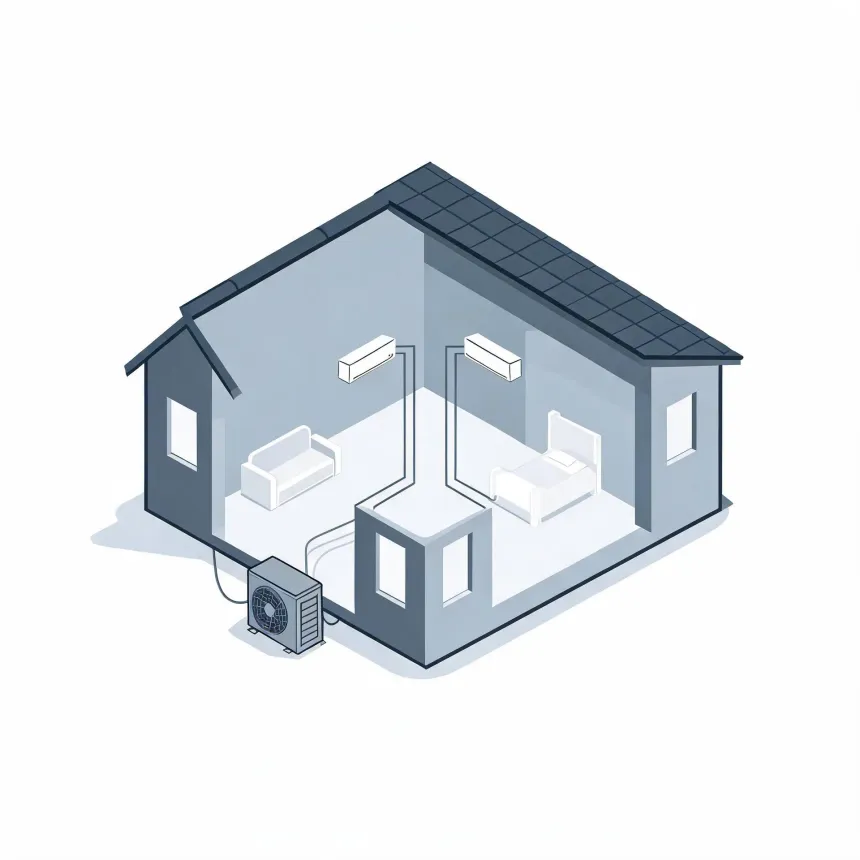
Isometric cutaway illustration of a small house showing two wall-mounted indoor air conditioning units connected by lines to a single outdoor condenser unit beside the building, with a sofa in one room and a bed in another.
Your system heats November through May and cools July through September.

NOAA nClimDiv, 1991–2020 normals

Cooling here doesn't start until July.

A mini-split put in before June gets set up and tested with nothing riding on it yet.

Gas heats most homes here, which makes a mini-split the exception, not the replacement

58.5% of homes heat with gas
Cooling runs July through September
Summer afternoons average 82°F

Santa Clara County falls under zone 3C in the energy code, the warm marine zone, and any mini-split installed here has to meet the federal split-system minimums that come with that. A unit built from 2023 onward needs to pull at least 14.3 Btu of cooling for every watt-hour it uses, and at least 7.5 Btu of heat per watt-hour on the heating side. Those numbers set a floor. They don't pick the unit for you, but they rule out anything that can't clear them, so part of what you're comparing when you compare systems is already decided before you start looking.

A mini-split sized right earns back that electric rate on every bill

Get the sizing and install right and that rate works for you instead of against you. Every kilowatt this unit pulls costs more here than almost anywhere else, so a system matched to the room and installed correctly is what keeps those hours cheap.

Find a contractor
A beige split-system air conditioner outdoor condenser unit mounted on metal wall brackets atop a stucco wall.

What the install decides before the unit ever turns on

How long a mini-split lasts and how well it holds its output comes down to two things: how it was sized and how it was set up on day one. A unit too big for the room cycles on and off fast, and every start draws more power than the run that follows it. A unit too small never gets ahead of the load, so it runs long and hard and leans on the compressor the whole time. Either way the equipment is working against itself before it's worked a single full season. The line set matters too. Every joint the refrigerant passes through is a place it can leak slowly, and a system low on refrigerant loses capacity without showing an obvious fault, it just quietly costs more to run the same job. None of this shows up on a spec sheet. It shows up months later, in how hard the unit has to work to hold a room at temperature.

Ask what the load calculation found

A mini-split should be sized off a room-by-room load calculation, not a rule of thumb based on square footage. The person doing the calculation needs to account for windows, insulation and ceiling height. If nobody can show you the numbers behind the sizing, the unit was guessed at, not sized.

Ask how many indoor heads run off one outdoor unit

A single outdoor compressor can run one indoor head or several, and the more heads tied to it, the less capacity is available to any one room when several run at once. If you're comparing a single-zone setup against a multi-zone one, ask how the system behaves when every head calls for cooling at the same time, not just when one does.

The outdoor unit sits outside year round, and this county doesn't get a quiet stretch to count on. Weather tracked 298 severe events between 2015 and 2024, and damaging wind alone hit 257 times in that same stretch. Hail isn't rare here either, with 33 events over that period, enough to matter when the outdoor unit has nothing covering it. Statewide, 17% of households lost power for a full day or more in 2024. A mini-split that loses power loses both heat and cooling at once, since it's running both off the same outdoor unit. Where that unit goes, and what sits between it and the weather, is worth deciding before it's bolted down.

Give the outdoor unit something between it and the weather, a mounting spot with an eave or overhang above it rather than open sky. That alone cuts down what hail and wind-blown debris can do to the coil and fan. Mount it up on a bracket or pad rather than down where runoff and storm debris collect. Since gas heats most homes in the county, an outage here usually doesn't take the furnace down with it, but it does take down the mini-split, heat and cooling both, since one outdoor unit runs both sides. If this system is covering a room that depends on it, like one without a working gas line or vent, ask the installer about backup power for that scenario before deciding it doesn't apply to you.