Winter storms are the norm here
El Dorado County logged 449 winter storm events between 2015 and 2024. The outdoor unit needs a spot where it won't sit under a snow drift or take debris off the roofline.
Takes about a minute. No obligation.
El Dorado County logged 449 winter storm events between 2015 and 2024. The outdoor unit needs a spot where it won't sit under a snow drift or take debris off the roofline.
Statewide, 17% of California households lost power for 24 hours or more in 2024. A mini split needs electricity to run, so if backup power matters to your household, that's worth deciding before installation, not after.
NOAA nClimDiv, 1991–2020 normals
Cooling only runs two months a year here, July and August, with afternoon highs around 83°F.
A mini split sized for Tahoe summers doesn't need to be the top efficiency model on the market.




No single fuel dominates heating here. Gas heats 34.3% of homes in El Dorado County, propane heats another 27.4%, and electricity heats 21.6%. A mini split is a straightforward add to a propane or gas household, since it runs on electricity and doesn't touch the existing furnace or lines. Plenty of homes here already split their load this way, electric for part of the year, gas or propane for the rest. If your house is one of the 21.6% already heating with electricity, a mini split can likely take over more of that work.
El Dorado County is zone 4B, and any mini split installed here, ductless or not, has to clear 14.3 SEER2 for cooling and 7.5 HSPF2 for heating under the federal standard. That rules out the low end of the market before you start comparing units.
Find a contractorTwo months of real work a year is not much for a mini split to carry. Even through July and August, afternoon highs here average 83, nothing close to desert heat. That's a light load compared to what these systems handle in most of the country. Put the money toward a unit that's built well and sized right for the rooms it covers, not the one with the highest efficiency number on the sticker.
If a furnace, boiler or baseboard system is being replaced outright, it has to be disconnected and hauled out, and if it runs on gas or propane, the line serving it has to be capped off properly rather than left as is. If it's staying in place as backup or for the rest of the house, it just needs to be left functional and out of the way of the new indoor and outdoor units.
Ductless systems run refrigerant lines to each indoor head, so existing ducts can usually stay exactly as they are, serving whatever they already serve, or get capped off if the old furnace or central air is coming out entirely. Either way, nothing about the duct run itself has to change for the mini split to work.
Every mini split on the market will heat and cool. What separates them is how they do it when the weather turns hard. Ask what the unit's rated output looks like at low outdoor temperatures, not just at a mild setpoint, since some systems lose real capacity in the cold and some are built to hold it. Ask how many indoor heads the outdoor unit can run and whether it still hits that rating at full load, not just on paper. Ask about the compressor, whether it's a variable speed type that can throttle down for a mild afternoon and still ramp up hard when it needs to, or a single stage unit that just runs full blast or not at all. And ask what the warranty actually covers, parts, compressor, and labor, since those often come from different sources and run for different lengths.
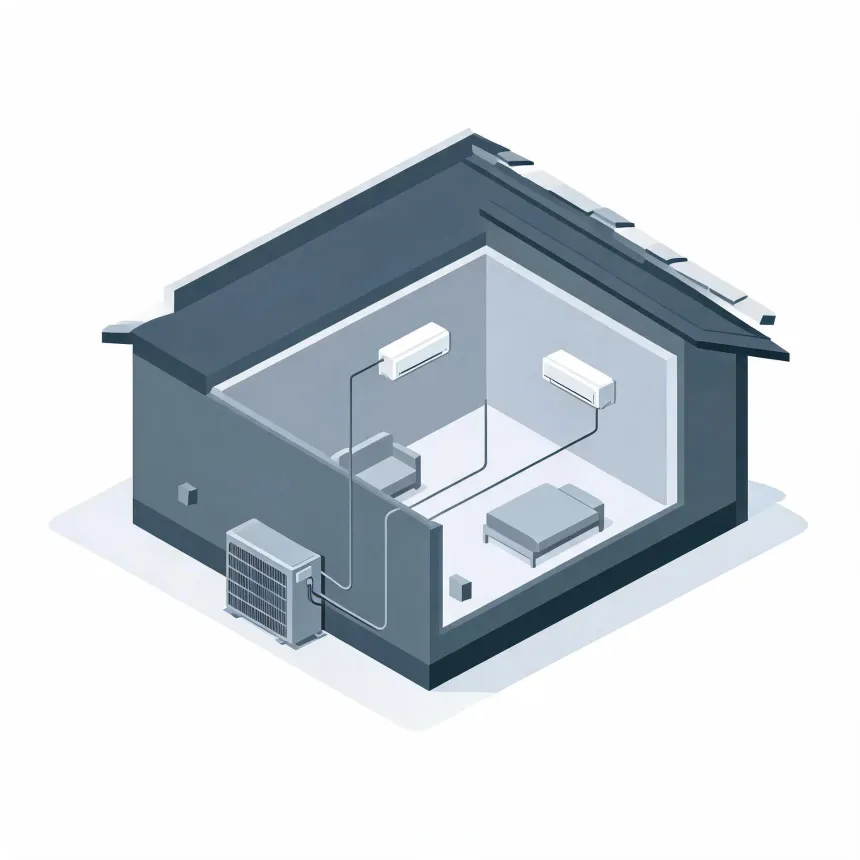
Installation day starts with the outdoor unit placement and the indoor head position, since the refrigerant line set connecting them has to run through a wall, and that path gets drilled before anything else happens. The line set, a drain line, and an electrical cable all run through that same hole, usually hidden behind a cover plate afterward. Once the lines are run, the system gets evacuated with a vacuum pump to pull out air and moisture, because any left behind will weaken the system's heating and cooling once it's charged with refrigerant. That vacuum has to hold for a stretch before the lines get opened to refrigerant, so a tech isn't standing at the unit the whole time waiting on it. The last steps are mounting the indoor head, wiring the outdoor unit to power, and running the system through both heating and cooling to check it holds temperature and the line connections aren't leaking.