Electricity here runs 31.97 cents per kilowatt-hour
California power costs more than it does in most of the country. A mini split that sits in the low end of its efficiency range will show that difference on every bill it touches.

Takes about a minute. No obligation.
California power costs more than it does in most of the country. A mini split that sits in the low end of its efficiency range will show that difference on every bill it touches.
Mini splits vary in how much heat or cooling they move per watt. At Stockton rates, the gap between a unit near the bottom of that range and one near the top is worth asking a contractor to walk through before you pick a system.
NOAA nClimDiv, 1991–2020 normals
Stockton asks a mini split to run five months straight, June through August averaging 91°F in the afternoon.
A unit sized for a milder climate will struggle to keep up on the hottest stretches.



Cooling starts in May here, so April is the month to get a mini split in. That gives a contractor time to size the system right and schedule the work before the first hot week hits, instead of fitting you in between emergency calls. Once summer starts, San Joaquin runs cooling five months straight, through September, and a unit put in under pressure is more likely to get rushed. Spring is also when installers have room to walk through the efficiency question properly, rather than just getting something running before the heat sets in.
Any mini split installed here now has to clear 14.3 SEER2 and 7.5 HSPF2, the federal minimum for split-system heat pumps. That floor narrows the field before you even start comparing units. A federal tax credit is available on qualifying systems, which helps offset choosing one that sits well above the minimum rather than right at it.
Find a contractorThe old system does not get sold or reused. Whoever installs the new one disconnects the line set, recovers whatever refrigerant is still in it, and hauls off the indoor heads and the outdoor unit. Refrigerant cannot just be vented into the air. It has to be captured, so that step belongs in the removal even if nobody brings it up first. Coming off a window unit means patching where it sat. Coming off central air means capping ductwork that will not be used the same way once the mini split takes over. Ask what happens to the old unit and whether taking it out is part of the quote or billed on top of it.
A technician runs the unit at a steady, ideal load to get that number. Your house never sits still like that. The system cycles on and off, pushes against a dirty filter, fights a closed vent. Every one of those things pulls the real result below the number on the label. The rating tells you what the unit is capable of under perfect conditions, not what it will actually deliver.
A single mini split's efficiency number does not tell you much on its own. Line it up against another unit sized for the same room, and now it means something. The one with the higher rating moves the same heat or cooling using less electricity to do it. That comparison is the whole point of the number. It is a way to judge one unit against another, not a promise about what your bill will look like.
A few questions tell you more than any brochure. Ask how many zones the system supports and whether the outdoor unit can actually run them all at once without one room starving another. Ask what happens at low load, whether the compressor can slow down to match a mild afternoon or just cycles on and off like a window unit. That matters more than the top-end number, because most of the year it's running well below full output. Ask who sizes the unit and how, since a system picked by square footage alone often misses what the room actually needs. And ask what the warranty covers if the install is done by someone other than who sold you the equipment, because some manufacturers tie coverage to that.
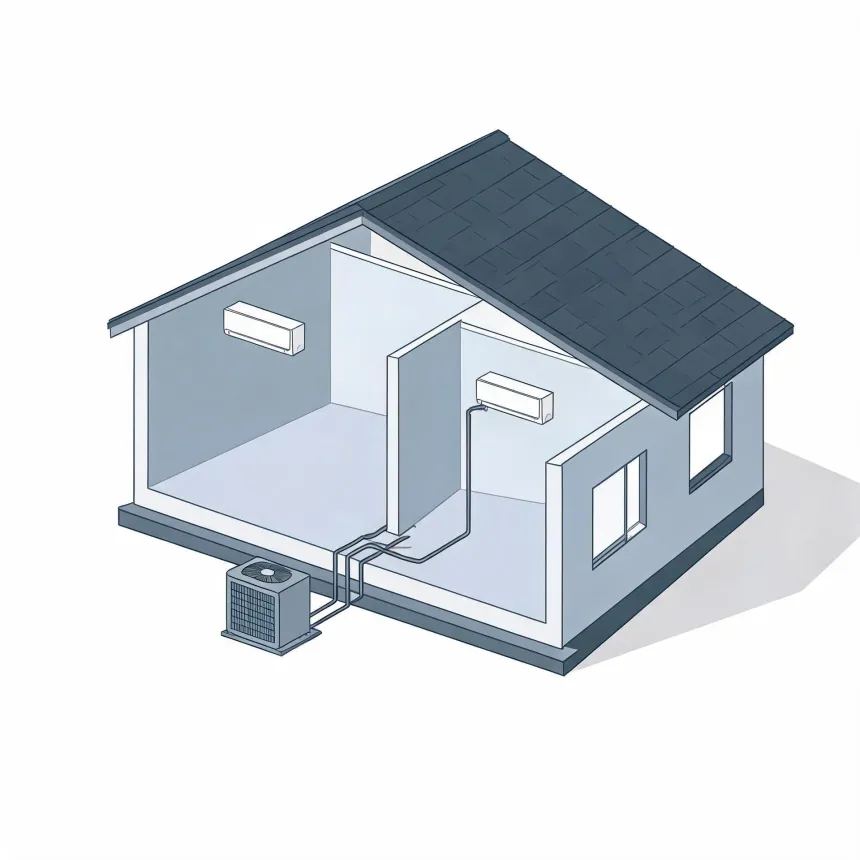
Installation day starts with the outdoor unit and where it sits. The crew mounts it on a pad or brackets, away from anything that blocks airflow around it, and runs the line set from there to each indoor head. That line set carries refrigerant, so the connections get flared and pressure tested before anything is charged. A tech pulls a vacuum on the lines to clear out moisture and air, because either one left behind will wear on the compressor over time. Each indoor unit gets mounted on its own wall bracket, leveled, and connected to power and the line set through a small hole in the wall. Once everything is in place, the system gets charged with refrigerant to the weight the manufacturer specifies for that line length, then run through a cycle to check that every zone is actually cooling and heating before the crew leaves.