Lit white stucco buildings with terracotta roofs nestled among oak trees on a dry hillside under a deep blue night sky.

Mini Split Installation in Ukiah, CA

Tell us about the job

Takes about a minute. No obligation.

New system or replacementMini-splitMendocino County, CA
Step 1 of 2

What ZIP code is the job in?

No single fuel dominates here

Gas heats 28.7% of homes in Mendocino County, electricity 22.2%, and propane 21.5%. A mini split doesn't ask which one you have now. It runs on its own circuit and takes over the job regardless of what's heating the house today.

That matters for this job

A mini split installed here is likely replacing a gas or propane furnace, or adding cooling to a house that never had it. Either way, the install means new electrical work and a line set run to an outdoor unit, not a swap of one gas appliance for another.

8 months
October through May, your system heats
2 months
July through August, it cools
37°F
the average winter night it heats against
81°F
the average summer afternoon it cools against
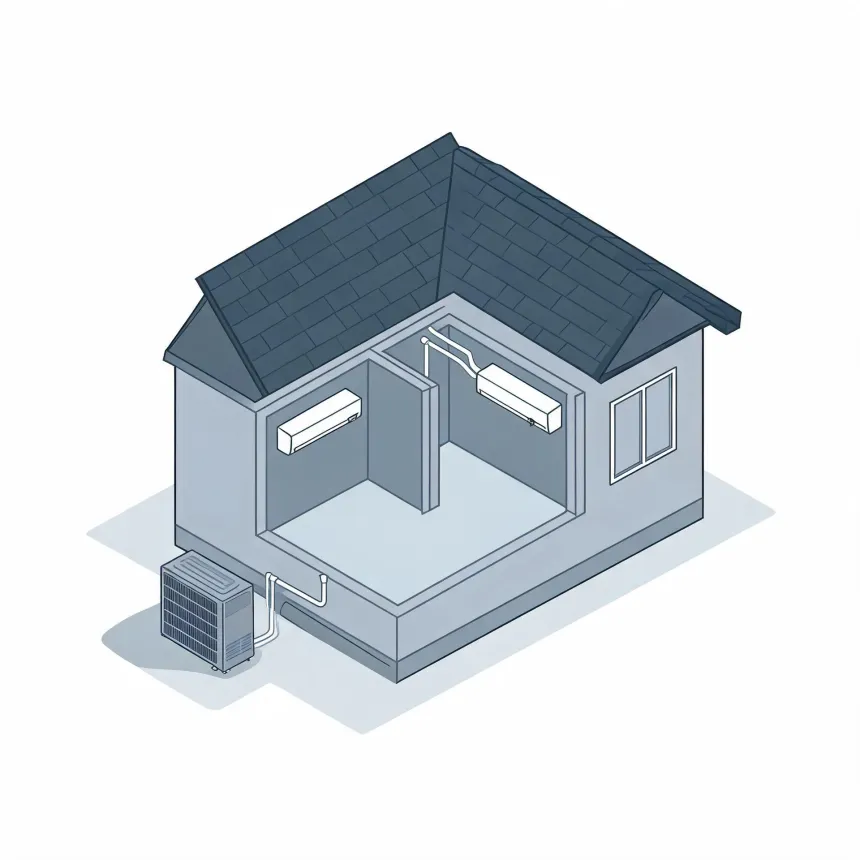
Isometric line illustration of a cutaway house with a shingled gable roof, showing two wall-mounted indoor air conditioning units connected by piping to an outdoor condenser unit on the ground outside.
Your system heats October through May and cools July through August.

NOAA nClimDiv, 1991–2020 normals

Cooling here only runs July through August.

Get the install done before July so the crew isn't working around a heat wave.

A standard mini split handles Ukiah summers fine

Half the homes here were built by 1977
Cooling runs July through August
Summer afternoons average 81°F

Two months of cooling a year is not much work for a mini split. July and August average 81°F in the afternoon here, which is a moderate load, not the kind of heat that pushes a system hard day after day. The rest of the year the unit sits idle or handles light heating. That kind of duty cycle means a mid-range system holds up fine here. You don't need to pay for the highest efficiency tier to get a unit that lasts. What matters more is a clean installation, with the line set sealed properly and the outdoor unit mounted where wind won't stress it. Mendocino County has seen damaging wind dozens of times over the past decade, so the mount matters as much as the model.

A right-sized mini split is the cheaper one to run here

Electricity here runs 31.97 cents per kilowatthour, on the high side, which is more reason to size this right rather than oversize it. A standard mid-range mini split matched to the load costs less to run than a bigger unit working under its capacity. Get the sizing and the install right now and that's settled.

Find a contractor
A man in a brown jacket, dark pants, boots and a cap walks up porch steps toward an open orange door, carrying a canvas tool bag beside a potted shrub.
A beige split-system air conditioner outdoor condenser unit mounted on metal wall brackets atop a stucco wall.

Light duty, most of the year

Two months of real work a year, and nothing in that stretch runs the unit hard. That's a system that spends most of its life idle or on light heating duty. When it's time to pick the model, let the contractor spec a mid-range unit sized to the room instead of the top tier. The install is what carries the weight here. A tight line set and an outdoor unit mounted somewhere the wind can't get at it matter more than which name is on the box.

The number of zones sets the price

A single indoor head tied to one outdoor unit costs less than a system feeding several rooms. Each added head means another line set run, another spot to mount indoor equipment, and more work balancing airflow so every room gets its share. Planning for extra zones in the first install costs less than adding them later.

Where the outdoor unit sits changes the labor

A straight line set run from indoor head to outdoor unit is the easy case. Running it through an attic, down an exterior wall, or around the shape of the house adds length and adds labor. The electrical work follows the same pattern. A panel with room for a new circuit is a quick tie-in. A panel that's already full needs work done before the mini split gets power at all.

Sizing a mini split comes down to matching output to the room it's heating and cooling, not the square footage alone. A contractor works out the load by looking at window area, insulation, ceiling height, and which way the room faces, then picks a unit that can cover that load without straining. Oversize it and the unit short cycles, kicking on, satisfying the thermostat fast, and shutting off again before it's pulled any humidity out of the air. That leaves rooms feeling cool but damp. Undersize it and the unit runs constantly, trying to keep up and never quite getting there, which wears on the compressor over time. A correctly sized system instead runs in long, steady stretches and holds a room at an even temperature. This is why a good contractor measures the room instead of guessing from a chart.

The efficiency rating on a mini split's label tells you how much heat it moves for the electricity it uses, and a higher number means a lower power bill for the same amount of comfort. But that rating only plays out if the unit is sized and installed right. A high-efficiency unit that's too big for the room still short cycles, and a well-matched mid-range unit beats an oversized top-tier one every time. The rating also doesn't account for ductwork or line set losses, since a mini split's whole advantage is skipping ducts and running refrigerant straight to the room. Think of the rating as a ceiling on efficiency, not a guarantee of it. What gets you there is a tight, well-sealed install feeding a unit that matches the load.