A gray tabby cat sleeps curled up on a dark gray bed in a dimly lit modern bedroom with warm ceiling cove lighting and a wall-mounted air conditioning unit.

Mini Split Installation in Visalia, CA

Tell us about the job

Takes about a minute. No obligation.

New system or replacementMini-splitTulare County, CA
Step 1 of 2

What ZIP code is the job in?

Storms here aren't rare

Tulare County logged 346 severe weather events between 2015 and 2024, including 191 damaging wind events and 149 winter storms. A tornado touched down once in that stretch, and hail hit four times. A mini split installed here will face that weather.

The outage risk is real too

Across California, 17% of households went at least 24 hours without power in 2024. For a mini split, that's a day without heating or cooling. Where the outdoor unit sits and how the system handles an outage both matter here.

8 months
October through May, your system heats
4 months
June through September, it cools
31°F
the average winter night it heats against
84°F
the average summer afternoon it cools against
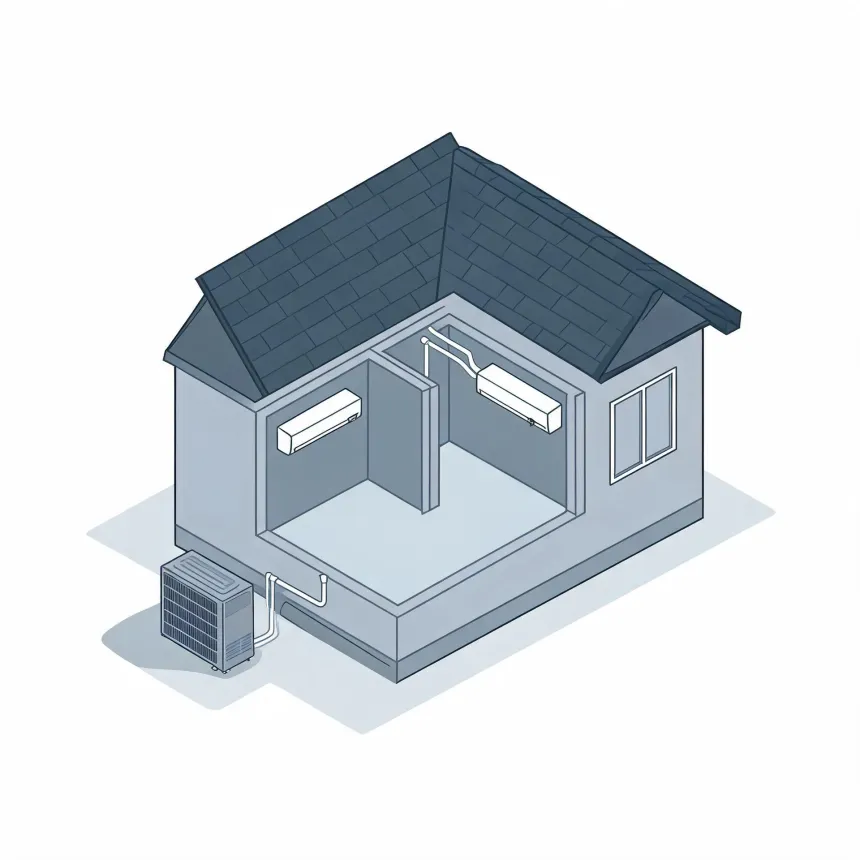
Isometric line illustration of a cutaway house with a shingled gable roof, showing two wall-mounted indoor air conditioning units connected by piping to an outdoor condenser unit on the ground outside.
Your system heats October through May and cools June through September.

NOAA nClimDiv, 1991–2020 normals

Cooling season runs June through September here.

May is the month to get a mini split installed, before the first hot stretch hits.

Most homes here heat with gas, and a mini split has to work alongside that

67.5% of homes heat with gas
Cooling runs June through September
Summer afternoons average 84°F

Tulare County falls under climate zone 3B, a warm zone with a long cooling season and a short, mild winter. Any mini split installed here has to meet the federal minimum for that kind of equipment. Units built from 2023 onward must deliver at least 14.3 Btu of cooling for every watt-hour of power they draw over the summer, and at least 7.5 Btu of heat per watt-hour over the winter. That standard applies to the whole system, not just the indoor head. It narrows the field some, but it also means whatever goes in has a floor on how well it has to perform here.

Plan for the outage before the install, not during it

Talk through outdoor unit placement with the installer, somewhere sheltered from wind and hail. Ask what the system does when the power drops and comes back. That conversation belongs in the install, not something to work out after a storm already hit.

Find a contractor
A beige split-system air conditioner outdoor condenser unit mounted on metal wall brackets atop a stucco wall.

Day after day, year after year, what it costs starts with how hard it has to work to get in

A mini split's price comes down to how much labor the install takes, not just the equipment itself. Running line set between the outdoor unit and each indoor head is the biggest factor. A short, simple run through an exterior wall costs less than a run that has to go up through an attic, across a long wall, or down multiple floors. Every indoor head needs its own line set, its own power, and its own spot on a wall or ceiling with clearance on both sides. Add a second or third zone and the labor multiplies, not just the equipment. Electrical work matters too. A mini split needs a dedicated circuit, and if the panel doesn't have room for one, that's its own job before the mini split work even starts. Where the outdoor unit goes affects cost as well. A pad on open ground is simple. A wall mount bracket, a stand built up above snow or debris, or a spot that needs extra clearance from windows and walkways all take more time to set right. The length of refrigerant line also matters on its own. Every system ships rated for a certain line length, and running past that means adding refrigerant charge, which is a real step, not an afterthought.

Sizing is a calculation, not a guess from square footage

A contractor works out heat gain and heat loss room by room, looking at window area, insulation, ceiling height, and which way the walls face. Two homes the same size can need different sized systems depending on all of that. Picking a unit off the square footage alone skips the part that actually matters.

Oversized or undersized both cause real problems

A mini split that's too big cools the room fast and shuts off before it pulls the moisture out of the air, so the space ends up cold and clammy. One that's too small runs flat out and never quite catches up on the hottest or coldest days, and that constant running wears on the compressor. The right size runs longer, steadier cycles and holds the temperature without straining.

Electricity here runs 34.62 cents per kilowatt-hour on average, more than in most US counties. A mini split that's sized right and running clean costs less to operate everywhere, but that difference shows up faster on a bill this high. The air here is dry too, with a summer dew point around 42 degrees, so a mini split isn't fighting heavy, moisture-laden air the way it would somewhere humid. That means less work pulling moisture out of the air, and more of what you're paying for goes toward actual cooling. A unit that's struggling, low on refrigerant, dirty coils, a failing part, costs more per hour here than it would somewhere power is cheap. Keeping it running the way it's supposed to matters more in a place like this.

Install day starts with the walk-through, confirming where the indoor heads and outdoor unit go before anyone picks up a tool. The installer mounts the indoor head first, usually high on a wall, then drills a single hole through to the outside for the line set, the wiring, and the condensate drain. That hole gets sealed well, since it's the one new opening in the wall. Outside, the refrigerant lines get connected to the outdoor unit, and the whole system gets evacuated with a vacuum pump to pull out air and moisture before any refrigerant moves through it. That step matters more than people expect. Any moisture left in the lines turns to acid once the system runs, and that shortens the life of the compressor. Once the vacuum holds steady, the installer opens the line and charges the system, then runs it through a cycle to check the temperature split and make sure the head is actually pulling the load it's supposed to.