When to replace a heat pump in San Bernardino, CA

One request ends the search for a heat pump installer.

Hand it over

How do I know when to replace my heat pump in San Bernardino?

Your heat pump handles both your heating and cooling here, and with San Bernardino summers running hot for months at a time, you notice fast when it starts struggling. Maybe it's running longer than it used to, or the power bill jumped higher than the weather explains. Maybe a repair tech already told you the unit is on its last legs. You want a straight answer on whether it's time to replace it or whether it's got more years left.

Replace it once repairs get frequent or your power bills climb despite normal use

A heat pump that needs a repair every summer is telling you the compressor or other major parts are wearing out, and each fix after that gets more likely. If your power bills have gone up while the unit runs more just to keep the house comfortable, it's losing efficiency, and that costs you every month it stays in. Power here is already expensive, so a heat pump running below its original efficiency hits harder on the bill than it would somewhere with cheaper electricity. If a contractor has already flagged a failing compressor or a refrigerant leak, that's usually the point where replacing costs less over time than continuing to repair.

A gray outdoor condenser unit on a concrete pad beside a light green lap-sided house, with a wall-mounted electrical disconnect box, mulch bed with shrubs, river rock, and a paved walkway in the foreground.

Running the way it should

A heat pump that's still earning its keep cycles on, does its job, and shuts off. Airflow is steady, the area around the unit is clear, and the coil fins stay open so the system can shed heat during the long stretch of hot months here.

An outdoor air conditioner condenser unit on a concrete pad beside a house with beige vinyl siding, with a gray electrical disconnect box and insulated refrigerant lines on the wall and river rock to the right.

Signs it's falling behind

Dirt packed into the coil fins like this blocks the airflow the unit needs to cool or heat your home. It has to run longer to do the same job, and in San Bernardino's heat, a unit working this hard is one that's close to needing a replacement.

A closed silver laptop and a dark ceramic mug of coffee sit on a wooden table in a dim kitchen, with a window showing a sunset at left and a wall shelf, plant, and stove in the background.

What a failing heat pump costs you here

When the compressor starts working harder to keep up with a San Bernardino summer, it shows up on your power bill before it shows up anywhere else. Power here already runs expensive, and a heat pump losing efficiency can add real money to a bill that's already high for months at a stretch. You might also start noticing the house doesn't hold its temperature the way it used to, or that one room runs warmer than the rest.

If the system goes out entirely during a heat stretch, you're stuck finding someone fast, calling around, explaining what happened more than once, trying to sort out who can actually come look at it. That's the part that eats a day or two you don't have when it's 100 degrees outside. Sending one form and having that search handled for you means you're not the one making the calls.

Interior corner of a dining room with a round wooden table, a ceramic vase holding olive branches, a dark spindle-back chair near a curtained window, and a sideboard with a lamp against beige walls.

What does your heat pump actually have to handle here?

  • Winter nights average 39°F

    Winter nights average 39°F. That's cold enough that your heat pump leans on its backup heat strips some nights, which costs more than the compressor working alone.

  • Heat runs November through March

    Heat runs November through March. That's five straight months your heat pump has to switch into heating mode and keep the house warm without a break.

  • Cooling runs May through October

    Cooling runs May through October. That's half the year the same unit is working the other direction, which means barely any downtime between seasons to rest or get looked at.

NOAA nClimDiv 1991-2020

A gray outdoor heat pump unit on a concrete pad beside a house with gray horizontal siding, with conduit and an electrical box on the wall and a shrub at left.

The compressor is the heart

Every time your heat pump switches between heating and cooling, a reversing valve redirects refrigerant flow so the same compressor can pull heat out of your house in summer and bring it in during those mild winter nights. That valve sees thousands of cycles over a system's life. When it starts sticking, you'll notice the unit blowing the wrong temperature air, or taking longer to switch modes than it used to.

An outdoor air-source heat pump unit with a dark grille stands on a concrete pad beside a white wall and wood-clad facade, surrounded by gravel.

Refrigerant charge rarely changes on its own

A properly sealed system holds the same refrigerant charge for its entire life. If your heat pump is low, it's losing refrigerant through a leak somewhere in the lines or coil, not through normal use. A unit that needs a recharge more than once has a leak that recharging alone won't fix, and running it low strains the compressor every hour it operates during a long San Bernardino summer.

Repair It or Replace It

Repair

  • A broken reversing valve or a failed capacitor are one-time fixes that can leave the rest of the system with years left in it.
  • If the unit is still under manufacturer warranty, a repair costs you far less than starting over on an install.
  • A single repair this year doesn't rule out needing another one next summer, so weigh how often you've already called someone out.
  • Repair makes sense when the compressor itself is sound and the problem is a part around it, not the heart of the system.
  • Keeping the system you have avoids the disruption of an install, which matters if you're not ready for that this season.
  • If the unit is handling San Bernardino summers without running constantly, a repair gets you back to normal without more money spent than needed.

Replace

  • A compressor failure on an older unit usually costs close to what a new system would, which makes replacement the better math.
  • A new heat pump installed with the right refrigerant charge and airflow for your house runs more efficiently against San Bernardino's expensive power rates.
  • If you're repairing the same system every summer, replacement ends the cycle instead of paying for another few months of limited time.
  • Newer systems handle the switch between cooling and heating with less strain, which matters given how many months a year yours runs here.
  • Replacing before a total failure means you choose the timing, not a hot July afternoon when the compressor finally gives out.
  • A system original to the house may be working harder than its rating suggests, even if it hasn't failed yet.
A man in a blue sweatshirt reclines with his eyes closed in an armchair in a living room, with a folded newspaper and ceramic mug on a side table and bookshelves and a couch behind him.
A bearded man in a navy sweater leans back in a brown leather armchair with his eyes closed and a slight smile, beside a window and a side table holding newspapers and a lamp.
A man in a dark gray sweater reclines with closed eyes and a slight smile in a brown leather armchair in a living room with bookshelves, a sofa, a lamp, large windows, and a folded newspaper on a round wooden table.
A man in a gray fleece pullover sits in a leather armchair with his eyes closed and a slight smile, beside a table with newspapers and a lamp, with a window, potted plant and bookshelves behind him.

Stop chasing a heat pump pro

Skip collecting and comparing quotes for the new heat pump.

Sending the form costs nothing.

A gray outdoor condenser unit on a concrete pad beside a house with horizontal lap siding, connected by conduit and lines to a wall-mounted disconnect box, with a shrub and gravel bed to the left.

Working the way it should

This is a heat pump holding its own. The lines running up the wall stay frost-free in winter and don't sweat heavily in summer. The pad sits level, the shrub and gravel nearby aren't blocking airflow, and the disconnect box is clean and dry. Nothing about it asks for attention.

An outdoor air conditioner condenser unit on a concrete pad beside a light gray vinyl-sided house, with an electrical disconnect box and conduit on the wall and bare soil in the foreground.

Signs of trouble

Here the same setup is working against itself. Ice or heavy buildup on the lines near the disconnect means the system is struggling to move refrigerant the way it should. If you've noticed longer run times or the area around the unit staying wet or frosted when it shouldn't, that's the coil telling you something's wrong.

Does my heat pump sound or feel off lately?

You'll hear it before you can explain it. The unit clicks on and runs longer than it used to before it satisfies the thermostat. Air coming out of the vents feels lukewarm instead of properly warm or cool. You might catch a burning smell when it kicks on, or notice ice built up on the outdoor unit on a cool morning that doesn't melt off once the sun's up. Rooms that used to even out now stay a few degrees off no matter how long it runs. None of this means it's done, but a heat pump that's straining to keep up is also straining your power bill every day it keeps running that way, and in a San Bernardino summer that adds up fast.

A gray outdoor condenser unit on a concrete pad beside a light-colored lap-sided house, with a wall-mounted disconnect box, refrigerant lines, mulch bed and shrubs, and a concrete walkway in the foreground.
This unit cycles normally, the pad and panel are clear, and the lines beside the disconnect sit clean.
An outdoor condenser unit sits on a concrete pad beside a house with horizontal vinyl siding, with a gray electrical disconnect box and conduit on the wall and a shrub at left.
This unit is leaning against the wall, its lines dirty and the ground beneath it stained, the signs of a system near the end.
An outdoor air conditioning condenser unit on a concrete pad beside a house with horizontal lap siding, surrounded by rocks, shrubs and trees.

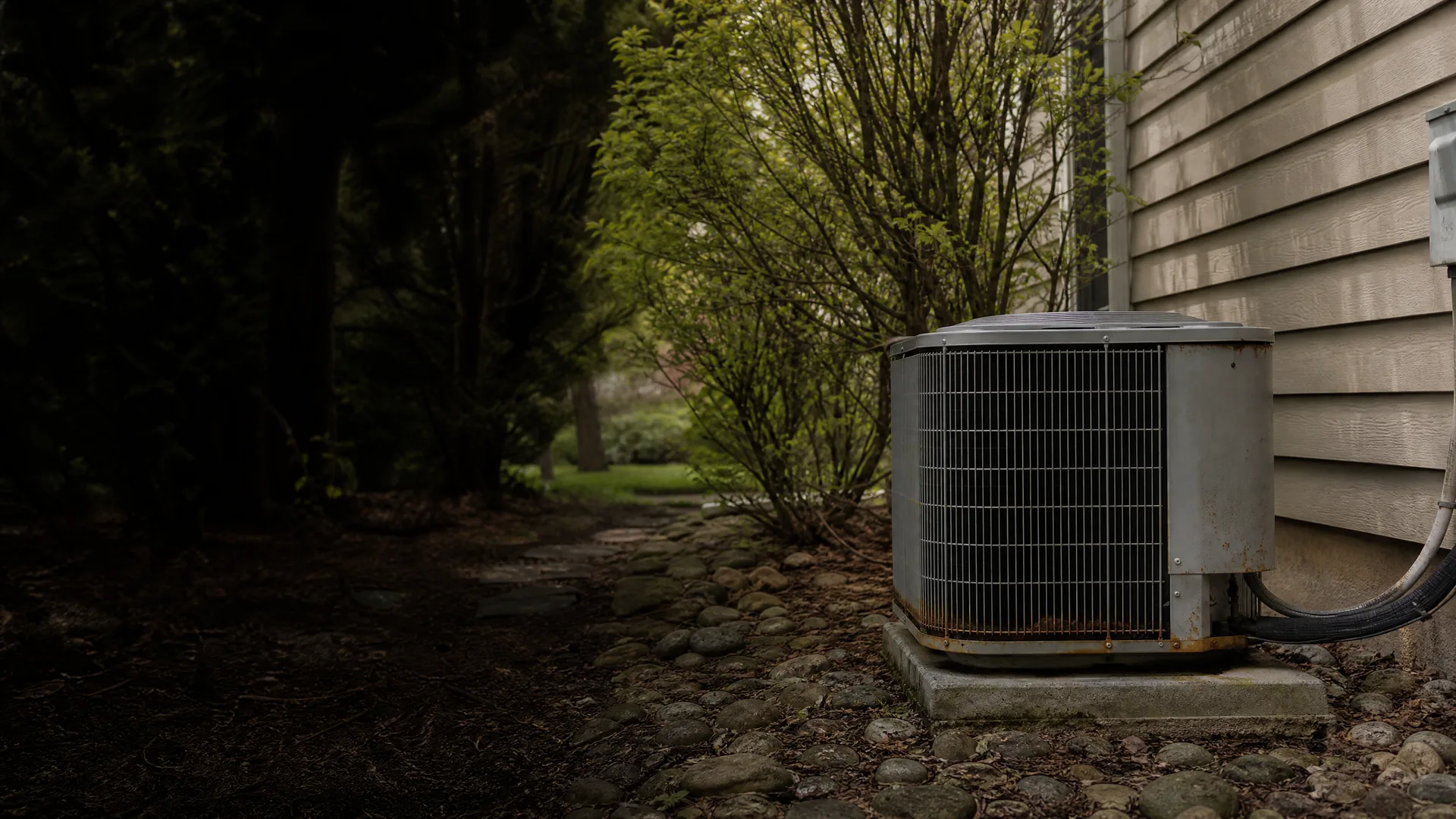
The unit sits against the side fence where the previous owner put it, and in the flat light of a March afternoon you can see what you missed all winter. Rust runs along the base, a line of orange-brown where the metal's been sitting in whatever water collects after rain. The paint above it has gone chalky. You crouch down to look closer and the panel feels thin under your knuckle, almost soft at the corner. It isn't making noise right now. It isn't doing anything right now. But you notice, the way you notice a crack in a windshield you've been ignoring, and you stand back up without touching it again.


Power here costs 31.80 cents per kilowatt-hour

At 31.80 cents per kilowatt-hour, a heat pump that's lost a few points of efficiency doesn't just run longer, it runs longer at a steeper rate. That difference shows up fastest in July and August, when the compressor is working hardest to keep the house cool.

EIA-861 2025

Where your heat pump stands

  • A heat pump that short cycles, blows lukewarm air, or shows rust at the base is telling you it's closer to the end than the middle.
  • Age plus a failing part is the clearest signal to replace rather than repair, especially once the unit is out of warranty.
  • A unit still running steady, with clear airflow and clean lines, has years left and only needs the repair in front of it.
  • Waiting through another San Bernardino summer on a struggling unit means paying the area's high power rates for a system working harder to do less.
  • Sorting out which is true for your unit means skipping the calls to different contractors, the repeated explanations, and the back and forth comparing quotes.
  • Once you know which side of that line your heat pump is on, the next step is getting someone out to confirm it.

You've got two kinds of signs to weigh here. One kind points to the unit struggling on its own: short cycling, lukewarm air, rust at the base, lines that sweat or frost when they shouldn't. The other is about timing, age against the part that's failing, and whether a warranty is still covering the cost. Put those together and most heat pumps in San Bernardino sort into one of two groups. Either the unit is holding steady, cycling normally, moving air the way it should, and the fix in front of it is a single repair with years of service left on the other side. Or the signs are stacking up, the unit is older, and the next failure is going to cost more to chase than to replace.

Waiting doesn't make that answer clearer. It just means another summer of a struggling compressor working harder against power rates that are already some of the highest in the country, and a bill that shows the strain before anything else does. The part that takes real time isn't deciding whether to act, it's figuring out who to call, explaining the same symptoms to three different contractors, and sitting with quotes that don't quite match up. That's the piece you don't have to do yourself. Getting someone out to look at the unit directly settles which side of the line it's on, repair or replace, faster than guessing from the symptoms alone.

A white clapboard house at dusk with a lit pedimented portico, wooden front door, potted ferns, stone walkway, lawn, and illuminated hydrangea shrubs.

Heat Pump Installation

Send one request and you're done looking

New system or replacementHeat PumpSan Bernardino County, CA
Step 1 of 2

What ZIP code is the job in?

  • A living room corner with a beige upholstered sofa holding a brown pillow and cream knit throw, beside a wooden side table with a lamp and a small vase of autumn leaves, in front of a white-framed double window showing yellow-green trees outside.
    • Your new heat pump project goes to an installer who works in San Bernardino County.
    • Get matched with someone who does this kind of work in San Bernardino County.
  • A wicker basket holding a cream chunky knit blanket sits on a weathered wooden bench beside a small bowl and a pale ceramic vase with dried branches, next to a window.
    • Send the form and stop researching installers for the new heat pump.
    • Once you send the form, finding a pro is off your list.
  • A covered front porch with a black front door flanked by sidelights and two lit lantern wall sconces, a dark rocking chair with a striped pillow, a potted plant, stone-faced columns, and white hydrangeas beside the steps.
    • Skip the round of in-home estimates for a new heat pump.
    • Describe the project once instead of to every installer.
  • Front entry of a dark gray shingled and lap-sided house with stone veneer, wood porch posts, and a paver walkway bordered by shrubs and a tree with orange autumn leaves.
    • A licensed installer who works in San Bernardino County gets your project.
    • The pro who gets in touch is licensed in California and works in San Bernardino County.