A leak doesn't fix itself
Low refrigerant means a leak somewhere in the lines or coil. Adding refrigerant without finding and sealing the leak just means warm air again in a few weeks.

Warm air from your vents usually means the system can't move heat out of the house anymore, even though the blower is still running. The most common cause is low refrigerant from a leak, which leaves the coil unable to pull heat out of the air passing over it. A dirty air filter or blocked coil can do the same thing by cutting off airflow until the system can't keep up. Sometimes it's simpler: the compressor itself has failed, and the unit is just pushing room-temperature air through the ducts. None of these clear up on their own, and running the system while it's low on refrigerant or short on airflow tends to make the real damage worse, often to the compressor, which is the most expensive part to replace. A contractor can tell within minutes which of these it is by checking pressures and airflow at the unit.




Low refrigerant means a leak somewhere in the lines or coil. Adding refrigerant without finding and sealing the leak just means warm air again in a few weeks.
No calling around, no explaining the problem twice, no sorting through quotes. Send the form and the work of finding someone is off your plate.
You set the thermostat to 72 and the house sits at 78. The air out of the vents feels room temperature instead of cold, maybe a little cool if you hold your hand right up to it. The system runs and runs, sometimes straight through the afternoon without the compressor ever cycling off, and your power bill shows it. You might notice ice on the copper line outside, or a hissing sound near the unit when it first kicks on. Rooms farthest from the air handler stop cooling at all. None of this fixes itself by waiting, and running the system hard while refrigerant is low can push the compressor toward a failure that costs far more than the leak would have.

Cold air at the vents, the condenser outside cycling on and off instead of running straight through the afternoon. The disconnect box and wiring sit untouched. This is what a properly charged system looks like doing its job in the heat.

The condenser outside is on, the fan is spinning, but the house stays warm. A unit that looks fine from the yard can still have a coil iced over or a leak draining the refrigerant it needs to pull heat out of the air.
Why does the air feel warm even though I can hear the blower running?
The blower's job is to push air through the house. Cooling that air is the coil's job, and it can only do that if refrigerant is moving through it at the right pressure. When the charge is low, the coil still sits in the airstream and the blower still runs on schedule, but there's nothing cold for the air to pass over. So the fan sounds normal, the vents still have airflow, and the air coming out is close to room temperature anyway. A thermostat reading won't tell you this is happening. You have to feel the vent or watch the indoor temperature hold steady no matter how long the system runs.

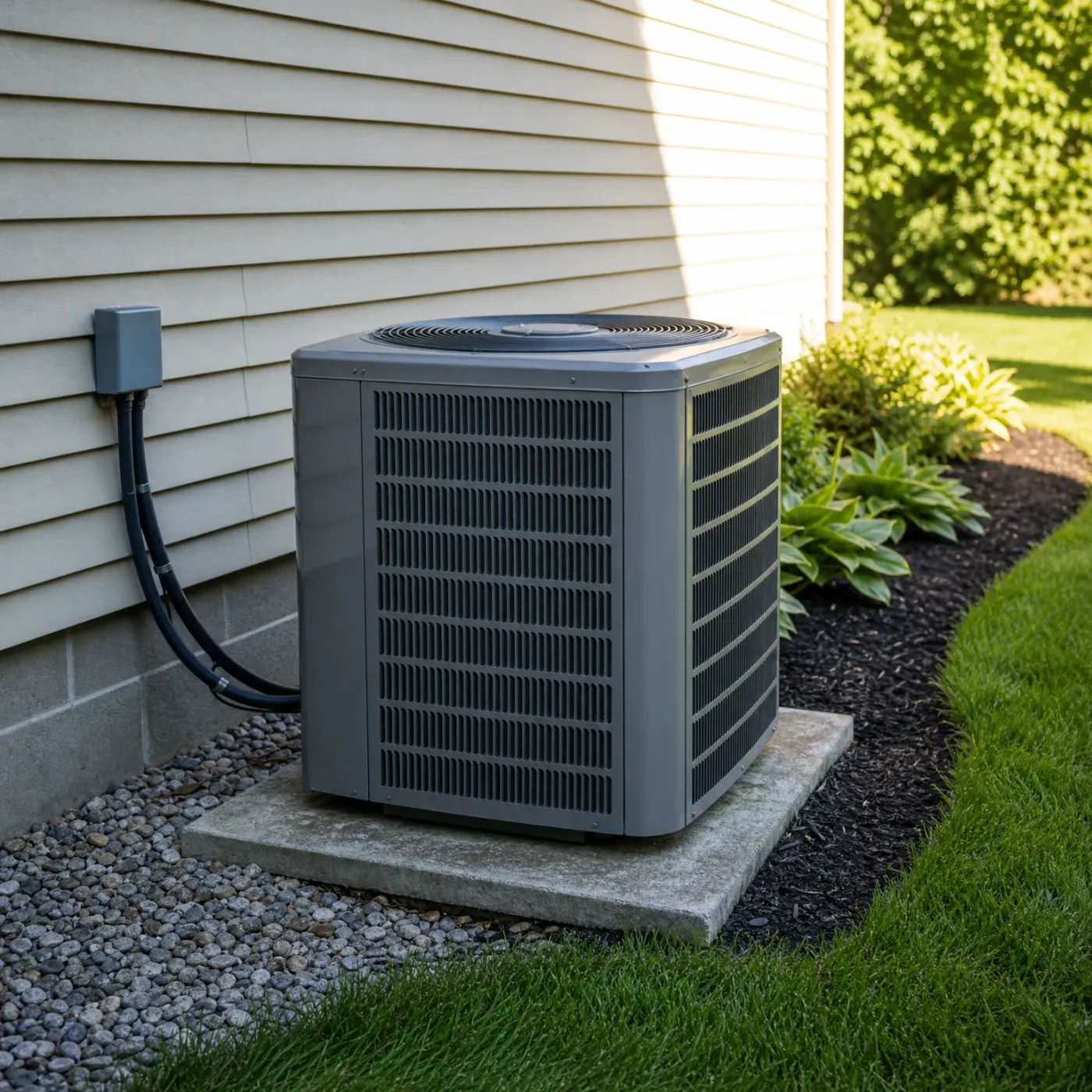
The outdoor unit sits clean on its pad, conduit running down to the disconnect box, nothing leaking or caked in grime. A unit in this shape cycles on and off through the day instead of running nonstop, and the air at your vents comes out cold.

Leaves piled against the cabinet, dirt coating the coil, a unit that looks like it hasn't been touched in years. That buildup blocks the airflow the coil needs to dump heat outside, and a refrigerant leak can go unnoticed the same way until the air inside turns warm.


A system blowing warm air doesn't get better by waiting it out. The refrigerant isn't going to seal its own leak, and running the unit on low charge day after day pushes the compressor harder than it's built to work. That's expensive to replace, in a state where the power to run one already costs more than almost anywhere else. Finding someone to look at it is its own job. Searching for contractors near you, calling a few, explaining what the house is doing and what the vents feel like, then waiting on quotes to compare. That's hours you don't have while your house sits at 78. Send the request once and that work is off your plate. No more calls to make, no more explaining it again to the next person on the list. Just your part in it, done, and the rest moving without you having to push it along.
Refrigerant doesn't get used up the way gas in a car does. It runs in a sealed loop between the indoor coil and the outdoor condenser, and the amount in that loop is fixed when the system is installed. If the charge is low, refrigerant got out somewhere, through a worn fitting, a rubbed-through line, or a pinhole in the coil itself. That coil is where the actual cooling happens. Air from the house passes over it, the refrigerant inside pulls the heat out of that air, and the blower sends it back through the vents. Low on charge, the coil can't pull much heat out at all, so the air coming back is warmer than it should be no matter how hard the blower works. Outside, the condenser is supposed to run for a while and shut off, then kick back on later. A condenser running straight through the afternoon without a break is working against a system that can't catch up, and that strain on the compressor adds up over weeks. Airflow problems cause a different version of the same complaint. A dirty filter or a blocked return starves the coil of air, the coil gets too cold, and ice builds up on it. Once that happens, the air at the vents goes warm even though the blower and compressor are both still running.



California summers don't carry much moisture. The dew point averages 50°F across June, July and August, per NOAA, which is dry enough that sweat evaporates off your skin fast and the air never feels heavy. That dryness hides a failing system longer than it would somewhere humid. With low refrigerant, a coil here can still pull the dew point down enough to keep the air from feeling swampy even while it's lost almost all its capacity to cool. You end up judging the problem by temperature alone, not by how the air feels on your skin, so warm air at the vents is the clearest sign you have that the system has already lost its charge.
NASA POWER T2MDEW county cells weighted by homes
Refrigerant leaks out slowly through a cracked coil or worn fitting.
The system runs lower on charge than its rated pressure.
The indoor coil can no longer pull much heat out of the air.
The blower keeps pushing that same unchilled air through your vents.


At 31.35 cents per kilowatt-hour, a compressor straining against low refrigerant for hours at a time runs up your bill well before it fails outright. A system that's low on charge doesn't just blow warm, it costs more to run while it does it.
EIA-861 2025 statewide residential average

The system isn't broken in some mysterious way. It's low on refrigerant because a leak let it out, and the coil can't pull heat from the air without it. Everything else, the blower running, the condenser cycling, is just the rest of the system doing its job around a problem it can't fix on its own.
Finding that leak means a gauge set and someone who knows where to look, not another afternoon of searching review sites and calling shops to ask if they can fit you in. You'd be explaining the same thing to every one of them: warm air, thermostat set low, no change. Send the form once and that part's done. You're left waiting for the fix, not the phone call.

Describe what your air conditioner is doing once, in one form.
It costs nothing to send, and you don't have to hire anyone.