







An overhead view of a residential air conditioning condenser unit mounted on a concrete pad next to a house with vinyl siding.

AC Maintenance in Bakersfield, CA

Tell us about the job

Takes about a minute. No obligation.

Tune-up, service, or cleaningCentral ACKern County, CA
Step 1 of 2

What ZIP code is the job in?

Electricity in California runs 31.97 cents per kilowatthour, among the highest rates in the country. A dirty coil or a low charge makes the compressor work harder to cool the same house, and every one of those extra watts gets billed at that rate. Out here, where the AC is the biggest draw on the meter most months, that difference adds up fast. A unit that's been looked at each year runs closer to the way it was built to run.

5 months
May through September, your air conditioner is on duty
93°F
the average summer afternoon it cools against
8 hail events
in ten years, and hail bends the fins on outdoor coils
711 wind events
in ten years, and wind drives debris into outdoor units
Isometric cutaway illustration of a single-story house showing interior rooms, ductwork and an air handler in the attic space, and an outdoor condenser unit connected by lines at the exterior wall.
Your air conditioner works hardest from June through September.

NOAA nClimDiv, 1991–2020 normals

Half the homes in Kern County were built in 1984 or later.

A system installed with a newer house still has a lot of life to protect.

Five months of 93-degree afternoons is a lot to ask of any system

Cooling runs May through September
Summer afternoons average 93°F
711 damaging wind events from 2015 to 2024
Storm season takes its toll out hereKern County logged 711 damaging wind events between 2015 and 2024.

A quick tune-up checks that the system runs. A thorough one checks why it runs the way it does. That means pulling the cover off the condenser and washing the coil, not just hosing off the top. It means checking the refrigerant charge against what the system calls for, not just confirming it has some. The contractor should measure the temperature of the air going in and the air coming out, because that split says more about how the system is actually cooling than whether the fan spins. Capacitor readings matter too. A capacitor can test weak long before it fails outright, and catching that on the bench means the compressor never has to work against it. If the visit takes less time than it takes to eat lunch, something on that list got skipped.

A tune-up pays for itself on the power bill

Have the coil cleaned and the charge checked before summer runs the bill up. A system that cools the house without a dirty coil or a weak capacitor fighting it draws less power doing the same job, and every watt it doesn't use is one you don't pay for at California's rates.

Find a contractor
A man in a cap, dark shirt and tan work pants, seen from behind carrying a worn canvas tool bag, steps up onto a porch toward an orange front door beside a potted shrub.
A gray cylindrical air conditioning condenser unit mounted on a concrete pad next to a light-colored vinyl-sided house exterior.

What the thermostat can't tell you, a gauge can

A system can still blow cold air and be wearing out underneath. The gauges tell you things your hand on the vent never will. Refrigerant pressure that's drifted off spec means the compressor is pulling harder than it should for the same result, and it will keep doing that quietly until something gives. A capacitor loses strength before it fails, and on a bench test that shows up as a number trending the wrong way, not as anything you'd notice from the thermostat. Contacts inside the contactor pit and burn a little more with every cycle, year over year, long before they fail to close. None of that shows up as warm air or a strange noise. It shows up as a system that runs longer than it used to, drawing more than it should, until the day it doesn't start at all. That's the part a tune-up is actually for.

Keep the filter clean

A dirty filter chokes airflow across the coil, and a coil that can't shed heat makes the compressor run longer to get the same result. Check it by holding it up to a light. If light doesn't pass through easily, it needs changing. This is the one job that's really on you between visits, and it's the one most people put off.

Keep the area around the condenser clear

The outdoor unit needs open air on all sides to dump heat. Grass clippings, leaves, a stack of patio furniture pushed up against it, any of that traps heat around the coil and makes the system work harder. Walk out and look at it now and then. If anything's grown up against it or piled near it, move it back.

Aerial view of a residential air conditioning condenser unit mounted on a concrete pad next to a house with vinyl siding and a sliding glass door.

Book your AC tune-up in April, before homes here start needing cooling in May.

  1. Jan
  2. Feb
  3. Mar
  4. Apr
  5. May
  6. Jun
  7. Jul
  8. Aug
  9. Sep
  10. Oct
  11. Nov
  12. Dec

A tune-up checks the refrigerant charge, cleans the coils, tests the capacitor and tightens the electrical connections.

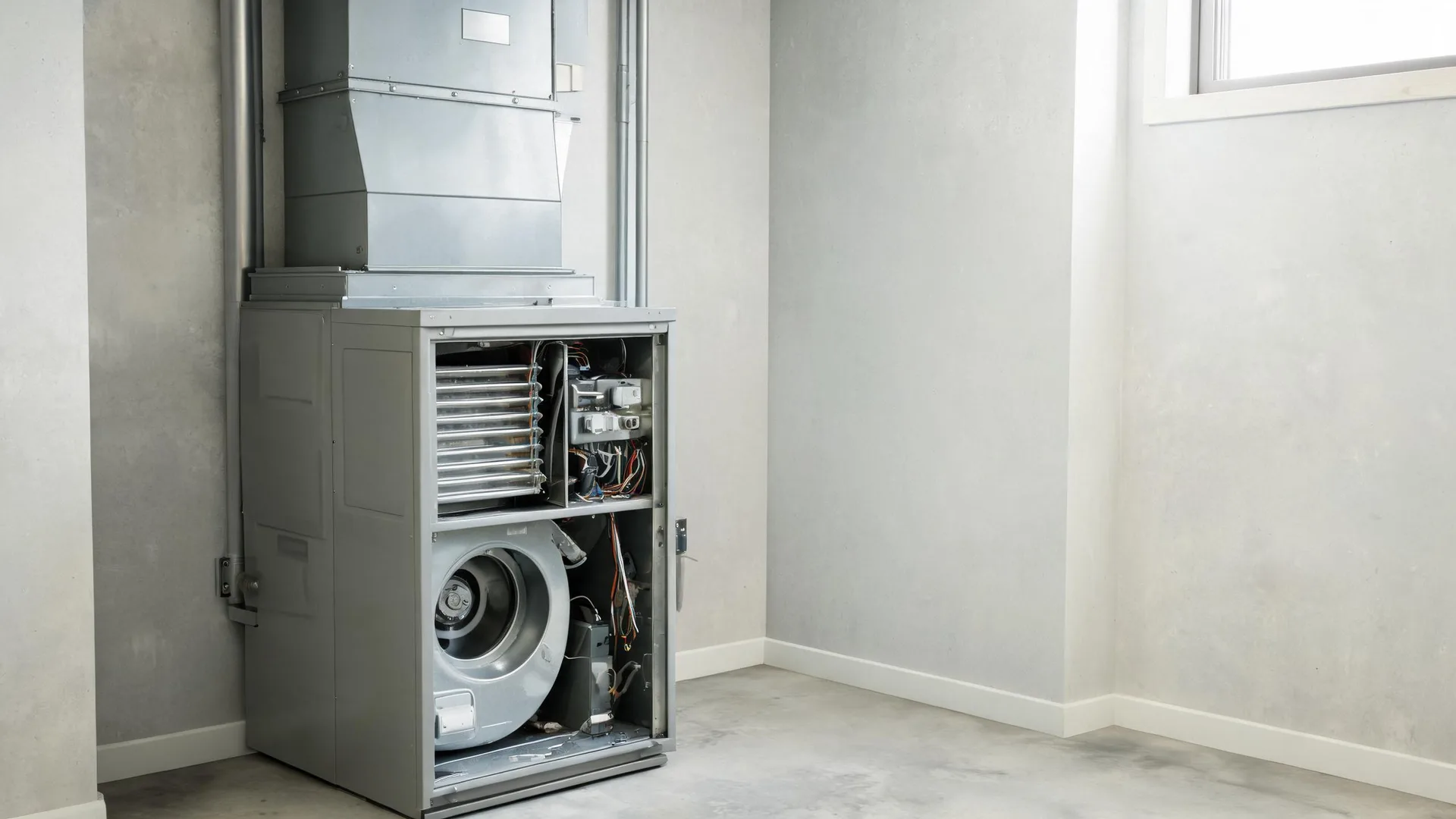
A tune-up also means checking the blower motor and the blower wheel, not just the outdoor unit. A blower wheel caked with dust moves less air even when the motor spins at full strength, and that shows up as weak airflow at every vent in the house. The contractor should check the condensate drain too, because a clogged drain backs up and can shut the system down or let water sit where it shouldn't. Electrical connections at the disconnect box and inside the air handler get checked and tightened, since a loose connection heats up under load and wears out the parts around it faster. The outdoor fan motor gets tested on its own, apart from the compressor, because a weak fan motor lets the coil run hotter than it should even when the refrigerant charge is right. Every one of these is a separate check. Skipping any of them leaves a weak point that won't show up until it fails.