A row of stucco houses with clay tile roofs behind trimmed hedges, seen past a tall stucco wall and overhanging tree branches under an overcast sky.

AC Maintenance in Roseville, CA

Tell us about the job

Takes about a minute. No obligation.

Tune-up, service, or cleaningCentral ACPlacer County, CA
Step 1 of 2

What ZIP code is the job in?

The system runs longer to do the same job

A dirty condenser coil can't shed heat the way it should, so the compressor runs longer to reach the same temperature. You might not notice at first because the house still cools down eventually. Weak airflow from a clogged filter does the same thing from the other end.

That extra strain is what a tune-up catches early

A technician checking refrigerant charge, the condenser coil and the capacitor finds the strain before it becomes a failure. A compressor that's been working harder than it should for months is closer to burning out than one that hasn't, and that's the part nobody wants to replace.

2 months
July through August, your air conditioner is on duty
84°F
the average summer afternoon it cools against
6 hail events
in ten years, and hail bends the fins on outdoor coils
223 wind events
in ten years, and wind drives debris into outdoor units
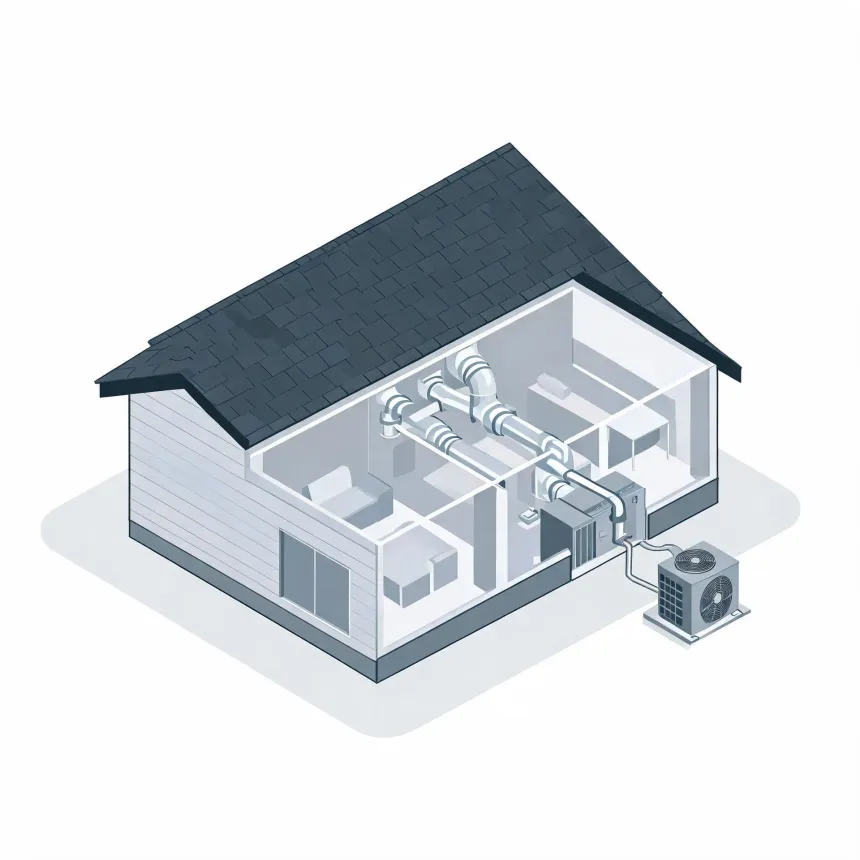
Isometric cutaway illustration of a house with a dark shingled roof, showing interior ductwork connected to an indoor air handler and an outdoor condenser unit beside the building.
Your air conditioner works hardest from July through August.

NOAA nClimDiv, 1991–2020 normals

Half the homes in Placer County were built in 1994 or later.

A system installed with a newer home still has years ahead of it, and a yearly check is what keeps it getting there.

Power here costs more than most places, so a neglected system costs more to match

Power costs 31.97 cents a kWh statewide
Cooling runs July through August
Summer afternoons average 84°F
A dirty system runs longer on expensive powerCalifornia electricity averaged 31.97 cents per kilowatt-hour in 2024, so a yearly check is worth it here

Skip enough tune-ups and the signs get easy to miss, because nothing fails all at once. A capacitor weakens a little more each season until the day it can't kick the compressor on. A dry contactor pits and burns a little more each time it closes. None of that shows up as a sudden breakdown until it does. A technician looking at the system once a year catches the capacitor testing low or the contactor starting to pit, and swaps it out before it takes the compressor down with it. Without that check, the system keeps running on worn parts right up until one of them quits, usually on the day it's asked to work hardest.

A newer system still deserves a yearly check

If your AC was installed with the house, it's probably got a lot of working life left in it. A yearly check is what gets it there without a breakdown along the way.

Find a contractor
A man in a cap, dark shirt and tan work pants walks up concrete steps toward a red front door, carrying a canvas tool bag with tools in its side pocket.
A gray residential air conditioner condenser unit mounted on a concrete pad in an open grass field.

The parts that choke quietly

The filter is the only part of this job you can do yourself, and it's the one most people forget. A dirty filter starves the system of airflow. The evaporator coil behind it can ice over when air can't move across it fast enough, and once it ices up, cooling stops until the ice melts. If it runs that way long enough, the compressor can go down with it. The outdoor coil has its own job, shedding the heat the system pulls out of the house. Grass clippings, cottonwood and dust mat it down over a season, and a coil that can't shed heat makes the compressor work harder for the same result. The drain line is the quiet one. It carries condensation away from the indoor coil, and algae builds up inside it the same way it would in any pipe that stays damp. A clogged drain backs up and trips the safety switch, shutting the system off, or it overflows where nobody's watching until there's water damage to show for it. None of these failures announce themselves the way a dead capacitor does. They just make the system work harder, quietly, until something else gives out from the strain.

Refrigerant pressure doesn't show from outside

A system low on refrigerant still blows cold air at the vent, just not as cold as it should, and it still runs the compressor through the same cycle. Only a gauge reading tells you the charge is off. Left alone, the compressor keeps pulling against a pressure it wasn't built to run on.

Electrical readings catch what a glance can't

A technician tests the capacitor's output against what it's rated for and checks the amp draw on the compressor while it runs. Both numbers can look fine to the eye and still be sliding toward failure. That reading is the only way to know a part is close to done before it actually quits.

Aerial view of a gray outdoor air conditioning condenser unit mounted on a concrete pad next to a house with vinyl siding.

Book your AC tune-up in June, before homes here start needing cooling in July.

  1. Jan
  2. Feb
  3. Mar
  4. Apr
  5. May
  6. Jun
  7. Jul
  8. Aug
  9. Sep
  10. Oct
  11. Nov
  12. Dec

A tune-up checks the refrigerant charge, cleans the coils, tests the capacitor and tightens the electrical connections.

A tune-up starts with the thermostat calling for cooling and ends with someone watching the system run a full cycle, not just glancing at it once. The refrigerant charge gets checked against the pressure it should be holding, not just whether the air feels cold. The capacitor gets tested under load, since a weak one can still start the compressor some days and not others. The condenser coil gets cleaned if it's matted down, and the evaporator coil gets checked for the same thing from the inside. Electrical connections get tightened, because a loose one generates heat right at the connection point. The drain line gets flushed so it isn't the reason the system shuts itself off later in the season.