





White stucco buildings with terracotta roofs glow with warm lighting on a tree-covered hillside at dusk.

AC Maintenance in San Francisco, CA

Tell us about the job

Takes about a minute. No obligation.

Tune-up, service, or cleaningCentral ACSan Francisco County, CA
Step 1 of 2

What ZIP code is the job in?

Afternoons here average 70 degrees in June, July and August. Your air conditioner barely has to work to get a house that comfortable. In places where summer pushes into the nineties for months, that load wears a compressor down fast. Yours isn't carrying that kind of burden, so the parts that fail elsewhere from overwork tend to last longer here. That's not a reason to skip the yearly check, though. A system that runs light for years can still end up with a dirty coil or a weak capacitor nobody noticed, simply because it was never pushed hard enough to show the strain.

70°F
the average summer afternoon it cools against
10 hail events
in ten years, and hail bends the fins on outdoor coils
50 wind events
in ten years, and wind drives debris into outdoor units
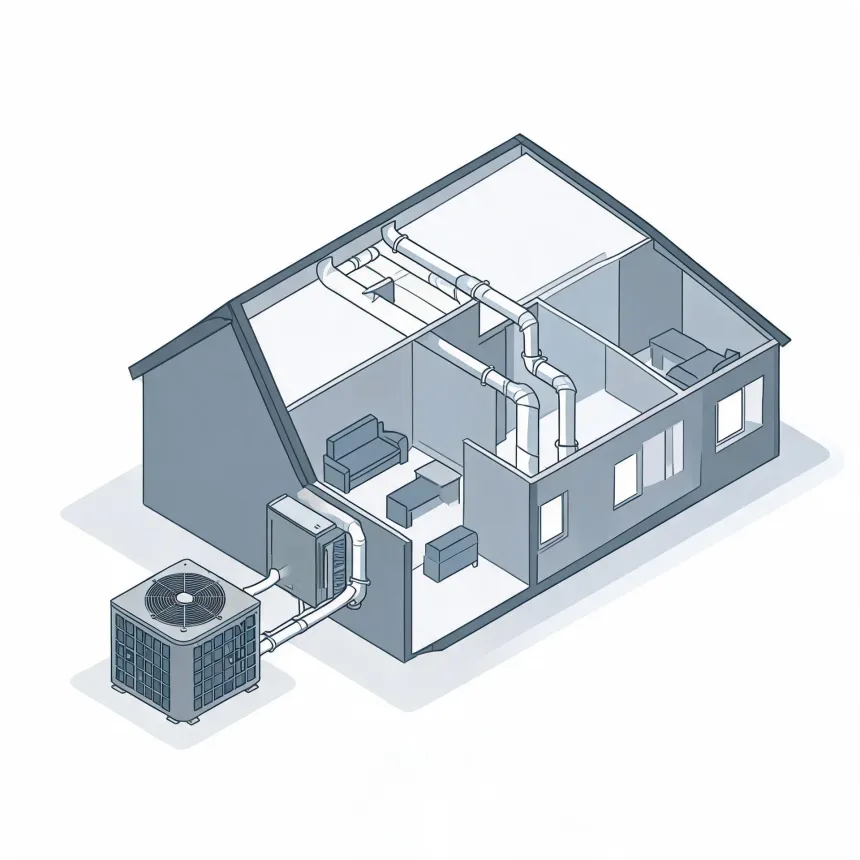
Isometric line illustration of a cutaway house showing interior rooms with ductwork, an indoor air handler, and an outdoor condenser unit connected by lines, on a white background.
Your air conditioner works hardest from August through September.

NOAA nClimDiv, 1991–2020 normals

Half the homes in San Francisco County were built in 1946 or earlier.

A home that old doesn't tell you the age of what's in it, so a yearly check is how you find out what shape it's really in.

San Francisco doesn't stress an AC. A yearly check still catches what quiet wear hides.

Power costs 31.97 cents a kWh statewide
Summer afternoons average 70°F
50 damaging wind events from 2015 to 2024

A yearly check here is a short visit. The tech isn't chasing down heat damage or restarting a system that's been running flat out for months. They're looking at a coil that collects dust because the fan rarely kicks on, a capacitor that's aged on the shelf rather than worn from cycling, refrigerant level, drain line, connections. Wind is the other thing worth having someone look at. The county has seen damaging wind 50 times in the last ten years, enough to knock an outdoor unit out of level or loosen a panel without anyone noticing from the yard. Neither problem announces itself until the one week it gets hot enough to need the system.

Book the check before you need the system

If your system came with a house built decades ago, nobody's been watching it the whole time it's been running. A yearly check is how you find the dirty coil or the aging capacitor before the week you need the system most.

Find a contractor
A man in a dark shirt and tan pants carries a waxed canvas tool bag up porch steps toward an orange front door, with a potted olive tree beside the entry.
A gray residential air conditioning condenser unit mounted on a concrete pad outdoors, surrounded by green grass under a partly cloudy blue sky.

Between visits, it's mostly about airflow

Keep the area around the outdoor unit clear. Leaves, grass clippings, a stack of patio chairs against it, any of that blocks airflow across the coil and makes the unit work harder than it should. A couple feet of open space on every side is enough. Inside, change the filter on a schedule instead of waiting for it to look dirty. A clogged filter starves the system of airflow, and that shows up later as ice on the coil or a system that runs long without catching up. That's really the owner's part between visits. Airflow in, airflow out, nothing blocking either end. The refrigerant charge, the electrical connections, the drain line, those are a tech's job. Not because they're complicated, but because it takes tools and training to tell what's normal from what's starting to fail.

A clogged filter hurts more than air quality

When the filter is choked, the system cannot pull enough air across the indoor coil. That coil gets cold enough to freeze the moisture in the air it touches, and ice builds up on it. Once that happens the system is cooling less and running longer, trying to catch up on a cycle it was never going to finish.

The drain line decides where that moisture goes

Every time the system runs, it pulls moisture out of the air and off the coil, and that water has somewhere to go. The drain line carries it out. If that line clogs with algae or dust, the water backs up instead of draining, and it ends up in the pan or past it, onto whatever is underneath.

Skip the yearly check long enough and the system doesn't fail all at once. A capacitor weakens a little more each year until the day it can't kick the compressor on. A coil collects enough dust that the system has to run longer to do the same job, and nobody notices because it still gets cold, just slower. None of that shows up as a problem you can see or hear. A tech catches both of those in a routine visit, before either one turns into a compressor that quits years before it should have. Left alone, the small problems don't stay small.

A proper tune-up starts outside at the condenser. The tech pulls the panel and checks the capacitor and contactor under load, since those are the parts most likely to fail outright rather than just lose efficiency over time. The coil gets cleaned, because dust packed into the fins cuts down how well the system sheds heat, and a dirty coil is the most common reason a system runs long without cooling well. Refrigerant level gets checked against what the system is rated for, not topped off out of habit. Low charge and a dirty coil look the same to the homeowner, a system that runs and runs, so the tech has to check both. Indoors, the evaporator coil and blower wheel get the same look, since restricted airflow at either end shows up as the same weak cooling. The drain line gets checked too, since a clog there backs water up into the pan. Electrical connections get tightened, because a loose one generates its own heat and wears out the part around it long before it should.