White stucco Spanish Colonial Revival houses with red tile roofs glow with warm light against a dry hillside at dusk.

AC Repair in Anaheim, CA

Tell us about the job

Takes about a minute. No obligation.

RepairCentral ACOrange County, CA
Step 1 of 2

What ZIP code is the job in?

Warm air from the vents means the system stopped cooling, not just slowed down

A unit low on refrigerant or with a failing compressor can still blow air, so the vents feel like something is happening. The air just never gets cold. That's a different problem than weak airflow, and it needs a technician to check the refrigerant charge and the compressor, not just the filter.


A short cycling system is wearing out its own parts faster

When the AC kicks on and off every few minutes instead of running a full cycle, the compressor takes the hit each time it restarts. Left alone, that pattern tends to end with the compressor failing outright. Catching it while it's just short cycling usually means a smaller repair than waiting for the compressor to go.

5 months
June through October, your air conditioner is on duty
82°F
the average summer afternoon it cools against
3 hail events
in ten years, and hail bends the fins on outdoor coils
138 wind events
in ten years, and wind drives debris into outdoor units
Isometric cutaway illustration of a single-story house showing interior rooms, ceiling ductwork, an indoor air handler, and an outdoor condenser unit connected by lines, in gray and white tones on a white background.
Your air conditioner works hardest from July through September.

NOAA nClimDiv, 1991–2020 normals

Anaheim runs its AC about five months a year, June through October, with afternoon highs around 82.

A broken AC here is almost never the climate's fault. It's a part that failed and needs finding.

Half these homes still have their original ductwork, not their original AC

Half the homes here were built by 1977
Climate zone 3B
Power costs 31.97 cents a kWh statewide

California electricity ran 31.97 cents per kilowatthour in 2024, among the highest rates in the country. An AC that's short cycling or low on refrigerant still pulls power every time it kicks on, whether or not it cools the house. That's money going out for a system that isn't doing its job. The longer a bad compressor or a stuck component runs like that, the more it costs you before it finally quits. Getting a technician to find the actual problem now costs less than paying inflated power bills for a machine that's limping along.

Find the part that failed, not an excuse for it

Orange County sees its share of wind and the odd storm, but none of it runs an AC harder than the heat already does. If yours isn't cooling, something inside it failed. Get it found and fixed.

Find a contractor
A man in a dark sweatshirt and tan work pants, seen from behind, climbs porch steps toward a red-orange door while carrying a worn canvas duffel bag.
A gray residential air conditioning condenser unit mounted on a concrete pad outdoors, surrounded by green grass under a partly cloudy blue sky.

Running sick doesn't make it well

A failing part doesn't get better because the thermostat keeps calling for cold air. A weak capacitor still forces the compressor to try starting every cycle, and each failed attempt heats the motor windings a little more than the last. A dirty coil makes the compressor work longer to move the same heat out of the house, so it stays on well past when it should have shut off. None of that looks like trouble from the thermostat. It looks like the system running and running while the house stays warm, which is usually what gets someone to finally call. The longer that pattern continues, the closer that part gets to failing outright instead of just failing to keep up.

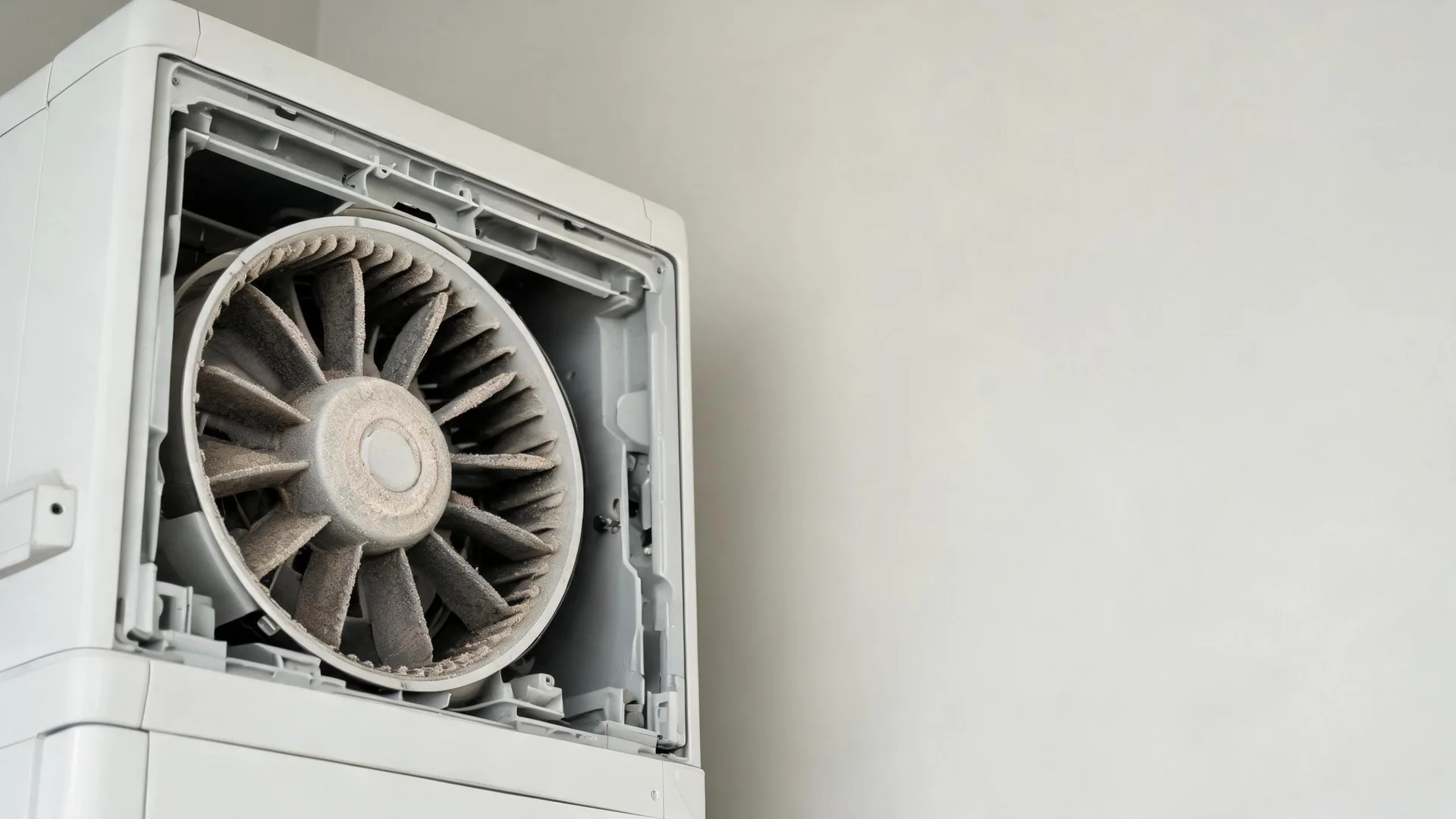
A dirty condenser coil forces the compressor to overwork

The outdoor coil has to shed heat into the air around it. When it's caked with dirt, grass clippings or cottonwood fluff, that heat has nowhere to go. The compressor keeps running longer to move the same amount of heat, builds up heat of its own it wasn't built to hold, and wears out well before it should.

A weak capacitor fails without warning

The run capacitor gives the compressor and fan motor the jolt they need to start turning. It weakens slowly, so the system keeps starting normally right up until the one time it doesn't. A technician can test a capacitor in minutes and catch it before it leaves the compressor straining to start on its own.

Aerial view of a square outdoor air conditioning condenser unit on a concrete pad beside a house wall with a sliding glass door.

A new air conditioner would cut about $70 a year off cooling for a typical Orange County home.

  • A new one at the federal minimum, 14.3 SEER2$440 a year
  • An older air conditioner$510 a year

Estimates for a typical Orange County home, compared with an older unit built to the previous federal minimum, from EIA household energy data, California fuel prices and NOAA climate normals. Your home will differ.

Repair makes sense when a part like a capacitor or contactor has failed.

Replacement makes sense when the compressor has failed or the system uses R-22 refrigerant, which is no longer made.

A diagnostic starts outside with the condenser running. The technician checks the refrigerant pressures first. That number tells them whether the system is actually moving heat or just moving air. From there it's the electrical side, the capacitor, the contactor, the wiring at the disconnect. Inside, they'll pull the blower compartment and look at the coil, checking for ice, dirt or anything restricting airflow across it. A set of readings off the thermostat and the return air tells them if the airflow and the charge match what the system needs. Each reading rules something out until what's left is the actual failure.